We returned to Brezhnev times: imitation of power, imitation of humility, imitation of management, imitation of unanimity, imitation of propaganda and imitation of trust. Together, this turns into an imitation of not only the state, but also the country. The vertical of power hung in the air. Her debugged levers are not applied to anything. And again, the proverb of the Brezhnev times is in force: "You pretend that you pay us, and we pretend that we are working." The country again moved to live on a farm and depicts obedience only as necessary that the authorities leave it alone
This became noticeable on the third day of the Georgian war, when President Dmitry Medvedev, the Supreme Commander,, by the way, announced on the air of all television channels that the war was over, the army stops and leaves Georgia, and the army did not stop and left. That is, the army is not that it rebelled, but quietly sabotaged the public order of the commander in chief.
One would have thought that the country has only sabotage the Presidential decisions, but not: it also sabotes the decision of the Prime Minister, as she sabotaged the food program of Brezhnev times. This has become especially noticeable with the beginning of the crisis. The prime minister traveled around the country, literally everything with whom he talked about the fact that there was no crisis, nodded - they say, there was no crisis, and the next day they continued to drain the shares and withdraw money abroad. If in the 99th year the pre-election rating was an unprofitly obeyed by Putin's Prime Minister and earnestly grew thanks to television propaganda, then in mid-2008, in spite of any television propaganda, the premiere did not obey exchange indices.
This is probably why the president and prime minister almost simultaneously made the same tested PR ridge-they appeared in public with animals. President Medvedev - with a dog, a symbol of obedience, and faithfully Style. True, they say it was a stranger dog. And Putin’s premiere was shown on TV with a hand tiger: the prime minister Tigrenka stroked and dragged by the paws, and the tigerok did not resist, obeyed, obeyed. However, no one followed the example of Tigrenka except the politician of Goman and journalist Bovt. The tiny Ingushetia insisted that I did not want to see the president of Murat Zyazikov. Huge America very clearly demonstrated that the economy would not collapse, no matter how Mr. Putin ordered her. And - most importantly - despite the command of the prime minister, their own exchange indices did not even “have grown up”, but on the contrary, they continue to fall.
If you recall the sensational public photography of Putin with a naked torso on fishing in Tuva, then a completely new image for Putin develops. He is now Rambo. He was left alone, and one is fighting against all. And no one is fighting against him. No one goes to open confrontation, like Khodorkovsky. But the forest is full of partisans. And it feels like the whole country is partisan.
We returned to Brezhnev times: imitation of power, imitation of humility, imitation of management, imitation of unanimity, imitation of propaganda and imitation of trust. Together, this turns into an imitation of not only the state, but also the country, which, in any case, last time, fell apart as soon as they stopped imitating it.
Queues and privileges
We, therefore, live in the Brezhnev paradigm familiar to us. For example, we do not like corruption, but we learned to use it and do not really remember how to live and solve issues without it. We, as in Brezhnev’s time, are endlessly outraged by the privileges that the elite uses, but we do not protest against these privileges, but strive to take communion as if possible. Only if in Brezhnev times it was about access to grocery specialists, where for the holidays they were given smoked sausage and cheese of Viola, now we are talking about the right to ride along the street with a miletic or about the access to state money at the time of the liquidity crisis.
And we continue to stand in lines in the same way as we stood in lines in Brezhnev times. Only the meaning of the queues has changed a bit.
Since Soviet times, we have remained lines for officials and omnipotent communal employees. A young woman, a fashionable photographer, told, for example, how she received the keys to a newly purchased new apartment on the Khodynsky field. The builder issued her a warrant. With this order, it was necessary to come for the keys to the office managing the house. The woman came to this office, and there is a Soviet ZhEK. The sluggish aunt literally shouted at people in line: “There are a lot of you, and I am one”-how the shows-shits shouted in the housing houses of Brezhnev times. And the owners of new apartments dutifully sat in line and dutifully listened to insults. It is noteworthy that the cheapest apartment in Khodynka costs about a quarter of a million dollars, and the average three -room room is more than a million. That is, the whole day in this ZhEK was a whole queue of millionaires, obediently waited for the keys to the apartments bought for a million, and did not dare to object, as in Brezhnev time I did not dare to object to anyone in ZhEK neither a general nor an academician.
However, the lines of a new type appeared. If in Brezhnev times the queues were primarily for consumer goods, now the main lines are for freedom of movement. We, according to the apt remark of the author of the "Opipel Day", are in traffic jams every day, and what is it, if not a queue? We stand for hours to the traffic light no less dutifully than stood in Brezhnev times, expecting Turkish sheepskin coats to be thrown onto the counter.
Even more dutifully, we are standing for freedom of movement in the visa departments of embassies. The most arrogant person in present -day Russia, a person who made it a rule to turn around and leave, if three people stand in the store in front of him, stands for a visa as cute: he comes by seven in the morning, is written on the list. And instead of drawing with ink on the hand our number in the queue, we dutifully popping our fingers in ink for dactyloscopy.
Finally, we dutifully stand in lines at the registration rack at the airport. We are ready for anything: to remove shoes, to score pants, freedom of movement - a real shortage in our time. Access to freedom of movement, that is, to visas and invitations abroad, is one of the significant privileges that the opposition uses in Russia easier than power. And Putin’s memorable words about oppositionists who “jammed by embassies” are a manifestation of Soviet envy: indeed, many oppositionists have more access to foreign trips than even Prime Minister Putin.
"Time", kitchens, samizdat
If you look closely, it turns out that most of the realities of the Brezhnev time are repeated now or another now, and as a rule, in the form of Fars promised by Charles.
Everyone who watched the President’s message to the Federal Assembly, probably, paid attention to the fact that this message was broadcast not on one television channel covering the whole country, but in two, and the third went in the record. In the same way, in Brezhnev time at exactly nine in the evening on both main television channels, the Information Program "Time" was aired. At the same time, the degree of confidence in these “Vesti from the fields” in Brezhnev’s time was zero, and now the TV channels are frantically fight for the rating, they still fall, and the composition of the audience is changing. The TV, as evidenced by sociologists, ceased to watch people who make decisions - both serious decisions about where to invest a huge company and minor decisions on whether to buy a family car or dishwasher this month.
People do not even hope to get any significant information from the TV, but do not require this information, hoping to get it on the Internet.
The Internet now plays the role of Samizdat of Brezhnev times. And just like in Samizdat, on the Internet it is impossible to separate the grains from the chaff. In the same way as in Samizdat the Gestri magazine was more popular than the “Chronicle of current events”, on the Internet the site “Odnoklassniki” is incomparably popular than any information resource.
Instead of intellectual conversations in kitchens that were popular in Brezhnev times, now there were conversations in a cafe. The intelligentsia spends most of its free and even a significant part of its working time in establishments such as Mayak, Jean-Jacques, Bilinguals, or for richer people-GQ. Opinions are formed there, projects are being discussed there, glorious alliances are formed there and disgusting quarrels occur. And everyone there is free to imagine that there is no one at all outside the walls of the cafe and outside this cafe circle of communication - no people, no power.
Power again, as in Brezhnev times, began to be perceived like the phenomenon of nature. It does not occur to anyone to argue with her, society is configured to adapt to power and live its own life, deceiving and using power in its interests.
Therefore, the president’s statement that the deadline for the presidential rule is increasing from four years to six did not cause protests even from the note of the Protestants. This is a little circumstance of insurmountable strength. As if on the radio they suddenly reported that the frost would stay not four months a year, but six months. So what? We still sealed the windows for the winter and prepared firewood for the fireplace. Four or six - what's the difference? All the same for a long time. But you can skate and play hockey. In Brezhnev times, as it is now, no one could even think that these times would someday end.
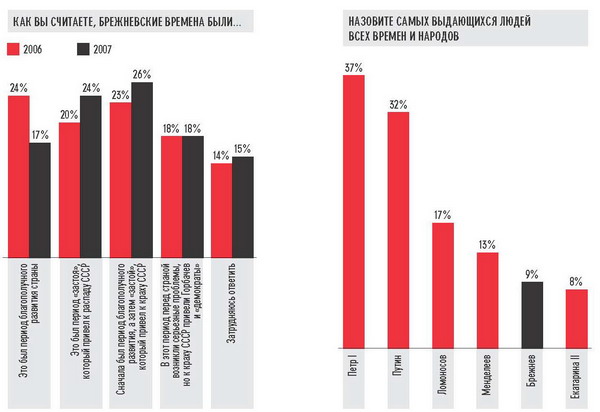
Every fifth Russian believes that the 70-80s were an era of well-being, and every third, that during the reign of the General Secretary of the Central Committee of the CPSU Leonid Brezhnev there were more good than bad. Where did this nostalgia for the time that has entered the history of the country as a time of "stagnation", The New Times found out Boris Dubin's Levada Social Political Studies of the Levada Center.
This is not even nostalgia, but some kind of constructed memory of the Brezhnev era as a golden age, when everything was fine, when power was understandable to the people, it did not particularly reach it and generally made it possible to do what the majority wanted. And if you do not want to do anything, then you can do nothing. This is an open picture. In fact, that era was boring, gray, suffocating, absolutely dysfunctional, complete uncertainty and futility. True, then the authorities a little release her hand, which she always held on her throat. But there was no more freedom - there was simply more opportunity to dissemble with power. The image of the Golden Brezhnev era was formed in contrast with the so-called chaos of the 90s, when people were impoverished, when they had to spin hard in order to somehow save the level that they had in the 70-80s. In the 2000s, powerful propaganda began from above, from the official media: de, the 90s is a black hole, an abyss, horror ... The first persons of the state, including Putin, said this. So the picture of the Brezhnev era arose. It is fictitious, even artistic, conditional, invented. But it satisfies a large number of people.
What social layers, groups of more than others are subject to this nostalgia? Most often these are elderly people, less educated, living on the social periphery. However, there are many similar moods among completely educated people. The 90s were quite strongly hit by the so-called service of the intelligentsia: teachers, librarians, and people of humanitarian professions. Very few of them managed to get a job in a new situation without losing status and profession.
It was especially difficult for educated people on the periphery. They are especially nostalgic for Brezhnev’s time, despite the then shortage of everything and everything - from films to vodka and meat. People prefer to forget about this today. Russia is a community of people who do not believe that they can do something with their lives. More than 2/3 believe that their life does not belong to them. Russia is a poor society, including poor possibilities. Poor societies value stability, not changes. The mantra of this stability - "if only it was not worse." We are constantly trying to convince us that today's era is the most prosperous and stable. But the events of the last two to three months did not leave from a sense of stability and trace. Salaries are reduced, inflation is growing, the ruble is weakening - confidence in the future disappears. In this coordinate system, that blessed land under the name "Brezhnev era" is built.