
Translated material
Kefir degree
The Duma is attempting to be on national drinks
Alcohol dependence. Since July 1, large changes are expected on the alcohol market: a number of amendments to the law regulating the circulation of alcohol in the country come into force. Their goal is to ensure that the population is less fond of "green serpent." However, so far the statistics testify: in Russia they did not drink less - they just began to pay more for degrees. What awaits the alcoholic market - the New Times sorted out
Some innovations in the alcohol market have already happened: they officially stopped selling strong drinks at night, they disappeared from kiosks and stalls-now they are available only in stationary stores. Excise fees increased - alcohol products have risen in price. True, so far not much - let's say, vodka is only 10%. Ahead is much more radical changes. Since July 1, according to the new law *** in July 2011, the State Duma of the last convocation made amendments to Federal Law No. 171 “On State Regulation of the Production and Turnover of Ethyl Alcohol, Alcohol and Alcohol -Continction of Products”. The very concept of "alcohol products" will change.
Caution: Koumiss
Before alcohol, products made using ethyl alcohol were considered, the content of which reached a total of 1.5% or more. Now, in principle, it will not matter whether alcohol was added or “it was thrown itself”. But if the concentration of ethanol in any liquid is 0.5%, it will be considered alcohol. And all the restrictions introduced by law will apply to it - related to both trade and advertising.
Say, beer will finally acquire the status of an alcoholic drink. And it in the same way as, for example, vodka, it will not be possible to sell in small retail outlets and at night. True, these restrictions will begin to act later - from the beginning of next year.
The situation with products that had never been considered alcohol before alcohol is even more paradoxical. In some regions, they cannot live without koumiss, and the fortress of this drink - from 0.2% to 2.5%. In others, kvass is adored in the same way, and in it from 0.7% to 2.6% of alcohol. What is there - in a three -day kefir, the alcohol content reaches 0.88%. That is, in any way, it exceeds the notorious 0.5%.
The government promised to correct the absurd situation, Rosalkogolregulovy prepared a list of food products with alcohol content of more than 0.5%, not related to alcohol. Confectionery, kvass, sour -milk products and even raw sausages fell into it. But ten days before the onset of the fatal date - July 1 - it was not yet considered and approved by the Duma.
Fatal date
A little earlier-June 15-Viktor Zvagelsky’s deputy, amended the law-to the very provisions that have not yet begun to act. They relate to the rules for the transportation of alcohol and alcohol -containing products, as well as the name of the wines.
The fact is that, according to the new rules, only 25% can only those who have a special license to carry alcohol and alcohol -containing products. Zvagelsky proposed postponing the introduction of this norm for another six months - "business is not ready."
The second norm stipulated that all the wines produced by not only natural fermentation, but also sweetened with concentrated grape juice or fixed with ethyl alcohol should not be called not wines, but “wine drinks”. This situation seriously alarmed winemakers, they predicted in chorus the loss of purchasing interest in Russian guilt in favor of the imported: who would take the domestic “wine drink” from the shelf if there is an overseas “wine” nearby!
The fact is, experts explain that in Russia grapes grow not in such warm and sunny places as in southern Europe, or, for example, in Chile. Less sun - less sugar. Therefore, it is necessary to sweeten the wine with a concentrated hustle - in principle, it is a generally accepted technology in the world. And if grape alcohol is added to more warm countries to fortified wines, then in Russia it is not enough - the yields of wine berry are not so significant. So they use it for the preparation of Kagor, port, maders and other sherry alcohol ethyl alcohol. Manufacturers can, of course, buy and import grape alcohol from abroad to the country, but this will significantly raise the price of the final product and make it uncompetitive.
The situation is strange, if not absurd, says Vladimir Pukish, head of the Fanagoria agro -industrial company : “After all, in fact, it is almost impossible to determine the difference in exactly how much the wing wine was made - the classic method of stopping the fermentation or the addition of concentrate - even in laboratory conditions is almost impossible. Meanwhile, from 70% to 80% of Russian manufacturers go the second way. ” In addition, an enterprise that produced wine for the production of a “wine drink” will have to change the existing license. It is good if you re -register - it will cost only 2 thousand rubles. But receiving a new license will already cost from 0.5 to 6 million, - Vladimir Pukish recalls. “The wine market is now in a pre -infarction state,” Leonid Popovich shared the president of the Union of Vinogents and Winemakes of Russia . “We still do not have approved documents and do not know what to do.”
Victor Zvagelsky suggests that the proposed definitions refuse and adopt the norms provided for in the European Union for the northern countries. “If the amendments urgently have time to accept in three readings at once, then they will stand up for an indefinite period from July 1 of the transportation of alcohol in Russia and production in the winery,” said Vadim Drobiz, director of the Center for Research of the Federal and Regional Alcohol Markets.
 Under the fifth state
On the banner of the anti -alcohol campaign, launched by the authorities, is concern for the health of the nation. The analyst of "Investkafa" Anton Safonov * believes in the sincerity of this message. “One way or another, but, increasing excise taxes and limiting trade, the state runs the risk of losing part of the additional revenues so necessary for the budget. So, we are really talking about the desire to reduce and streamline the use of alcoholic beverages by the population of the country, ”he says.
The head of the digirr Vadim Drobiz categorically does not agree with this. “The alcoholic market was interested in our state somewhere until 2001, when oil prices were low, and the budget revenues are insignificant. Surrounded by Vladimir Putin, there were always people who had their interests in alcohol business, and he instructed them to control this market. But oil prices went up abruptly, and alcohol ceased to be “gold residential”. They safely forgot about him and remembered only by the beginning of 2009, when the economic crisis rolled around the world, ”the Drobiz says. The expert claims that the current anti -alcohol campaign is absolutely not motivated. Yes, they drink a lot in Russia, yes, there is a problem of the health of the nation, but it previously existed - so why did this kind of campaign not be started 10 years ago, but only now? "
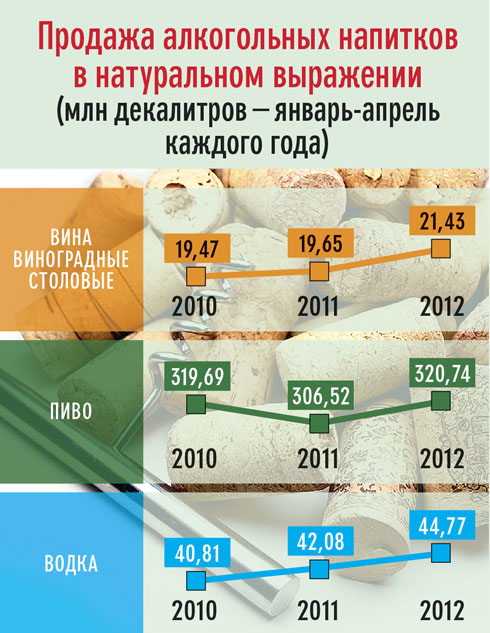
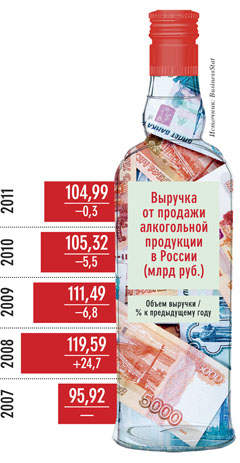
Over the past 12 years, prices for various types of alcohol have jumped about 2-3 times. The volume of sales of alcohol, meanwhile, is growing steadily: drinking in Russia still did not become less
"According to the Drobis, the" anti -alcohol campaign "is actually nothing more than a smoke curtain designed to hide the genuine interests of the state in the alcohol market. From the very first steps, the Rosalcoolreguli -large -scale checks of industry enterprises - manufacturers, importers, distributors, accompanied by their colisrational. As a result of the number of market participants, The digitry has been reduced approximately twice.
So from July 1, more stringent requirements will be presented to the trading of a beer of up to 5% (and this is 85% of all Russian beer), and individual entrepreneurs will no longer be able to trade. But the market will not be empty: Pepsi-Cola is looking at this segment with interest, it is possible that other large corporations will begin to unfold where the small owners will come from. In fact, we are talking about a red -randing market, the expert believes, because the enlargement of the participants makes the market more controlled and creates additional opportunities to expand the participation of the state itself in the alcohol business.
“It is quite obvious that the main trend today is the strengthening of the public sector in the alcohol industry,” says Vadim Drobiz. “If the trend continues the current pace, then in the next few years the state will own the third market of vodka, champagne and cognac.” According to the Drobis, before the introduction of a state monopoly on alcohol in the country is a stone's throw. Although there are other points of view: the head of the non -profit partnership “Black Sea Garage Wine” Valery Loginov believes that the Russian state will not take such a step - especially on the eve of the entry into the WTO. 
The anti -alcohol campaign, the expert claims, is called upon to hide the true fiscal policy of the state. The increase in alcohol prices is one of its directions. From July 1, the minimum price of a bottle of vodka will rise from 98 to 125 rubles (by January - even more), and, given the increase in excise fees, it will really cost in July not cheaper than 170-180 rubles. As a result, the volumes of trade in legal alcohol products, which now, according to the distillation of the breeding, are about 50%, will be reduced by another 5-10%, while excise taxes will grow by one and a half to two times. The growth of counterfeit products will cause a blow to the health of the population (which the authorities allegedly care about), and the state will only win, since its income will still increase.
Objectively, the picture looks like this. Over the past 12 years, prices for various types of alcohol have jumped about 2-3 times. The volume of sales of alcohol, meanwhile, is growing steadily: drinking in Russia, despite all the tricks of the authorities, still did not become less. And in the world ranking in terms of the number of alcohol, Russia is occupied by a little -considered fourth place, second only to Moldova, the Czech Republic and Hungary.
Varvara Armeeva took part in the preparation of the material