
Translated material
Diagnosis: disaster
Sergey Aleksashenko - About the Ukrainian economy
This is how almost all Ukrainian politicians assess the state of the national economy. The numbers confirm this. The question is different: how can Ukraine get out of the crisis?
Sergey Aleksashenko Director for Macroeconomic Research of the Higher School of Economics, invited researcher Georgetown University, Washington, USA
The time of success ...
| *All statistics used in this article are taken from the sites of Ukrstat and the National Bank of Ukraine. |
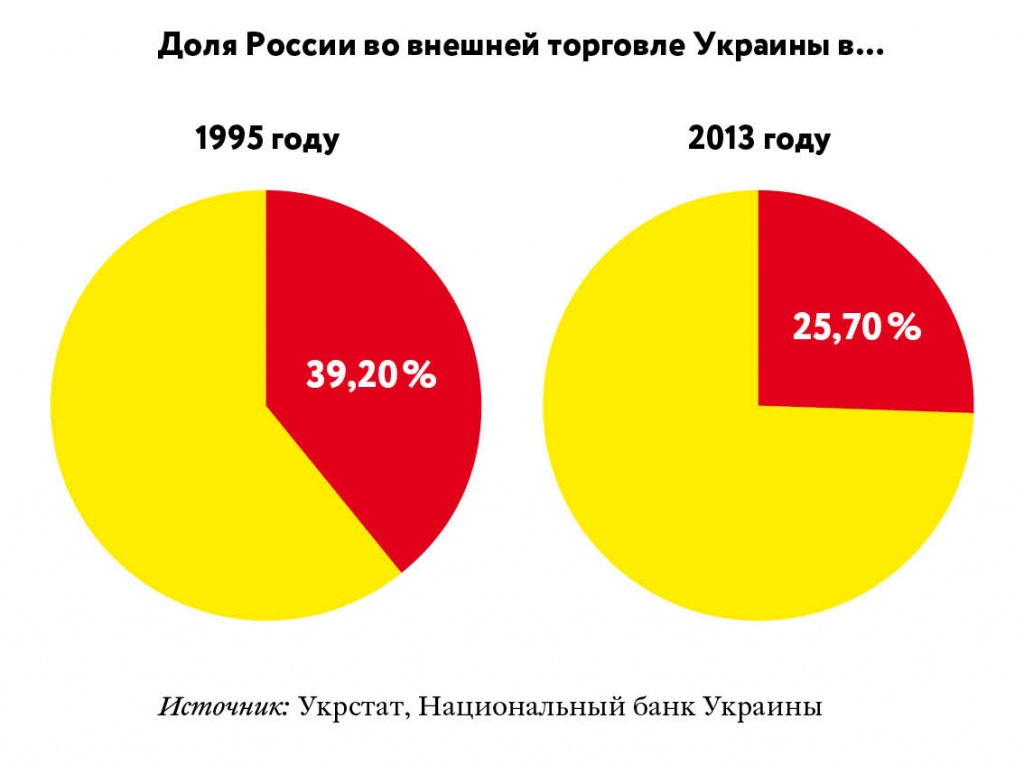
The decade between the two crises, 1998 and 2008, was successful not only for the Russian economy, but also for the Ukrainian one (as, indeed, for most other countries in the post-Soviet space). Over the ten years of Ukraine, Ukraine grew by 82%*, that is, the economy grew at an average speed of more than 6.1% per year. And although you often hear that, they say, the Ukrainian economy is the same Russian only without oil and gas, the growth of the Ukrainian economy in some parameters was healthier than the growth of the Russian. So, according to Ukrstat, labor productivity in Ukraine in the intercrisis decade grew noticeably faster than GDP volumes - on average by 7% per year: it was a reaction to the reducing labor force, while Russia met the attracting amounts of low -qualified labor force from Central Asia. Industry in Ukraine grew on average by 10% per year, and exported oriented industries were especially well earned - from transport engineering to food products. It is clear that a lot went to Russia, and it would be stupid not to use the neighbors market rapidly developing in those years. But it is curious that the share of Russia as a foreign trade partner of Ukraine has decreased steadily (see the schedule below). However, the share of Ukraine in the foreign trade in Russia for the same period also decreased - from 11% to 5.4%.
"
The National Bank of Ukraine for a year and a half spent a third of his currency reserves to support hryvnia
"
A certain “fracture” in the Ukrainian economy occurred in 2005: until that time, the balance of current payments of the payment balance was stable, but in the middle of the decade, imports began to grow much faster than export, and as a result, since 2006, the balance of current operations became negative and was already a minus of $ 12 billion by 2008, in the context of a rapidly growing economy, this was not created at first, at first glance, not created. Great problems - a deficit of payment balance was funded by external loans attracted by Ukrainian banks and companies. Moreover, in 2005-2007, the National Bank of Ukraine was able to increase its currency reserves by $ 20 billion.
... and the time of defeat
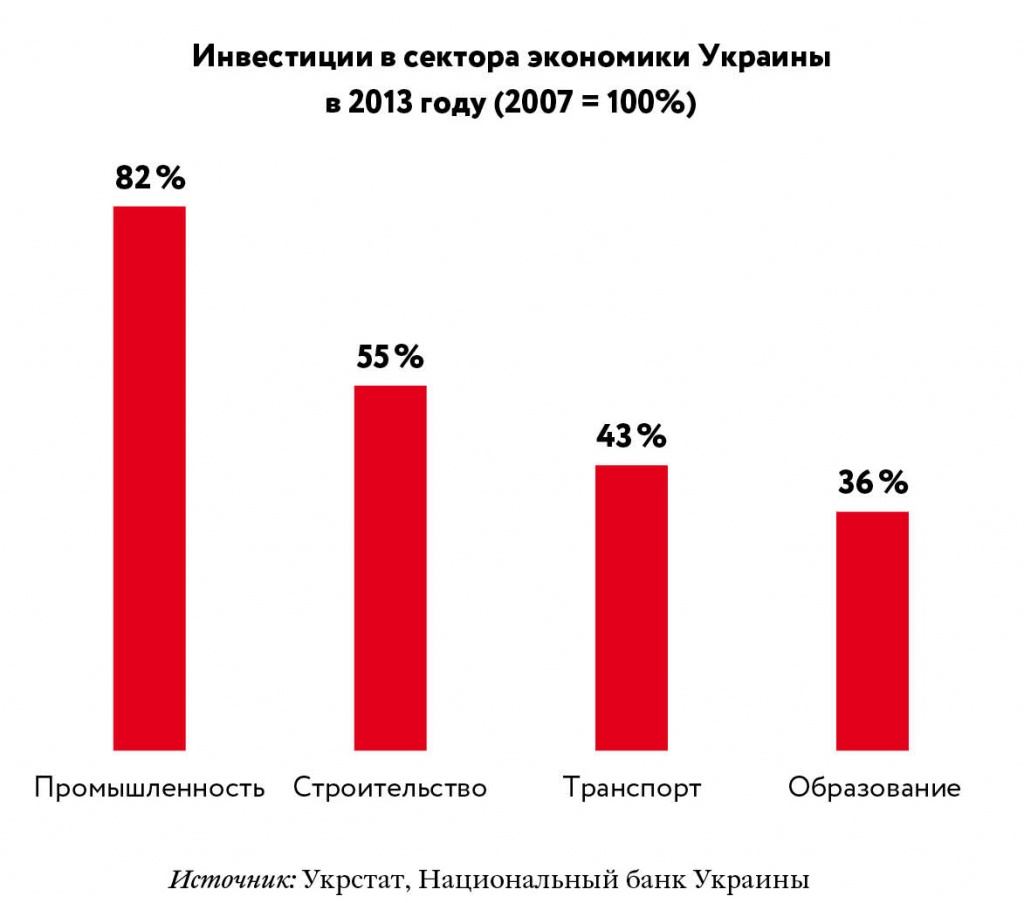
With the onset of the crisis in 2008, the situation began to change sharply. Moreover, the collapse in the Ukrainian economy was more rapid and deeper than in Russia: in the fourth quarter of 2008, the economy fell by almost 8%, in the first quarter of 2009-by 15%(compared with the quarter a year earlier), and according to the results of the year-by almost 20%. The exit from the crisis in Ukraine went much slower than in Russia: 4% growth in 2010, 5% in 2011 and the lack of growth in 2012-2013. As a result, today Ukraine’s GDP is 6.5% lower than it was in 2008, and Ukrainian industry produces 15% less products than in the 2007 pre-crisis, which allows us to talk about the actual de-industrialization of the country. But this is not enough: the Ukrainian economy also encountered a sharp fall in investment.
As a result, export stopped growing, and imports already in 2010 exceeded pre -crisis volumes. The balance of current payments of payment balance went far in minus and last year amounted to minus $ 16.5 billion (8.9% of GDP). The National Bank of Ukraine for a year and a half spent a third of his foreign currency reserves to support hryvnia. The country came close to the fierce currency crisis.
Populism price
| ** On March 12, in Kyiv, at a conference under the speaking name: “Resuscitation measures for the Ukrainian economy”, which was organized by a number of Western research institutes, the Minister of Economy of Ukraine Pavlo Sheremet made it clear that in the coming month the government will be made that cancel the subsidies of energy prices. *** What is at least the statement of the acting President of Ukraine Alexander Turchinov that budget debts are exceeding $ 75 billion. And this is that the state budget in expenses in 2013 amounted to 403 billion hryvnias, and consolidated - 506 billion hryvnias (about $ 50 and 63.5 billion, respectively). |
From representatives of the new Ukrainian authorities, you can constantly hear phrases like: "The treasury is empty." However, it is impossible to understand how true, without access to operational information about the state of the budget. On the one hand, the tax revenues and expenses of the state budget in the second half of last year were few (by 3.5% and 4.2%, respectively) less than in the second half of 2012. But taking into account zero inflation and zero growth, it cannot be said that collapse has occurred in the budget sphere. Obviously, the most difficult problem of the Ukrainian budget is exorbitant expenses for subsidizing energy prices and heat, the volume of which exceeds 10% of the state budget expenditures. If the transition government of Ukraine can go to a painful and unpopular step - the abolition of subsidies, then this will release colossal resources to the budget. Of course, they are hardly enough to solve all the tasks facing Ukraine, but the treasury will clearly fill **. There is another source of savings: the Ukrainian authorities could go to a radical reduction in military expenses. Recent events have shown that the Ukrainian army is still not able to withstand Russian aggression. Then why do you need such an army at all?
How much money is needed?
No one knows the answer to this question. Because, perhaps, no one today understands how serious the decline in the Ukrainian economy is and to what extent the basic mechanisms of protection of property rights are destroyed and, therefore, the incentives of private business to investment are undermined. The new Ukrainian ministers have already voiced all their requests that are increasing in scale: $ 15-35-50 billion. (Actually, the response to this “request” was the statement of the Director of the Director of the IMF Christine Lagard, which Ukraine does not need urgent assistance, and the Ukrainian authorities should better calculate its requests.) But there was no justification or explanation ***, which is created from The impression is that, firstly, the new Ukrainian authorities themselves did not understand the situation, and secondly, they have mastered the well-known rule: “Ask more, they will give less.” Let's try to figure it out ourselves.
The International Monetary Fund intends to allocate $ 15–20 billion for three years to Ukraine. It seems that this is enough to restore macroeconomic stability in the country. Indeed, the state budget deficit in 2013 amounted to 64.7 billion hryvnias (approximately $ 8.1 billion at the rate of hryvnia at the end of 2013). Obviously, the devaluation of hryvnias (and a 20 percent devaluation, from 8 to 9.5 hryvnia per dollar, has already taken place) reduces the dollar amount of the budget deficit. If Ukraine refuses subsidies to gas prices, this will give the budget a savings in the amount of about $ 5 billion and ultimately the annual budget deficit may be $ 3 billion.
But there is another, except for the budget, the problem, and the problem is much more serious: whether Ukraine can serve its external debt.
The total external debt of Ukraine (state and private) is approximately $ 140 billion - more than 75% of GDP, which in itself is a lot. But a much more alarming fact is that almost half of this debt ($ 66 billion) is short -term: it must be repaid during 2014. Considering that the international ratings of Ukraine assess the state of its economy as pre -ended, loans of private foreign banks are closed to her, then the ability to serve external debt seems very, very problematic. However, the IMF is an organization engaged in the problems of states and governments, and not the problems of the private sector. And here the situation is not so bad: the short -term debt of the government and the National Bank is a little less than $ 6.5 billion, and this already fits into the scale of the possible Emweef program.
The total external debt of Ukraine (state and private) is approximately $ 140 billion - more than 75% of GDP
"
What can the IMF
Successful experience in overcoming the debt crisis in Europe clearly demonstrated that in the modern world there is only one organization that has a sufficient examination to formulate programs for overcoming macroeconomic problems. And this organization is called the International Monetary Fund (IMF). It is no accident that this is why the European Union, negotiating with Ukraine before the Vilnius summit, did not pay attention to financial issues at all - European politicians were sure that this plot was discussed in Washington.
Today, when the scale of potential economic assistance to Ukraine is growing as on yeast, it is obvious that any assistance to Europe (with the exception of possible loans/guarantees for a couple of billions of dollars in the short term) will be indeed tied to Ukraine agreements with the IMF.
Throughout the post -Soviet period, Ukraine has not been able to clearly formulate its economic doctrine. In politics, radicalism was bizarrely intertwined in carrying out individual reforms (in the second half of the 90s, Ukraine was ahead of Russia in a number of directions) and frank populism and unwillingness to recognize new reality (the most striking example of this is still the preservation of gas and enterprises that have become excessive to the budget).
Such inconsistency and inconsistency of economic policy was fully manifested in the history of the relationship between Ukraine and the IMF. Since 1994, Ukraine signed agreements with the IMF several times, but each time after receiving the second tranche, it terminated the fulfillment of the signed obligations.
The penultimate program agreed with the IMF, the volume of $ 16.4 billion was envious of Prime Minister Yulia Tymoshenko in November 2008 and provided for the transition to the floating rate of hryvnia and the balanced budget by increasing domestic prices for energy carriers. A year later (and the program was designed for two years), the fund froze the provision of a loan, and then terminated the agreement. In July 2010, he was replaced by a new program with a loan amount of $ 15.1 billion with the same obligations from the Ukrainian authorities. Ukraine received the first tranche of $ 1.89 billion and ... ceased to fulfill this agreement. How will it be now? Perhaps, given that today the situation in Ukraine in the center of European policy, the IMF will give Ukraine the first tranche, and then it will wait again how the government is ready to fulfill its obligations.
Poland today has become the largest trading partner of Germany in Eastern Europe, overtaking Russia with its oil and gas. Ukraine may well follow the path of Poland
"
At a crossroads
The European choice for Ukraine, in fact, is non -alternative. It is unlikely that any of the serious politicians in a neighboring country is seduced by the idea of a close economic alliance with Russia, which itself is more and more immersed in the stagnation swamp and can hardly offer Ukraine something more than relatively small money sufficient to “maintain pants”, but no more. The strategic course towards rapprochement with the European Union, starting with associated membership, could set Ukraine not only the vector of institutional transformation, but also eventually turn it into a powerful industrial cluster. So, for example, it occurred with Poland, which in the 2000s accepted many industrial enterprises on its territory, attracting investors lower-compared to the European-earned payment and not so rigid social guarantees. As a result, Poland today has become the largest trading partner of Germany in Eastern Europe, overtaking Russia with its oil and gas. Ukraine may well follow the path of Poland. But this will take a couple of decades. Finally, recently they have been talking a lot about the Marshall Plan for Ukraine. However, it is impossible to seriously analyze both prospects and the consequences of such a decision. Moreover, the question of the consequences of the Russian military invasion of Russia has not yet been removed from the agenda.
Photo: Vladimir Smirnov/ITAR-TASS