
Translated material
Laws - packs
What laws deputies of the State Duma adopted in May, which are about to accept and what all this is fraught with citizens: The New Times watched a seasonal exacerbation on the Okhotny series
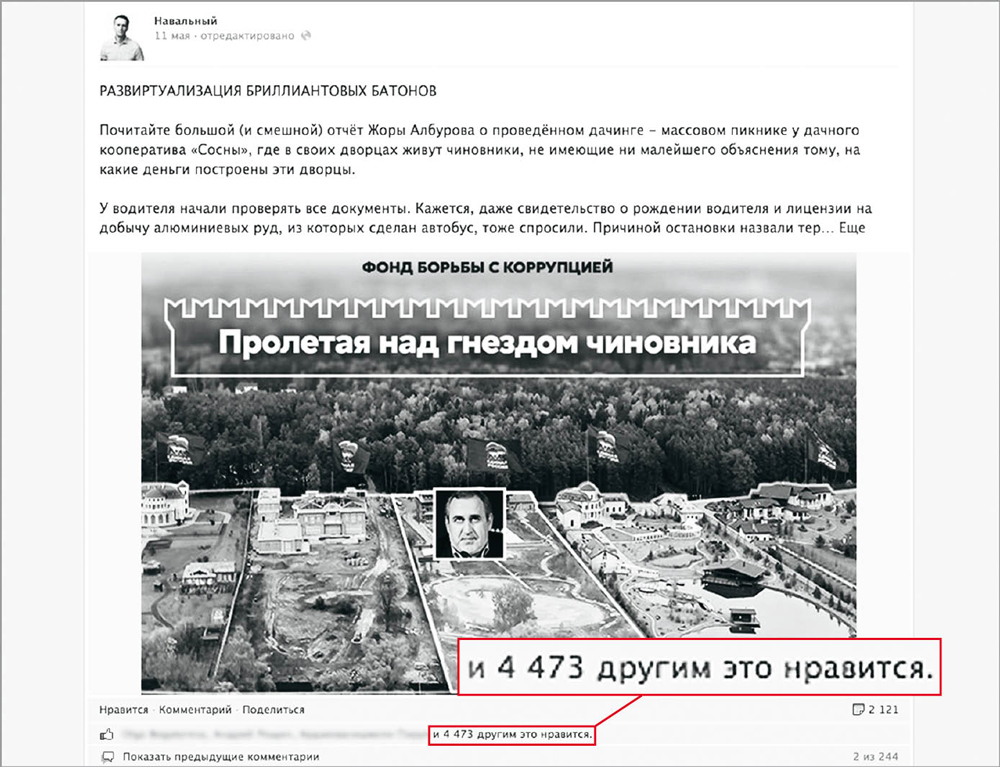
According to the new requirements for bloggers of the Navalny investigation, officials may turn out to be “outlawed” /photo: from Facebook by Alexei Navalny
While the country lived from one May holiday to another, State Duma deputies actively, if not furiously, were submitted for consideration and adopted new laws. "And when are they there a summer vacation?" - uneasily asked each other by users of social networks after watching news tapes. The holidays have a State Duma in mid -July, which means that there are almost two months of legislative activity ahead.
There is something to worry about: in May, the “printer”, as it has long been customary to call the lower house of the Federal Assembly, prints laws literally in packs. The New Times studied those that should pay special attention to Internet and the media users.
"About bloggers"*
| *Federal Law No. 97-ФЗ “On Amending the Federal Law“ On Information, Information Technologies and the Protection of Information ”and individual legislative acts of the Russian Federation on streamlining information exchange using information and telecommunication networks”. |
The bottom line: the bill undertakes bloggers whose Internet pages visits more than three thousand Internet users, register as the media and partially observe the media law.
The speed of passage: the first reading of the law took place in February 2014, in the last reading it was adopted on April 22. The president signed it on May 5. The law will enter into force on August 1, 2014.
Who will affect: politicized Internet users, whose pages per day are visited by more than three thousand people, popular opposition politicians and human rights activists. As well as providers who must provide Roskomnadzor with user data within three business days from the date of receipt of the request - for them this is an additional load.
The service of the online Devils Live Journal in this regard decided to display in the profiles of all bloggers and communities, the number of subscribers of which exceeds 2.5 thousand, not the actual number of users, but 2500 +. However, Roskomnadzor has already warned that such measures would not help bloggers-the number of original subscribers will be a robot program that will be prepared to monitor the entire content in the World Wide Web. True, bloggers have not yet been informed how their registration in the register will take place.
Punishment for non -fulfillment: if the owner of the popular page refuses to register as the media or violates the rules of maintenance of the page, his resource can be blocked, and he will have to pay a fine of up to 30 thousand rubles. Repeated violation will cost 50 thousand rubles.
Why were it accepted: the purpose of the law is to strengthen political control over the Internet content, according to Alexey Terentyev, owner of the Creative Telematics & Trade Itative Holding. “Bloggers are based on selectivity. For the type of media, the media will register, for example, to Nick Belotserkovskaya with her culinary blog - so that everything is honest, and then there will be a hunt for objectionable users of social networks and LJ, ”Terentyev explains. According to the expert, the likes will be the easiest way to prove the presence of high attendance by a blogger. “Navalny’s each entry on Facebook receives thousands of“ I like ”. So his posts about the dachas of Russian officials may well fall under the ban for the media to disclose private information. And to the famous designer Artemy Lebedev, who considers the mat “an integral part of the Russian character,” will be banned in LJ.
"On the prohibition of the rehabilitation of Nazism" **
| ** Federal Law of the Russian Federation of May 5, 2014 No. 128-ФЗ “On Amendments to Certain Legislative Acts of the Russian Federation”, Art. 354.1 - “Rehabilitation of Nazism” of the Criminal Code of the Russian Federation. |
The essence: the ban on the public denial of the facts established by the Nuremberg Tribunal, as well as on "the spread of knowingly false information on the activities of the USSR during the Second World War." What exactly is meant by “false information” - the law is not specified. Those who publicly desecrate memorable dates related to military glory and their symbols will also fall under criminal liability.
The speed of passage: “Fascism is already in full growth,” the deputy from United Russia and the initiator of the law Irina Yarovaya colleagues in the Duma on February 27, 2014 warned. The first reading passed on April 4, and Vladimir Putin signed it on May 5.
Who will affect: the media, Internet users, authors of books and scientific works and everyone who publicly allow themselves to criticize the Soviet regime of the war.
Punishment for non -fulfillment: a fine of up to half a million rubles or imprisonment for up to five years. For those who insult memorable dates or symbols, a fine of up to 300 thousand rubles, mandatory work for up to 360 hours or correctional labor up to one year.
Why were they accepted: “This is primarily connected with the course to increase the degree of patriotism in connection with the events in Ukraine,” said Valery Zaitsev, an expert at the Analytical Center for Owl. “It is no accident that Yarovaya asked to adopt the law until May 9.”
“The law will limit the academic discussion,” Zaitseva suggested. “It is possible that as the propaganda of collaborations, a simple presentation of the point of view of the ROA soldiers (Russian Liberation Army. - The New Times) can be perceived.
The sensational survey of the Rain television channel, whether it was necessary to pass Leningrad in order to save hundreds of thousands of lives, still under this law there was no crime, the expert explains, since the survey did not contain charges against the Soviet leadership. But the article of political scientist Andronik Migranyan in Izvestia, where Hitler is called the “high -class politician”, according to Zaitseva, could fall under this law. However, experts are afraid that the law will apply selectively.
"On fascist symbolism" ***
*** Amendments to Art. 20.3 Code of Administrative Offenses of the fines for demonstrating the symbols of organizations that once cooperated with the Nazis.
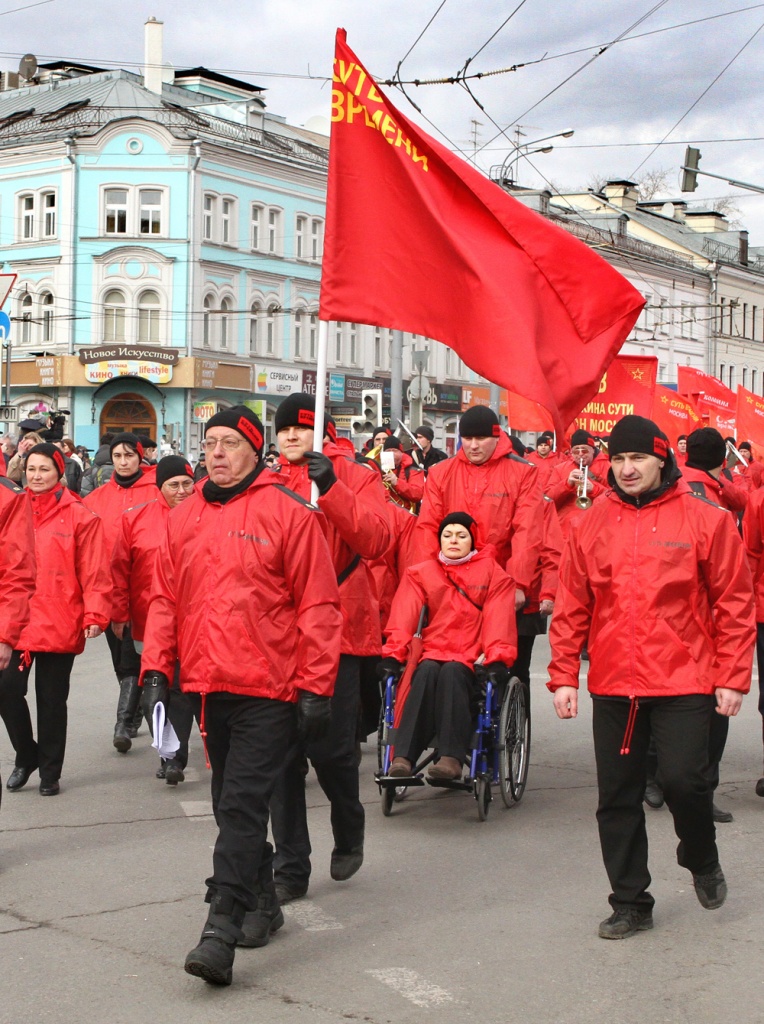 |
| The pro -Kremlin movement “essence of time” also falls under the bill on the ban on collaborationist symbols. The rally "In support of the Crimea." Moscow, March 15, 2014 /Photo: Vladimir Mashatin /ITAR-TASS |
The bottom line: the Vice Speaker of the State Duma Sergey Zheleznyak proposed to introduce responsibility for the demonstration of collaborationist symbols, that is, the symbols of organizations that collaborated with the Nazis.
The speed of passage: March 21, the bill was submitted to the State Duma. The profile committee approved him on May 13.
Who will affect: Internet users, as well as political activists who sympathize with Ukraine before making repost or publishing pictures with red-black symbols of the organization of Ukrainian nationalists Stepan Bandera, should be seriously thinking.
True, experts believe that not only Bandera will fly into fines. “Anything can fall under the law: General Vlasov used, for example, the Andreevsky banner-the current symbol of the Russian naval forces,” says historian Boris Kovalev, who studies the theme of collaboration in Russia from the Great Patriotic War. - Many symbols of the time of the Second World War, including collaborators, have deep historical roots. Symbolism was not invented specifically - more often it was borrowed. ” The borrowing is also taking place to this day: for example, the Prochrevsky movement “essence of time”, led by an eccentric political scientist Sergei Kurginyan, holds his actions using attributes in red-black tones, as well as supporters of Stepan Bandera.
Punishment for non -fulfillment: for propaganda and public demonstration of forbidden symbols, a fine of up to 2 thousand rubles with the confiscation of the “subject of the offense” or arrest for up to 15 days is entitled. For officials, a fine of up to 4 thousand rubles, for legal entities - up to 50 thousand rubles. For the manufacture, sales or purchase of such symbols - a fine of up to 2.5 thousand rubles, for officials - up to 5 thousand rubles and for legal entities - up to 100 thousand rubles.
Why were they accepted: “The revival of Soviet patriotism against the backdrop of an aggravation of relations with Ukraine and the West,” Arseny Roginsky, chairman of the board of the International Human Rights Society “Memorial” explains without delights.
"On double citizenship" **** **
| **** Amendments regarding dual citizenship are proposed to introduce to Federal Law No. 62-ФЗ “On Citizenship of the Russian Federation”. |
The essence: Russians who have received citizenship of a foreign state should notify the FMS bodies for a month, and those who, at the time of amendment come into force, already have another citizenship - notify the FMS within three months.
The speed of passage: March 27, Vladimir Putin, at a meeting with Senator Andrei Klishas, discussed the introduction of criminal punishment for concealing double citizenship. On March 29, a deputy from United Russia Andrei Lugovoi sent a ready -made bill to the government. On May 14, the bill was adopted in the first reading.
Who will affect: according to Rosstat, based on the census of the 2010 population, about 78 thousand Russians have a passport of another state. These are only those who wished to inform about it. “In this bill there is a game with the words“ double citizenship ”and“ second citizenship, ”explains Ruslan Koblev, head of the Koblev and partners lawyer. “My acquaintances of the deputies admitted that they themselves do not understand what is meant there.” According to the lawyer, if there is a special interstate agreement between the countries, then we are talking about “double citizenship”. If not, this is a “second citizenship”. This law will affect all citizens with foreign passports or only one of these two categories - it is not yet clear. Koblev says that the bill is not about making people abandon some of the citizenships, and those Russians who live in another country should not be afraid to return to Russia. But the keyword is “so far”.
Punishment for non -fulfillment: they will be punished under the new article of the Criminal Code “Failure to fulfill the obligation to notify the presence of citizenship (citizenship) of a foreign state” - a fine of up to 200 thousand rubles or mandatory work for up to 400 hours.
Why were they accepted: according to the deputy of the meadow, the state should keep records of its double citizenship citizens due to the fact that the country is in a difficult political situation. For the effective work of the special services, the deputy is convinced, the authorities must know which of the Russians depends on the foreign state.
But according to Ruslan Koblev, the bill is aimed at control in relation to those who are engaged in socio-political activity. “A very similar story was with NGOs - with the introduction of the Law“ On Foreign Agents ”. Organizations did not close, but became subject to greater control, ”the lawyer explained.