Not fatal eggs. The most ancient and simplest food of a person can be the most refined. The basis of life and the basis of cooking studied The New Times
From the egg, as they believed in antiquity, our whole universe hatched and all life has occurred. It is not for nothing that in the cosmogonic beliefs of the southern Slavs, the egg was the prototype of the cosmos and its individual parts, the sun was called the "God's egg", the starry sky - "a sieve full of eggs." The whole world was like a huge egg: the shell is the sky, the film is clouds, protein - water, yolk - earth. The motive for overcoming death through a life that is born in an egg is reflected in riddles: "Living will give birth to the dead, and the dead will give birth to a living." So the death of Kashchei, enclosed in an egg, provides him with immortality. The egg, thus, was comprehended as the beginning of all the principles, a symbol of fertility and vitality.
Eggs ice
But not only among the Slavs, but in all world cultures, the egg symbolizes the source, the beginning of life. In ancient Persia, chickens were called the birds of the nascent day, and their eggs, valued as much as gold, were given to the wedding. In India, where two and a half thousand years ago they tamed and domesticated chickens, the eggs still marked the sun, which charges with energy all living things.
Being a symbol, so to speak, kind, the egg was understandably understandably became a tidbit for Evil Forces. It is not surprising that in the film of Alan Parker “The Heart of the Angel” the hero of Robert de Niro Luis Saifr, he is Lucifer, with such a defiant look, the boiled egg eats, as if to show that he, the prince of darkness, is under control. You can’t slip away from him ...
Elena beautiful, the root cause of the Trojan war hatched from the egg. The mother of Elena, Leda, the daughter of the festival, King of Etolia, was so beautiful that Zeus-Gromovets himself appeared in the form of a swan. Leda demolished Yaichko, but not one thing: from the second, the brothers Elena Gemini Castor and Polluks were born. So the expression “eggs of the ice” went as a symbol of the beginning of something, its root cause. Even the Roman poet Horace praised Homer for the fact that he began his story about the Trojan war not with the ovs of Leda, but immediately introduces the listener in Medias Res - to the essence of the matter. And Pushkin, in a letter dated September 24, 1820, wrote to his brother Lev: “Dear brother, I am to blame for your friendship, I will try to make amends by my long letter and detailed stories. I start with the eggs of the ice ... "
Soft and bag
Myths of myths, and the egg remains the basis of both unpretentious and the most refined kitchen. In cooking, chicken eggs are almost always used. But the eggs of turkeys, geese, ducks, guineasets, quails and gulls are also edible. Today, in many European countries, by special permissions, you can collect eggs of gulls - dark, spotted, green or blue, with a light fish flavor, they are considered a delicacy in England and Scandinavian countries, especially in Norway. In France, Chibis eggs are considered a special delicacy. They are boiled and used in jelly and salads, as snacks and side dishes. Quail eggs can be served as a side dish to many hot and cold dishes, as well as as the main dish: for example, a salad of greenery with hot mushrooms and quail eggs, cooked in a small amount of water (pasot eggs), or a tartlet with quail eggs and mushrooms, creamy oil sauce, wine vine juice.
Egg dishes are fastest and simply prepared. Well, what a wisdom: take two eggs, break them into a hot pan, salt, pepper - and now she, ready food. Without delights, with a minimum time spent. But you can prepare in Chinese, the so-called canned "centennial eggs". The eggs are coated with a three -centimeter layer of thick paste mixed on a tea infusion of mulberry trees with lime, soda and salt, collapsed in rice husk and withstand in large tightly closed vats or in the ground for exactly 100 days. After such processing, they do not deteriorate at ordinary room temperature for several years. The yolk acquires a dark green color, and the protein-amber. It becomes quite specific and x Taste - very piquant, slightly similar to spiritual cheese. Before serving, the eggs are cleaned, cut into half or slices, laid on a plate and watered with soy sauce with finely chopped ginger and vinegar. The Sunhuadan dish is called and is considered a delicacy.
The ancient Egyptians simply wrapped the egg into the sling and quickly twists it. The egg was warmed up, and it was believed that it was welded softly. They once tried to cook eggs not only in boiling water, but also in hot air. In Paris, the Favorite machine gun equipped with an hourly mechanism was designed, which after a certain time extracted a basket with boiled eggs from boiling water.
Special alarms were also produced, which were started depending on the requirements: cooking eggs, in a bag or screwed. Today they produce electric eggs with a timer, but normal people do without special devices. It is worth lowering the egg into boiling salted water - and after 3-3.5 minutes a soft egg will be ready, after 4–4.5 - into a bag, and in a screwed - after 8-10 minutes.
Omlet in centaurian
In one of the novels about the Pirks pilot, the great Stanislav Lem describes how Pirks, having arrived with the inspection at the space station, discovers that the crew died, and at the station someone had a wild pogrom. Due to the broken devices, it is impossible to find out exactly when the tragedy occurred, and Pirks gets out of the situation, only finding a bowl with a slurry for an omelet in the kitchen compartment. Seeing that nothing has vanished yet, Pirks realized: the astronauts died recently.
Here, it’s not the dramatic plot of the science fiction novel that is important for us, but the agricultural faith of the science fiction writer that in the future, after several centuries, will also make omelets, and somewhere in the interstellar space, in the space ship, among the food supplies of astronauts there is a place for dozens of eggs.
This is understandable. Now the omelet is one of the most common dishes (there are omelettes in Chinese and Gollandic, Pomksikan and injected, etc.), and why not remain the same in the future? Omlet in the alpha-centaurian, for example.
But the charm of an omelet is not in established recipes for cooking (respectively - taste and pleasure from eating), but in its diversity. The omelett map of the world is really so extensive that it is impossible not to say about its unifying role. “Omlet of the United Europe”-it was such a item that was somehow found in the menu in a small diner on the Belgian-German border. And it’s hard to imagine that this dish unifying humanity will ever disappear.
Thin technologies
But the omelet is far from simple. The classic French should be slightly browned on top, inside - light and air. It is very important - than to beat. You can with a fork, but the material from which the fork is made is important, as well as the angle of bending of the cloves. You can like a whisk, you can with a mixer. The latter is technologically advanced and soulless. It is also important to handle the pan (mandatory cast iron!), Moreover, the omelettest pan never, under any circumstances, can not be washed (only wiped with a piece of slightly dried bread!) And you can never use for others except omelettes.
In addition, it is very important when cooking the pan to heat the pan over low heat, but to the state of red tape, and during the frying of the omelet, to be able to shake the pan so that the omelet does not burn. The classic pan for an omelet has a diameter of 23 cm, you need to hold the pan of the pan only in the left hand, and with the right with a fork or a special spatula (just not metal, but wooden!) Wrap the omelet to the middle, giving not yet a folded mass to leak to the edges. Everything must be done very quickly, and when the edges of the omelet will curl up, but will be still wet, and in the middle the omelet will be still half -dead, it will need to be folded in half and moved from the pan. Where, you ask? Yes, on a plate, but be sure to heated, almost hot! In general, the omelett plate is large, thick and heavy.
In France, the preparation of an omelet is an integral part of cook art: to become a cook, you must first bake omelet! True, a classic French omelet (manipulations with a pan - just a French little thing) - the food is quite boring. Let us recall how, in the film of Roman Polansky’s “Bitter Moon”, the hero of Peter Koyott, sitting in a wheelchair and hearing how his wife goes to dancing with a lover, looks at a plate with a prepared incorrect omelet (ordinary, only eggs, milk, flour, salt), and it covers more longing from one more longing.
The above examples can show the omelet not from the best side-a cosmic disaster, a personal tragedy ... But the omelet is still good, it is already good for the possibility of imagination, searching.
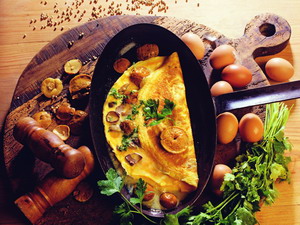
Let's try to prepare an omelet in a inemenic one. In a deep cast -iron frying pan, we will begin to pass onions sliced in olive oil in olive oil. We add thinly cut tomatoes, sweet pepper, spices, burning pepper, garlic, dill, parsley to the bow, parsley, to give piquancy - a slightly tattered between the fingers of the anise. While the process is going on in the pan, we’ll show the eggs with milk, where we add a little flour and salt. When the foam begins to appear in the mass, pour there cut by small cubes of Brynza. By this moment, the pan should be encouraged. Here we pour our mass. It is not necessary to turn over in French, but we are simply obliged to control the uniformity of frying. When frying, serve with pickled spicy olives and hot cakes. In extreme cases - with just fried toasts. Wrap with tomato juice with salt and black pepper. And ice. Yes, the entire southern coast of the Arabian Peninsula will envy you!
... The ancient Romans necessarily began even the most magnificent feast AB OVO, that is, "from the egg." In this way they gave a tribute to the basis of cooking. Since then, a lot of water flowed, billions of eggs were broken, frying, cooked, and went as an ingredient to other dishes. Without eggs - nowhere. And to this day did not lose the relevance of the old-old parable.
In some kingdom-state, a court cook died. Everyone who wanted to take his place was invited to prepare a dish consisting of 1 kg of any product, 1 liter of water and 1 kg of salt, and at the same time the dish should not be pierced. Most applicants refused to participate in such a difficult competition. However, there was a brave and smart cook, who added a kilogram of salt to a liter of water and cooked a kilogram of eggs ...
Omlet in a nitriyan
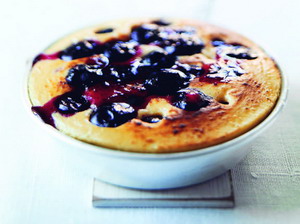
Stir the flour in milk, break the eggs there, add the salt and how to knead it to the consistency of sour cream. Half of the omelett “slurry” in a volume in a frying pan preheated and abundantly greased with fat, on top - a layer of sugar powder sprinkled with sugar (without bones!), After which we pour the residues of the “slurry”. Next, you need to remove from the stove and put in a moderately heated oven for 30-40 minutes. Sprinkle with cinnamon, cut and serve with coffee, which should be a lot, and it should be with sugar and cream.