
Translated material
Theater, go out!
St. Petersburg Post in Moscow
Theater, go out! The tour of the St. Petersburg Pos Theater was held at the moment when you least think about the theater
The writer Mikhail Weller was indignant on the radio, as during the May holidays he turned on the rain television channel in search of at least some news, and there, "instead of processions, there are some idiotic performances that are not needed for anyone." Most citizens determine the place of art in a large life-somewhere in the parachm area, away from the main events that unfold in the center of the camera. Many cultural figures secretly are even glad that in the days of popular unrest and political upheaval, society pushes them aside so that they do not interfere.
It was on such days that he visited the capital of the “vagabond” theater from St. Petersburg, led by actor and director Dmitry Volkostroelov. “Three Happy Days” fell on the very peak of the civil activity of Muscovites - May 4, 5 and 6. Performances played in the thick of the events - at the Pushkinskaya, in the theater center on a passionate. In early May, Moscow finally turned into a besieged city - tanks rumbled along Tverskaya, exits from the metro were blocked in the center, with batons and poisoned with gas, Moscow was littered with iron barriers, military trucks and police patrols. And then "some idiotic performances." It was hard to imagine a greater mismatch.
Theater-target
 |
The POST theater is a phenomenon of absolutely contemporary art, brought to the ultimate clarity of form, clarity of thought and clarity of goals. Such a target theater, a theater-overput, a theater that denies a theater balancing on the verge of spectator patience. To some extent, the theater of Dmitry Volkostralov can be called the St. Petersburg analogue of the theater.doc Mikhail Ugarov-both speak of the most terrible and painful problems of society, and one and the other are explained in the extremely tough today's language. But with one significant difference: Post does not work in the genre of journalism, this is more the theater of associations, the theater of signs, theaters will say: the existential theater in which the public is part of the study.
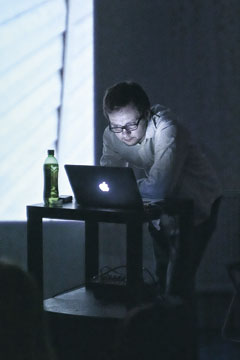
Dmitry Volkostralov himself is a student of Dodin, a completely demanded actor, a participant in some projects of the Moscow Theater.doc. Outwardly, a typical “botanist” from a good family: glasses, printing intelligence on a clean face, shy smile. What is going on inside him? Why do you immediately pay attention to him when he appears on the site? Such a strange antiger hero, to whom the attention of others is attracted, from which you are waiting for something all the time, some kind of provocation, a trick, and footings. The feeling that you are participating in a certain experiment does not leave. Actually, it is: the spectator in the POST theater is neither the enemy who must be conquered, nor a friend who is customary to entertain. The viewer here is the same participant as the artist, and each viewer has his own role, his role and even a certain semantic load. Of course, it is unpleasant when you are used in a dark, but on the other hand - terribly interesting.
Find yourself
The performance "The owner of the coffee shop" is played in the theater buffet, right in front of the bar. On the monitor screen, we see a person with a laptop who sits under the stairs right in the lobby. When he presses the “print” button, the performance begins, and we obediently, for a long time, concentratedly, look at the printer working in silence, seeing the leaf behind the leaflet with our eyes, a sheet behind the leaf. So in the "Rain Man" Dustin Hofman looked at the working microwave. Like on TV.
Similar meditations of wolfers are satisfied in every performance, he focuses on the audience on some nonsense, as if translating registers in our mechanisms, changing speeds, turning on and turning us off his remote control, and we become the center of this dead time. At the end of the performance, the monitor showed portraits of spectators: we are again involved in this idiotic game “Find yourself”, and no one leaves, we look like these photos, similar to shooting in the amusement park. We are looking for ourselves.
In principle, you can, of course, leave. Scream: "Return the money and stop mocking!" Surely the director also provided for such a reaction. 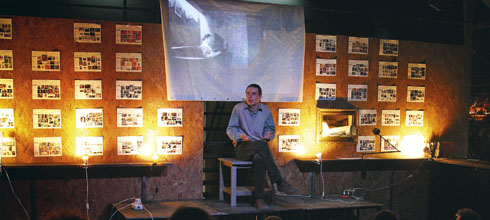
It is not difficult to escape from the buffet. Although when a person sits in front of you in a chair and chatting with you about the meaning of life for an hour, it is somehow inconvenient to get up and leave. It is also inconvenient as to ask: "What, what?" - If I did not hear. It is difficult to hear, because in parallel with a monologue from the speaker there is a phonogram of ordinary bar life - the ringing of dishes, pieces of conversation, laughter, shuffling steps, hissing coffee machine. Gradually, the human speech of a hero sitting on the chair is isolated from this haze of sounds, who seems to not try to shout a rumble, tells himself without any “acting messages” there. The tension is colossal. Sweat praises! But they talk to you! They trust you! "
The people came running to the premiere literally from under the riot police. Smooth, excited people with white ribbons on handbags and jackets could not calm down for a long time, shared what they saw and heard
"The Hero of the" Master of Coffeei "is the playwright Pavel Pryazhko himself (actor Ivan Nikolaev), one of the most popular modern authors living in Minsk. Its texts mainly sound in the Volkostroelov Theater. The Monologue Pogozhko is about how creativity ripens in a person, how it drives him from steps to a step, about what the infantility of society, infantility of the country And the infantility of the world, how the formulas and norms were replaced by life and became its main vulgarity, about deafness and habit of deafness, that you can die without hearing each other ... However, all other performances in the texts of Perezhko are about the same.
The effect of the mirror
The “locked door” goes in two spaces - on the screen, like a video with sunbathing text, and on the stage in front of us. Spectators are also on stage-and you definitely won’t run away from it, running out of the audience will be tantamount to running out of the play.
The “locked door” is such a study, a theatrical dissertation that traces the path from person to mechanism. Vypery and very pretty people, leading a completely ordinary lifestyle, live as if in an absurd flask. Mechanical life, devoid of sound, color, taste, smell, is a life in which everything is imitated, even pregnancy and miscarriage. Life is like a false stomach that a young man brings a girl in a plastic bag and gives him in the center of a large supermarket. At home, the girl puts it on and dances in front of the mirror, the belly dance.
Volkostroelov performances have some mysterious, almost mystical properties. They produce the effect of a mirror where everyone gets exactly what he is. No more or less. They in no way unite the hall, but on the contrary, they maximize the audience from each other, immerse everyone in absolute hopeless loneliness. The spectator who flounders alone in the full hall is the same provocation from which you want to instinctively dodge. Volkostrokov expels the theater from the theater, like demons from the temple, and does it fun, without tearing and violence. 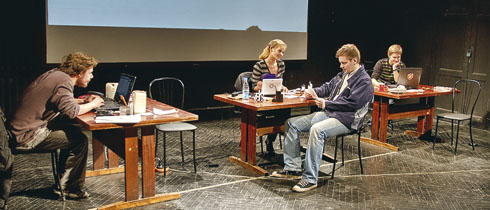
The culmination of the tour was the premiere of the theater performance "I am free." The people came running to this premiere literally from under the riot police. Smooth, excited people with white ribbons on handbags and jackets could not calm down for a long time, shared what they saw and heard. Those who were not tortured those who were. Exactly on the song Vysotsky: "How did you survive, how did you escape?" - Everyone asked loudly. But the poor fellow was only shaking and shooting the chinars. ” The buzzing inflamed hall was clearly not ready for immersion in Nirvana. Volkostrelov stood behind a small remote control under a large screen and looked at us like aliens. "Let's declare a moment of silence!" Someone shouted hysterically. “No, let's do something in solidarity! - answered another broken voice. - Well, let's even raise your left hand! ” The absurdity of this proposal, it seems, understood only Volkostroilov: when the whole hall implicitly raised his left hands up, the director smiled at a crazy smile and thought: “They are mine!” And then in grave silence, he showed us photos on the wall, 535 pieces - a regular photo album from pieces of city, rain, cars, dogs and girls in a white knitted hat. Frozen, frightened by the city, Muscovites looked at the scraps of someone else's life, gradually plunging into their own. At the end of the Volkostrelov sat in the first row with everyone and said: "I am free." And do not believe it - everyone believed.