
Translated material
Crisis Light: June version
Than and when the ruble calms down
Crisis Light: June version. On June 1, the ruble fell: tightly and as if for a long time. Russian citizens nervously rushed to buy currency. But literally three days later, the fall stopped and the course leveled off. And on June 8, the ruble rolled down again, forcing people to think: what will happen to the national currency tomorrow (p. 17)? Indeed, more recently, in mid -March, it seemed that things in the Russian economy were fine. Oil prices rose above $ 120 per barrel, stock indices reached a maximum in 10 months, and the ruble was strengthened for a year and a half in a row. The decrease in oil price that followed at the end of May - early June led to a sharp weakening of the ruble and drove the Russian stock market into annual minimums. The Central Bank is trying to cope with the fall, but experts warn that there are new troubles ahead (p. 14–16). Moreover, a cheap ruble can also be a game of a native state against their own navypayers (p. 19). Only one thing can be argued: Russia has so far faced a short -term and lightweight version of the economic recession, a sort of Light crisis. What will happen next, no one can predict now. What will the oil hangover turn out for Russia and how to insure him from it? About all this - in the main topic of the number
The fall of the markets turned out to be fast and sharp. The MICEX index lost by June 7, 18.5% relative to the March peak. More strongly, by 27.2%, the RTS index fell at the same time: it is calculated in dollars and reflects not only a decrease in shares, but also a drop in the ruble. In turn, the ruble exchange rate to the dollar for May and early June fell from 29.34 to 32.78, by almost 12%. In the wave of market panic, the rate reached at all to 34 rubles per dollar, but then played part of the fall.
Who is to blame?
Why did thunder struck in Russian financial markets in the early days of June? Most of the experts surveyed by The New Times agree that the totality of reasons has led to this. The risks associated with the terrifying state of the Spanish Banking Sector were added to traditional fears about the release of Greece from the eurozone. Plus, on the last day of spring, disturbing data from the United States related to the labor market and a decline in business activity were published. And then extremely negative statistics from China and India arrived, indicating a noticeable slowdown in these countries of economic growth (more about this - on page 32). 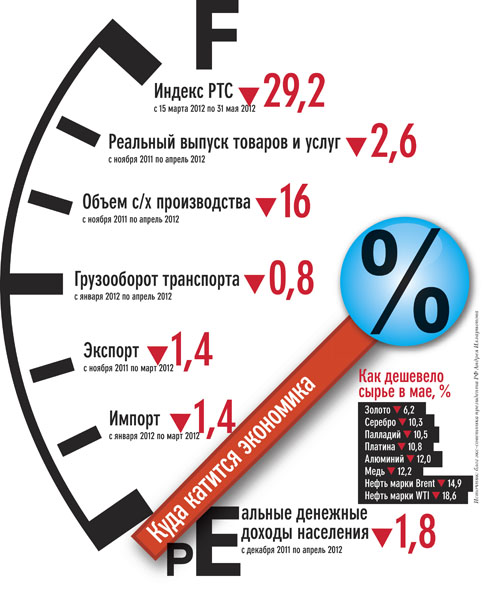
Under the influence of these factors, the world oil price fell sharply. Since the beginning of March, she generally lost exactly 20% of the cost, planning from $ 125 to $ 100. And in the early days of June, the decline reached $ 98, but then the price was a little adjusted. Such a steep fall in oil prices - the main “nurse” of the domestic economy - the Russian markets could no longer survive and fought in a friendly failure. Which has also aggravated an internal problem: Russia meets the new stage of the global financial crisis in a long and strong period of the outflow of private capital. In the first 5 months of this year, the country left, according to the Central Bank estimates, $ 46.5 billion: capital flees one and a half times faster than it was a year ago.
The saving corridor
Russian political players reacted to the negative events in the markets in the usual way. Dmitry Medvedev the day after the collapse, June 2, held an economic meeting at which he instructed the Central Bank to “hold the stability of the ruble exchange rate and, if necessary, increase interventions” in his support. The prime minister does not seem to know that the Central Bank is separated from the executive branch and the government is not entitled to command them. The head of the Central Bank Sergey Ignatiev, of course, did not argue, confirming that his department was ready to spend as many dollars to support the ruble. Indeed, the Central Bank’s international reserves by the beginning of June amounted to $ 510.4 billion: only 17% less than before August 2008.
However, now the Central Bank, taught by the bitter experience of the previous crisis, controls the currency course more flexibly - using the currency corridor, also calculated for the bivalyut basket *** Bivalyut basket - the average value of the ruble exchange rate to the dollar and the euro .. This is the plan of the Central Committee. So at a meeting with Prime Minister Sergei Ignatiev said: "The volatility of the ruble inside our corridor is not serious, it suits us." Indeed, the upper boundary of the corridor is now 38.15 rubles per bivalyat basket, or 35.26 rubles per dollar. Even at the peak of the fall, the ruble did not reach these values.
However, the ease with which the Central Bank agreed to spend reserves on maintaining the ruble causes concerns. Medvedev and Ignatiev seemed to have forgotten about the experience of four years ago, when in six months, from August 2008 to January 2009, the Central Bank spent almost $ 210 billion, or 35.1% of its reserves to support the ruble. And still he was forced to let the ruble exchange rate. It is curious that in the past year and a half - until the beginning of June - the Central Bank did not resort to intervention in support of the ruble. And after the meeting, Medvedev began to spend $ 200 million per day in the foreign exchange market. This, of course, made it possible to support the ruble, but left the question open: is the Central Bank "crutches" is not too expensive for the national currency?
Conditional reflexes *
The ruble falls - it must be supported: this conditional reflex worked not only with Medvedev. Vnesheconombank recalled how in 2008 he received 175 billion rubles from the National Condition Fund to support the stock market. And he successfully supported: he bought it close to a minimum, sold at a maximum. A year later, he returned the money to the Ministry of Finance, and left himself a profit from stock speculations - about 100 billion rubles. The State Bank, thus, has well invested other people's money, earned about 60%in a year. "
Such a cool fall in oil prices - the main "nurse" of the domestic economy - the Russian markets could not calmly survive and fucked up a friendly failure
“Now the market is falling again, and the VEB, of course, would like to repeat this focus, which it the other day and notified the government, at the same time predicting the fall of the ruble to 34.7 per dollar and advising the Central Bank to prevent the“ one-guided and continuous reduction of the socially sensitive financial indicator ”-the ruble exchange rate to the proposal of the stock market at the expense of the federal The government has not yet answered the budget of the government.
Conditional reflexes are triggered, of course, in private companies. In 2008, almost three hundred enterprises received support from the budget to pay debts and prevents the prevention. So far, only one thing was requested for help - Chelyabinsk pipe factory. He needs state guarantees for 30 billion rubles, otherwise - default. The government thinks and prepares a list of enterprises that will provide support this time. However, now there is no need to roll your lip for a state assistance to the state accounting account today: our budget is scarce, and not a surplus, as it was before the last crisis, and the reserve fund lost over the past four years two times: from 4 trillion rubles to 1.67 trillion rubles.
“Now for Russia the situation is more critical than in 2008,” said Pavel Andreev, director of the FG BCS foreign exchange markets. - Then there was a crisis in the United States, and we simply hit us with an explosive wave. Now the crisis in Europe. And Europe is our main trading partner. They buy more than 60% of oil and gas from us. And most importantly, they are the main creditors of our banks. That is, when banks have problems with liquidity, there will be no one to re -wrap. ” 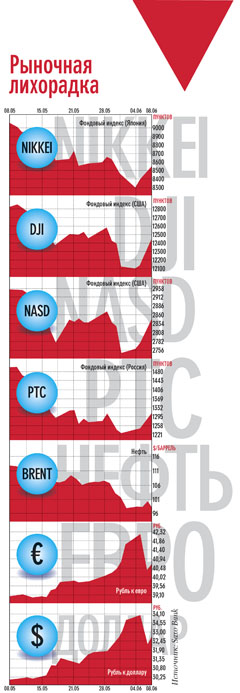
“The dependence of the Russian budget on oil and gas revenues is almost 50%,” recalls Alexander Suslin from the economic expert group. “Even at a price of $ 115, even a small but budget deficit was expected.” Reducing the price of oil by $ 1 per barrel, according to the calculations of the Minister of Finance Anton Siluanov, reduces the budget revenues by 56 billion rubles, and a slowdown in GDP growth by 1% by 150 billion rubles.
Meanwhile, it is time for the world to prepare for low oil and gas prices, CITI economists say. According to their forecasts, in the price range of $ 65–90, oil can fluctuate until the end of this decade: the development of alternative energy, successes in energy conservation and stagnation in developed countries will not allow Barrere to rise in price. In addition, oil quotes are put on information that Saudi Arabia is ready to increase production volumes to create conditions under which the price of a barrel will drop to $ 60. About this with reference to influential sources from Saudi Arabia itself was told by the former main strategist Morgan Stanley, now managing the Head Fund Traxis Partners Barton Biggs. True, domestic analysts pay attention to the peculiar “X Day” in the oil market - July 1. It is from this date that the US oil embargo comes into force against Iran, which, in principle, can throw up oil quotes.
In the meantime, after black gold, industrial metals are shown negative dynamics: aluminum prices have decreased by 1%over the past week. Copper prices have fallen to a minimum over the past five months amid weak statistics from China, which accounts for more than 40% of world demand for metal. The Standard & Poor's GSCI ENCHANCED Commodity index, taking into account the dynamics of prices of 24 types of raw materials, has lost more than 2.5% since the beginning of June and has been trading in the lowest value since October 2011. It is not surprising that the Russian metallurgical industry against this background feels very unimportant. “Rusal” over the first quarter reduced profit by 84%, and its debts increased by 0.7% to $ 11.3 billion.
What's next
Ironically, while oil fell, the Ministry of Finance and the Ministry of Economic Development argued about what rules the price of “black gold” laid out in the budget should be calculated. The Ministry of Finance offers a more conservative option: not to engage in endless fortune -telling on the barrel, but to lay the average oil price over the past 10 years - to smooth out all conceivable fluctuations in oil quotes. According to the Ministry of Finance, the budget 2013 would have to be closed based on the cost of the barrel $ 82. The Ministry of Economic Development does not agree: at this price, all costs of expenses will have to be cut, but to forget about the development. In addition, this price is poorly compatible with trillion investment consumptions of natural monopolies, increasing expenses on the army, law enforcement and social sectors. But if the crisis in Europe is not quickly resolved, it may turn out that the conservative price is from the Ministry of Finance and will be a real forecast of oil value for 2013.
Meanwhile, with a decrease in the price of a barrel to $ 80, the growth of Russian GDP in 2013 will slow down to 1.5%, Bofa Merrill Lynch believes. If Saudi threats come true and oil will fall to $ 60 per barrel, the Russian GDP will decrease by 1% in 2013, and the budget deficit will reach the forecast of Standard & Poor's, 6–8% of GDP.
Such a scenario is fraught with another danger, which is warned by Alexander Suslin from the EEG: trying to close the gaps in the budget, the government can switch to “manual” government management. Pavel Andreev from the BCS notes: “We have enough reserve fund to maintain our obligations for 8-10 months. Then they will release some eurobonds, take money in foreign markets. The worst thing will begin when the money is over to maintain the dollar and giant growing budget payments. ” The expert believes that when a dollar year in the region of 38–40 rubles, “personal Margin Call * * requirements for the mandatory introduction of additional funds will begin to advance. Those who took loans in the currency - a mortgage, car loans and so on. And when collectors come to take housing and cars, the people will go out into the streets. ”
Although the accumulated external debt of Russian companies is now lower than in 2008, in recent years the country has been trapped in high oil prices (see table). The expenditures of the budget and the share of social payments in them have increased, a very high is a non -iftegaz deficiency. That is why the medium -term decrease in oil prices can bury “Putinomics” - hospitalism based on large power and social expenses and creating favorable conditions for business companies close to power.
“If I knew how to predict the course, I would head the Forbes list.” The New Times asked the experts two questions. We suggested that they answer famous financiers with experience in leading positions in the government and the Central Bank 
Sergey Aleksashenko, Head of Macroeconomic Research of the Higher School of Economics, First Deputy Chairman of the Bank of Russia in 1995-1998.
1. Talking about the beginning of a full -scale crisis is now clearly premature. For Russia, the main trouble is that oil price has fallen. But here we are in antiphase with the rest of the developed world. For our economy, focused on the export of hydrocarbons, the higher their price - the better. For most countries that are importers of raw materials, cheaply oil - good that allows their economies to develop more actively. I think that the drop in oil prices up to $ 100 per barrel has already occurred is uncritical for the Russian budget. With this price of oil and the current exchange rate of 33 rubles per dollar, we have a shortage of 1.3–1.5% of GDP by the results of the year. Unpleasant, but this is not a crisis.
2. If I knew how to predict the course, I would head the Forbes list. As an analyst, I can say that the Central Bank still stiffly kept the course within the framework of the corridor he had set: the current plus minus 10%. I have no reason to believe that the Central Bank will move away from this line. Do the conclusions about the future course yourself.

1. At the moment, the crisis does not threaten the Russian economy. The crisis in my understanding is when the “domino effect” happens and the banks begin to pour one by one, and the depositors cover the panic and they massively close their deposits and transfer them to currency. We have nothing like this. This indicates common sense of depositors and bankers. Of course, in the long term there is a threat emanating from Greece. But I do not believe that she will develop into a full -fledged crisis. If only because everyone in Europe see this threat and is ready to resist it. If we talk about Russia, then, probably, we will expect a period of high volatility of markets and low rates of economic growth, but not a collapse of the late 2008 sample.
2. For Russia, it would be optimal to gradual (and not a sharp, provoking panic) reducing the ruble to the dollar in accordance with the same gradual decrease in oil price. Then the competitiveness of our economy would naturally support. But this is an ideal design, and as it will be in practice - this, unfortunately, is unpredictable.

1. Until it has begun. As long as the US Federal Reserve and the European Central Bank adhere to the principle of soft monetary policy and the low price of money, the cost of financial assets will not be significantly reduced, and the price of oil will remain more or less comfortable for the domestic economy. Although the aggravation of the situation under the influence of negative news from Europe may be repeated.
2. The ruble exchange rate under current policy is a derivative of oil price. A sustainable (not one week) reduction in oil price from the current level will lead to a corresponding reduction in the ruble to the dollar. At a stable price of about $ 100 per barrel, as now, there are no objective factors for a new reduction in the ruble against the dollar.

1. The threat of the crisis is obvious: in the coming year there will be a tendency to deteriorate the situation in the entire world economy. According to the IMF forecast, the EU economy awaits a decline by 0.5% - which means that most likely we will see a recession of Eurozone this year. The European recession will hit the USA, and indeed everywhere in the world it will become worse. Including in Russia. If, according to the results of 2011, the growth of our GDP is 4.3%, then the expectations for 2012 of our Ministry of Economy are 3.7%, and the IMF is even lower-3.3%.
2. Reducing the ruble course is economically justified. Over the past ten years, as a result of high oil prices, we have strengthened our national currency by 92%, that is, we almost doubled the barrier before Western imports. The system, when we sell our oil and gas resources, and buy foreign products for the proceeds, is the most powerful factor in Russia to reduce the capabilities of the industrial sector. In addition, an excess amount of money in the economy leads to an increase in inflation and, as a result, the growth of credit rates.
Reply to relate to all overwhelm