
Translated material
Sleight of hand
The great magic of the theater
Sleight of hand. The performance "Great Magic" in the theater. A.S. Pushkin - about how to become happy without changing reality. It is enough to change the attitude towards it
Evgeny Pisarev staged a very Tairov performance, the shadow of Alice Coonen can finally calm down, sit in the hall and brush a tear of tenderness from the porcelain cheek. “Great Magic” based on the play by Eduardo de Filippo is a recognition of love to theatrical art, the most illusory, the most insidious and the most mocking of all arts, in which there is nothing real, except faith in the proposed circumstances. The art of seductive quackery, in which the viewer always remains in fools. And the more cynical the performers, the more sophisticated deception.
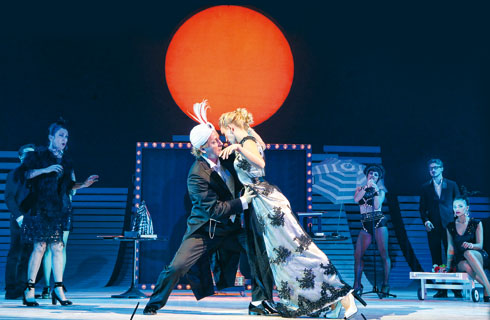
In the scene of the presentation on the resort embankment, actor Viktor Verzhbitsky demonstrates the skills of a professional illusionist Naples and contrasts of Eduardo de Filippo - one of the most theatrical authors, the flesh of the flesh of the theater world, a baby’s child, born almost during rehearsals. He absorbed this elevating deception from the first minutes of his life and served him until old age, becoming the leader of the Italian theater and one of the most popular playwrights in the world. "Great Magic" was once with us in the theater. Vakhtangov with Vladimir Moys and Yuri Yakovlev in the main roles, in the same only translation by Sergey Mikhalkov, and was a funny and touching story about someone else's foreign life, sweet in appearance and difficult, as is usually the case in some sunny Napol-a “city of contrasts”.
"Great Magic" of the theater. Pushkin is deprived of any sociality, perhaps, excessively buffoonery and greatly overloaded with rude peasant humor (apparently, to attract the public). However, it is not at all as simple as it seems. In this performance there is that genuine magic of hidden meanings, second and third plans, which is bewitched no worse than real circus tricks, generously scattered throughout the space. Evgeny Pisarev turned out a spokeswoman, a performance, in which reality and fantasy endlessly replace each other.
"
The game takes possession of the hero as a disease, as a curse, and brings him to that sweet sensation of physical rapture when treatment becomes meaningless
"
Crac, Peak, Feks Jealous and Desp that Kalojero di Spelt (Evgeny Pisarev) falls together with the beautiful wife Marta (Victoria Isakova) on the representation of the visiting magician Otto Marvulia (Viktor Verzhbitsky), whose crown number are movements in time and space. The magician hides Marta in the sarcophagus and promises to return it exactly fifteen minutes later. After this time, the sarcophagus is empty, and the magician gives the casket discouraged to her husband and assures him that his wife is there. “Until you believe it, do not open the box in any case, because if your faith is not so strong, then the box will be empty and you will lose your wife forever.” The whole further life of the deceived Kalojero takes place in this painful struggle of faith with unbelief. The discoveries that the hero makes for himself during this battle with reality change beyond recognition both his personality and the world surrounding him, in which he prefers to stay without releasing a closed box.
And the surrounding world must admit, incredibly beautiful: the artist Zinovy Margolin the dream of the “city of the Sun” brings to perfection. The Italian Riviera flooded with sunlight, it seems, is all saturated with the love, the salty smell of the sea and the velvety moisture of the tanned body. In this Swel City with an endless blue sky and radiant sun, perfectly built men and women live, reminiscent of either Egyptian frescoes, or the life-affirming canvases of Grigory Alexandrov and Leni Rifenshtal. It would seem that nothing can disturb this endless feast of flesh and spirit, but, as they say in another fairy tale, "the mouse ran, waved his tail, the testicle fell and crashed."
The ideal world order of Kalojero brought the gang of rifle rods, thimbles and crooks once overnight: a cynical old man-shuler, his wife of drunkenness and Kloshar's assistant.
Viktor Verzhbitsky, behind whom the role of the “evil wizard” was firmly fixed, in the role of the vagrant magician Otto Marvulia literally shakes the walls of the theater with his seething temperament and a decadent tear. The serious passion with which he gives himself to his beloved business looks comical, as if the provincial tragic of the non -compliance has entered the metropolitan scene in the role of Hamlet. To match him and the companion, not the first youth, a lady with a slightly floating figure and an unsteady gait of the artist of the corps de ballet (fearless and magnificent Vera Voronkov).
The evening performance on the resort embankment turns into a dizzying circus attraction, in which Verzhbitsky demonstrates professional illusionist skills and multi -colored handkerchiefs from guests' pockets, gets no worse than a magician of Akopyan. However, the performance, as expected, ends with an arrogant deception, which is visible to everyone, including the audience in the hall and guests on the stage. To all, except one person, for whom this random plot is twisted.
There are no romantic heroes, nor insidious villains, nor genuine feelings, no real suffering, the main driving force is deception, a trick, an absurd accident, and an attempt to dodge responsibility gives rise to a new reality, which eventually filled all the voids of life.
Evgeny Pisarev, a lover of simple -minded comedies with dressing, turned the Italian trifle into a personal, almost intimate statement. The very topic of the performance turned out to be so for him that the director went on stage in the title role, unexpectedly remembering his acting past. The artist Pisarev looks not just good - rare, working on half -tones, on soft inaudible transitions, inconspicuous internal switching and paradoxes. A person whose worldview turns over before our eyes is frighteningly open and unarmed. And this unprotected, inability to resist other people's will, other people's ambitions and pushes the hero Pisarev into a trap placed by an accidental fraudster.
Pisarev is surprisingly playing the scene of the disappearance of Marta-the moment when the earth leaves under the legs and your whole creature to the ends of the hair instantly fills despair, growing into panic, when in search of support you are ready to cling to anything, albeit into a slipped empty box that accidentally turned out to be nearby. The look with which he looks at this stupid box, in a few moments turns it into a magic vessel, into a philosopher's stone. From now on, this will be the only thing in the world in the existence of which Kalojero will believe. Everything else will be only a game of imagination.
The imaginary world will be filled with meaning and give the hero a whole gamut of feelings and discoveries, which were previously inaccessible to him. He will no longer want to return from the world of beautiful illusions. The game takes possession of the hero as a disease, as a curse, and brings him to that sweet sensation of physical rapture when treatment becomes meaningless. When the patient crosses the line and slyly looks at the doctor on the other side of being.