According to unofficial data, in Moscow alone, about 5 million illegal workers, and throughout Russia there are even more - 20 million. Official data is more modest - only 12 million, of which only 1 million are legal. In October, the Ministry of Health and Social Development reported that this year this year to attract foreign workers increased from 1.8 million to 3.4 million people. They assure that the crisis does not cancel the needs of the Russian Federation for labor migrants. Whether the crisis of migrant workers touched - found the New Times
The intersection of the Moscow Ring Road and the Yaroslavl highway is a well -known place, it is popularly called the “Labor Exchange”. There, in the open air, migrant workers are standing almost round day, mainly from the republics of the former USSR. The young Moldavian Andrei has been shifting from foot to foot for several hours, then, seeing the Mercedes slowed down at the side of the road, along with a dozen such as he runs to the car. But a minute later he returns and lights up: “It was a forehead, he said that a crisis and that more than 5 thousand for the bathroom and the toilet would not give. You can now stand like this for a month, two, three. Well, last week at a construction site I worked in Medvedkovo, but they stopped it and they didn’t pay me money and the guys. ” A few more migrant workers gather around. The phrase about the “world financial crisis” will not surprise any of them.
“The trend at the moment is as follows: if earlier employers came up with different motives for the dismissal of people without a salary, now a link to the financial crisis is increasingly arising,” says Gavhar Dzhuraev, chairman of the Center for Assistance to Labor Migrants Migration and Law. - But we do not feel the tangible influence of the crisis itself on the shadow market, they just have another reason to rob their slaves. However, this will inevitably influence the legal market, here they will simply be forced to dismiss. ”
“The crisis will hit the less protected and disenfranchised migrant workers,” said Rinat Ziganshin, an employee of the department of integrated international relations of the Institute of Oriental Studies of the Russian Academy of Sciences. - They will be dismissed, reduced the salary. The flow of these people into crime is also likely ” 1 .
A bag of flour
“I threw one job and for several months on another,” says Alim, who is engaged in the interior decoration of the premises. - In one month they paid me, there was still two more. Now I work, look, they will pay or not. They promise, I don't know. We trust for now. If anything, let's go to another place. There is not enough money. A friend works for me, in the last two months the flour cannot earn a bag - to send a family. ”
“If the workers do not agree to these pennies, the bosses shout: you don’t want it, then now we’ll call the police. And we are all, as always, scatter, ”says another worker from the street“ Labor Exchange ”named Maruf.
In the meantime, according to Dzhuraeva, the number of people who find themselves on the street is growing: “Some of them actually go into crime, because they find themselves in a hopeless position. Some part remains without work permission and falls into the field of view of the police, they are prescribed a fine with expulsion, but they cannot pay it, so their passports remain in the police, and people become half-bombers and already absolutely illegal immigrants. These are people without documents at all, they have no legal opportunity to earn at least to return home. Therefore, they either get from compatriots, or also go to crimes. ”
As several workers from the Yaroslavl highway admitted, if they are caught illegal, the police requires a fine of up to 5 thousand rubles from them. Now, they say to go home, some of their acquaintances-builders began to steal mobile phones. According to Dzhuraeva, due to the crisis, it is possible to increase the number of employers who consciously do not want to legalize migrant workers, since legalization can hit their income.
Buildings on the shoulder blades
Many construction companies in Moscow are now freezing their facilities. The open letter of the Association of the Builders of Russia about this industry says that it "lies on the shoulder blades." At the same time, 6.5 million migrant workers are busy in construction.
“Construction is the main sphere of employment of migrants,” says Nikita Mkrtchyan, a specialist in the Migration Institute of Demography of HSE. -Many experts are now scaring that people will be on the street, go along the porches, will rob people, but I think that the majority will simply not come to Russia or go to some other country. And those who are already here, they also basically come for a short while: they worked here for six months, handed over the facility, returned to their homeland, then they called them - and they arrived again. And those who have been living here for years are now less. Some of them, of course, will have to leave, and someone will switch to other areas of activity. ” 37-year-old Tajik Dilshod for two years in Moscow. He used to be a bridge with a stone, but since September he has been engaged in a private carrier. The dilshod has no his car, I took the old “threek” from the neighbor by proxy, now he should regularly give him part of the revenue. Dilshod says that he decided to escape from construction to transport precisely because of the financial crisis when he heard about him from the same neighbor. “There is no more money in construction. However, my passengers also become greeder every day: no one has enough money, ”he concludes.
Reorientation
By the way, according to the observations of experts, some employers, in connection with the crisis, on the contrary, decided to reorient with cheaper labor: “Now women from Penza called me,” says Gavhar Dzhuraeva. - They were recently specially brought from Tajikistan to a company that is engaged in sewing bags. From September 24 they have been working. Their schedule is from 7 a.m. to the 21st, half an hour for lunch. They pay them from 1.5 thousand to 5 thousand rubles. ”
According to Nikita Mkrtchyan, the number of migrants can significantly grow in large retail chains: “Gigant network will now decide to reduce costs. Therefore, it is possible that migrants to some extent will replace Russians in these areas of activity-in transport and trade-due to the relatively low price of their labor. ”
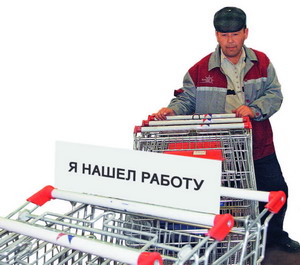
“I don't want to go into trade,” says the builder Mamasaid. - I thought at first. But the acquaintance called me, said that he, too, has not paid salaries there for three months. And he collects carts there. I don’t know where to go now. This crisis is everywhere, everywhere. I am now following the dollar’s exchange rate, although I don’t know what I have from him at all. ”
_______________
1 The New Times studied in detail the problems of legal and illegal migrant workers from the former republics of the USSR to No. 9 of April 9, 2007.