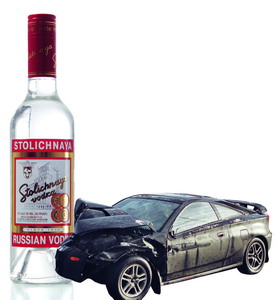
The proposal that sounded was to deprive the driver’s freedom for one that he got into the car in a state of intoxication, has not yet passed. But for an accident “with consequences”, a drunk will sit longer than a sober
The latest amendments made in the Code of Administrative Offenses - the Code of Administrative Offenses have tightened the punishment for those who allows themselves to drive a vehicle in a state of alcohol or drug intoxication 1 . It should be noted that the number of accidents, the participants of which were drunken drivers, is gradually declining: according to the State traffic inspectorate, from January to June of the current year 1356 drivers were detained for a drunk condition, however, the number of accidents due to drunk drivers decreased by 47% compared to the same period of 2007. Nevertheless, the Russian government decided to amend Article 264 of the Criminal Code of the Russian Federation, according to which the state of intoxication of the driver will be qualified as a separate corpus delicti.
So it was already
According to the Criminal Code of the Russian Federation, a sober and drunk driver for an accident with serious consequences is responsible the same. The amendments to the Criminal Code proposed last week by the Presidium of the Government, after approval by parliament, can significantly reduce the path from the driver's seat to prison bunks and increase the deadline for a drunken participant in the accident. This is not the know-how of Putin’s government, but a return to the norms of the Soviet period, when intoxication was considered an aggravating circumstance.
For an accident committed due to the fault of a drunken motorist, it is proposed to establish a non -alternative sanction in the form of imprisonment of up to three years with a mandatory deprivation of a driver’s license for the same time if the victims were harmful. If, as a result of the accident, a person has died, then the maximum term of imprisonment will increase from the current five to seven years, and at the death of two or more persons - from seven to nine years. Thus, the real term will have to serve on the bunks not only to those who, driving the car while intoxicated, have caused serious harm to people's health, but also to those who have harmed light or moderate severity.
Support group
According to the statistics given by the Minister of Internal Affairs of the Russian Federation, Rashid Nurgaliev, in the first six months of 2008, about 90.6 thousand accidents occurred in Russia, in which more than 11.7 thousand citizens were killed, and another 111.5 thousand were injured. According to the minister, drunken drivers caused 5.5 thousand accidents (that is, about 6%). Nurgaliev believes that "a person who used drugs or drank before sitting behind the wheel is already a criminal by definition." That is why such severe measures are proposed so that lovers to drive “under a fly” do not try to justify their behavior with some mythical information that the new edition of the Code of Administrative Offenses allows you to drink while driving, but only within the established norm 2 .
Law -abiding motorists also advocate the strict punishment of drivers who abuse alcohol. Nobody wants to collide on the road with a person in feeding, and even more frankly drunk, whose inadequate behavior can lead to very grave consequences.
On the side of the "tightening" and the world practice of persecution for drunkenness on the road. If in Russia, criminal liability is still provided for an accident with serious consequences, then in the UK, a driver who has been driving into a drunk form can be landed for six months - provided that he did not fall into an accident. And if an accident occurred due to his fault, especially with the victims, then he faces a prison conclusion for up to 14 years and a fine of unlimited size. In Germany, a drunken driver who has an accident is threatened with either a great fine or imprisonment. In Israel for drunk driving, the driver loses his rights for at least two years - if there are no special mitigating circumstances. In addition, criminal liability was established for refusing to undergo a check for alcohol intoxication - deprivation of rights up to two years, a large fine and conditional or actual imprisonment. In the United States, an accident that entailed the death of the victim, a drunken driver may deprive of freedom for a long time - up to 30 years. And in Thailand for drunk driving, which entailed severe consequences, the driver can face the death penalty.
Voices of skeptics
But human rights activists who are by no means sure that tightening of sanctions will automatically entail a decrease in the number of offenses. They suggest not to forget that the back of the rigidity of the law will certainly be the growth of the “bribe stability” of the traffic police. There are also circumstances of the legal properties: advocate for the humanization of domestic legislation, the State Duma several years ago canceled criminal liability for causing harmful harmfulness. This kind of offense now falls only under the Code of Administrative Offenses. It turns out, now it's time to return everything to your own circle? It is also reminded that the indictment in the courts did not have a past.
Opponents of human rights activists claim that the introduction of administrative arrest has already stopped many, warned into drunk driving. At the same time, even the most zealous supporters of toughening responsibility for gross violations of traffic rules do not deny obvious facts - the amount of bribes that traffic police inspectors from not quite sober drivers have increased significantly. More recently, a person who did not get into an accident, but simply stopped for drunken driving, could avoid drawing up an official protocol, facilitating his wallet for 30-50 thousand rubles. Now, according to expert estimates, the amount of renovation can be comparable to the cost of the car itself.
The law is not for everyone
The government is confident that the State Duma will not only support the amendments proposed by the Presidium, but will also accept them in the fall of this year. But even among the deputies of the State Duma that make up the parliamentary majority, there is no complete unity in this matter. Many recall that there is a very painful Russian problem - a selective approach to violators of the law. The rigidity of the law is still compensated by the inanimacy of its execution, especially if the offender is a politician, police officer or some famous person, as well as their wives and children.
“When the son of a traffic police for a booze sits down, then we will be able to say that the law is really fulfilled in a row”, the famous lawyer Andrei Makarov commented on the new legislative proposals of the Government of the Government of the Government. And the leader of the LDPR faction in the State Duma Igor Lebedev proposed to generally cancel administrative arrest for motorists and replace it with a fine of 3 to 5 thousand rubles.
In 2007, 233,800 accidents were recorded in Russia, in which over 33 thousand people died. This is almost as much as in the entire European Union, but there is a population of 3.5 times more than in the Russian Federation, and the number of cars is 6 times more.
_______________
1 The first part of the amendments to the Code of Administrative Offenses entered into force on August 11, 2007, the second - from January 1, 2008, the third - from July 1, 2008.
2 In fact, the notorious 0.3 ppm is a value that reflects the possible amount of alcohol in the blood of a completely sober person, taking into account the permissible error of the measuring device - the alcohol (see The New Times No. 28, July 14, 2008).