90 years ago, the First World War ended. Why it turned out to be “unknown”, unusual and caused the unprecedented tightening of customs, which, in turn, led to severe political consequences - analyzed The New Times
The First World War became a “unknown” war for Russia. Her victims and veterans are remembered much less than the veterans of another war, even more terrible and large -scale, which happened a quarter of a century later. The Great Patriotic War, and before it, the revolution and civil war obscured in our historical consciousness for more than three years of military efforts, victories and defeats of Doboloshevik Russia, for which the First World War became a swan song. This is probably unfair to the memory of the dead, but psychologically explainable: they prefer not to remember the lost wars too often. And the First World War was lost cleanly, ending for Russia (already under the rule of the Bolsheviks) the “obscene” Brest-Lithuanian world. He gave into the hands of Germany, Austria-Hungary and their allies the entire western part of the collapsed Russian Empire, from the Baltic states to the mouth of the Don, as well as the Transcaucasia. For a short time: in just a few months, the Brest winners were waiting for a final defeat in the West.
That is why, in the West, primarily in France and Britain, the memory of the First World War "is more lively of all the living." November 11, Armistice - the ceasefire Day of 1918, is widely celebrated now. Almost in every village there is a monument to the fallen in that war, which, unlike the Second World War, is still called the Great War. For the Russians, the main victory is May 1945, the Red Banner over Berlin. For the French, British and residents of the former dominions of the British Empire, this, with all the reservations, November 1918, for the first time in 4 years brought silence to the bloody fields of the Flanders, Balkans, Northern Italy ...
Unusual war
However, the question of the winners of the First World War is not as simple as it seems. And the point is not only in the arithmetic of deaths and injuries, according to which the winners lost significantly more than the vanquished. 1 The case is both in the features of the war itself, and in its consequences, equally catastrophic for the victorious and losers.
The First World War was in many respects an unusual war. Firstly, this was the rare case when the first emotional reaction of millions of people to the news of the declaration of war was a violent joy. After all, no one assumed what a massacre would turn into a conflict, the beginning of which was laid by the shots of Gavrila of the principle in Saraev on June 28, 1914. Neither before nor after that many people perceived the beginning of the war with such enthusiasm as crowds of excited inhabitants who gathered in early August 1914 in the squares of Berlin and Vienna, Paris and St. Petersburg. Unless the British minister Eduard Gray prophetically remarked on the day of his country entered the war, that "the light will go out throughout Europe."
Secondly, the war arose, as it were, from the intricacies of international treaties and coalitions. Because of this, the Club of mutual obligations Sarajev’s shots, breaking the life of the Austrian Archduke Franz Ferdinand, caused a chain diplomatic, and then a military reaction, as a result of which the two coalitions of the great powers came together in a four-year battle. To the question of who, in fact, is to blame for the unleashing of the First World War, there is still no clear answer. So far, the winners wrote the story, in accordance with the famous Maxim, the main culprit was customary to consider Germany. But recently, historians have found grounds for mitigating the verdict: in the German tops on the decisive days of the summer of 1914 there was no less oscillations and fear of a possible catastrophe than in the leadership of other powers. It is almost impossible to determine which of the four countries-Germany, Russia, Austria-Hungary or Serbia, who played an active role during the July crisis of 1914-lies the greatest share of guilt for what happened.
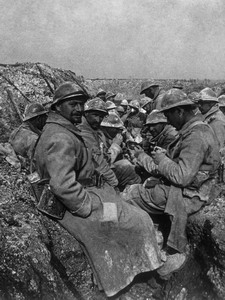
Thirdly, from a military point of view, the First World War was the case when the shield was stronger than the sword, the defense prevailed over the offensive. This concerned primarily the Western Front, where the exhausting and insanely bloody positional war was going on - on such a scale, mankind did not know it before or after 1914–1918. Incredible physical and mental pressure, under the press of which were millions of German, French, British, Austrian and Italians ”The First World War Iedlessly fierce European society, the habit of violence and blood appeared among millions of people,“ later, was reflected in literature (it was enough to recall “on the Western Front without Change” by Erich Maria Remarque). A peculiar saga about the First World War, a sad legend about many ruined lives arose. About those who survived, but remained forever spiritually and mentally crippled, replenishing the ranks of the “lost generation” of the 1920s. And about those who remained on the Battle Fields overgrown with red poppies. These poppies became a symbol of the Great War, and Flanders were immortalized in the same poem, written after the death of a best friend, Canadian lieutenant colonel, military doctor John McKray:
We Are the Dead. Short Days AGO
We Lved, Felt Dawn, Saw Sunset Glow,
Loved, and Were Loved, and Now We Lie
In Flanders Fields.
(We are dead. Until recently
We lived, met dawn, saw the game of sunset,
Loved and were loved, and now we are lying
On the fields of Flanders.)
A victory that was not
However, the suffering of the soldiers had the opposite side. As he writes, not afraid to seem cynical, the British historian Niall Ferguson, "people would not fight if they had not developed a habit of fighting, and if they had not liked to fight to some extent." The anti -war movement in all the warring countries in 1914-1918 was very weak. In addition to the revolution in Russia, which led to the decomposition of the Russian army, and several rapidly suppressed attempts to rebellion in the French troops in 1917, there were no cases of mass disobedience of military personnel at the front. Millions of people disciplined, often and enthusiastically went to death and disappeared into an unprecedented military meat grinder. The same poem “On the fields of Flanders”, mourning the dead, ends with their call to the living - “pick up the fallen torch”, and continue the fight against the enemy.
The first world in an unprecedented way, fierce European society, the habit of violence and blood appeared among millions of people, and in this sense the great war was also unique. Hundreds of thousands of veterans felt uncomfortable in the post-war world not only for socio-economic, but also for psychological reasons. It is not surprising that many of these people soon replenished the ranks of the fascist, radical-nationalist and communist parties, which returned them the feeling of a soldier's brotherhood and collectivism, once known at the front. Mass bitterness and violence of unprecedented scale, generated by the First World War, spilled into the sphere of politics, internal and external. Democracy, undertaken by an economic crisis, turned out to be powerless before this threat. Totalitarian dictatorships and the Second World War became the logical consequence of the Great War.
The First World War had its own ideological justification, primarily from the Western powers. After the February Revolution in Russia, when a short -lived democratic regime replaced the tsarism, the propaganda of the Entente began to represent the war as a battle of democracies against the militaristic reactionary monarchies, the struggle for the liberation of the oppressed peoples from the power of the rotten empires and, finally, the “war for the end of all wars”, since the result of the victory of the coalition of the democratic powers had to become Fair world order.
In fact, everything turned out to be different. Versailles and other peace treaties that summed up the Great War were compiled on the principle of “woe to the defeated”. The states that arose on the site of the decaying empires, primarily Austria-Hungary, turned out to be weak and also conflict among themselves. The main formal winner, France, came out of the war a weakened and paradoxically devoid of a fighting spirit, which after only 20 years did not allow her to resist the German revenge. The humiliation, experienced by the Germans, who, contrary to all diplomatic traditions, dictated the conditions of the world (even worse, by the way, Vengram, which lost 70% of the historical territory of their state) became one of the main factors that led Hitler to power.
The Great War did not solve a single serious European problem and created many new ones. The continuation of the conflict was, if not inevitable, it was very likely - and in 1939 it happened. As a result, Europe lost, which has lost millions of lives and divided by mutual hatred. There were no winners.
_______________
1 powers of the Entente lost 5.5 million people killed, almost 13 million wounded and over 4 million missing; Germany and its allies are less than 4.5 million killed, more than 8 million wounded and more than 3.5 million missing.