
Translated material
Student immunity
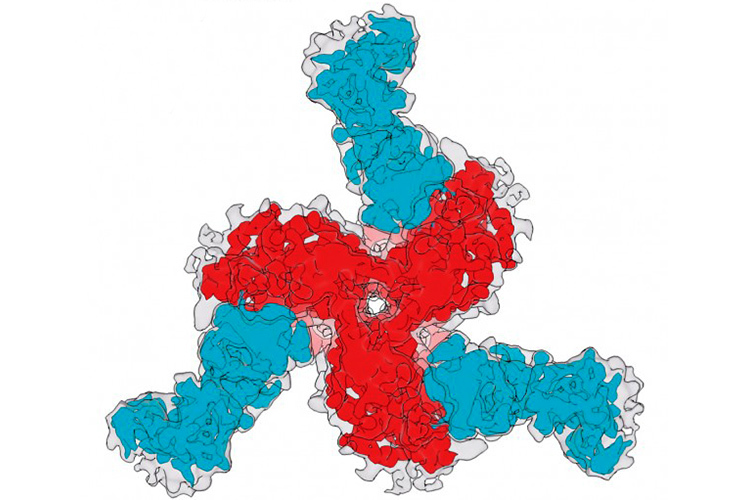
As I remember myself in scientific journalism, I hear so much messages such as “tested medicine for AIDS” or “scientists create a vaccine for HIV”. He himself wrote dozens of such news. Then he began to pay attention only to overview publications in serious magazines. I think that many colleagues are familiar with this feeling: at some point you understand that this is again not that, there is no complete victory and in the coming years will not be, you can look at the topic in a very eye. And in vain: a laboratory mole is swarming slowly, but true, the means to fight the human immunodeficiency virus are spent huge, which means that sooner or later some breakthrough will happen. There are two strategies: to improve and improve medicines, antiretroviral therapy, and finally create a vaccine that makes a person immune to infection.
The other day, in two serious magazines, Science and Cell , three articles appeared at once on the creation of a prototype of a vaccine based on a new principle - using the so -called neutralizing antibodies of a wide range of operations. No, we are not talking about the fact that tomorrow there will be a finished vaccine and humanity will breathe calmly. This is still far away. But scientists with enviable perseverance repeat that a new approach is based on a rational calculation, and not on the method of blind poke, which are usually created by vaccines. It turns out that with HIV you can only. Why?
Because HIV is a rather unusual thing. The point is not that it attacks just the cells of the immune system that are designed to protect against such diseases. The fact is that he has two very uncomfortable properties at once. Firstly, the viral proteins in the most vulnerable parts are closed by a dense net of carbohydrates-the so-called glycan shield, under which it is difficult to get antibodies, the immune system almost does not “see” most of the virus. Secondly, the virus mutates at a high speed both inside the body and in general in the population. It turns out that as soon as the immune system adapts to defend himself, so immediately this protection becomes useless against the mutated virus.
In some infected people, the immune system still knows how to find holes in viral protection and create a universal weapon acting on many variants of the virus.
Well, there are still a number of seemingly technical problems that greatly complicate their life researchers. For example, there is no good laboratory model - an animal on which it would be convenient to work, infect it with a virus and study how useful a vaccine is. Another problem: there is not a single documented fact of the recovery of an infected person, which usually allows you to see, due to which he nevertheless recovered ...
As a result, we have something: 30-year pandemia with 70 million infected, of which 39 million have already died. Moreover, this is the only pandemic of the disease today, which is guaranteed to end with death, if you do not give the patient the drugs. Now it is recognized that it is impossible to stop it with medicines, you need a vaccine.
And in the last works that I said about at the beginning, the question is raised: what should be the vaccine? As much is known about the virus as, probably, about any other, so the answer is not difficult to formulate. It should be non -specific, that is, act against all variations of the virus, and it must configure the immune system so that it “crawls” under the glycan shield.
What is a vaccine? This is some kind of substance that encourages the immune system to produce antibodies against the virus. Usually these are some parts of the virus, proteins, or a whole inactivated virus. When we vaccinate, the immune system perceives it as an invasion, learns to produce neutralizing antibodies and remembers such a skill for a long time. Sometimes for life. To do this, there are V-cells of memory-one of the many varieties of lymphocytes. Actually, in the 90s of the last century, it was this approach that was tried with HIV: it did not work. Memory cells were formed, but against a specific variety of the virus - and he, as already mentioned, mutates with great speed. We tried a couple of approaches, some vaccines even brought to clinical trials, but almost all of them ended in complete failure. Small success-with 30 percent protection-was in 2009, but this is not enough to stop the pandemic.
If you just introduce pieces of the virus, even very specific ones that attack just such antibodies, then nothing will work.
However, not everything is so bad. Now the very antibodies of a wide range of operations enter the stage. They were discovered back in the 90s in patients who had long wore a virus, but not sick with AIDS. It turned out that some infected people still know how to find holes in viral protection and create a universal weapon acting on many variants of the virus. The weapon itself is also antibodies protein molecules, but they are born in the cells of lymphocytes, which have mutated many times. This process takes two years or more, and, unfortunately, the weapon appears too late in too small quantities. But who said that it is impossible to artificially spur the creation of such lymphocytes, that is, immunize the body?
About ten years ago, with the advent of new methods in biological science, the antibodies of a wide range of action began to open in dozens and immediately began to try to stimulate their production in animal models. Fresh work in Science and Cell is about this. For the first time, it became clear that if you simply introduce pieces of the virus, even very specific ones that attack just such antibodies, nothing would work. Non-absorbing predecessor cells do not see them and, accordingly, do not remember them, and there are still no mutating. But it turned out that it is possible to stimulate the reproduction of predecessor cells with completely different antibodies. Oh yes, the multiplying cells are invalid against HIV, but they can be made effective, having carried out through repeated vaccination by already specific immunogens. A picture of multi -stage vaccination is emerging, when doctors will meaningfully grow and teach the necessary cells. At this point, science is still located.
It is difficult to say how successful a new approach will be. This will turn out in a few years, then for years to test the vaccine. However, do not say that there is no progress. For thirty years of studying the virus, science has advanced very far. Take the same antiretroviral therapy that actually translated the disease into the category of chronic diseases, now infected can live up to 80 years. Another thing is that this showed how much the epidemic itself is a social phenomenon: now it is raging in those countries where a bad healthcare system or barbaric ideas of the population about its health. We have, for example.
But in general, everything is fine. HIV is just a virus, which means they will cope with it. Humanity is generally quite fiercely in the last hundred years to treat infectious diseases. Some of them-as the OSPU-completely rubbed the planet from the face, some brought to insignificant incidents.
Author - Deputy editor -in -chief of the magazine "Cat Schrödingra"