
Translated material
Boarding school | Colta.ru
Sergey Zhadan is a sign figure in modern Ukrainian culture: a poet, prose writer, rock musician, organizer of literary festivals and media forums, a person known for his consistent civil position.
Readers of the Colt are already familiar with the prose of Sergei Zhadan . His new novel “Cordate” was published in Ukrainian just the other day. This book is a cut of life of front -line Ukraine. Her heroes are people trying to escape from the war. On its pages there are fighters protecting their land, people with weapons without identification marks and many, many others-refugees, looters, prostitutes ... And, of course, pain, suffering, fortitude in extreme situations of human life.
Elena Marinicheva, translator
The moon floats across the sky towards the night, leaving the void along. It is necessary to go, Pasha recalls, you need to get home. The spring is sharply pressed into the heart, drives forward, reminds him of the time, which is becoming less. Water in puddles freezes, covered with sharp crust. Malo [1] slides between the wall and the minibus, Pasha has been leaning after him, they follow the street further, between the military, which are becoming more and more: the sunken, inflamed eyes, dry mouths and screams - sharp, loud, irritated - with the help of which they try to understand each other. A new transport drives up - buses beaten with fragments, cars, crushed by clay, trucks with combat slogans on the sides, more and more fighters crawl out of the cabins, jump out of the bodies, get out of broken windows, all the smell of smoke, the smell of sweat and gunpowder becomes more difficult to make ahead, bypassing the frozen figures. But Pasha makes his way, persistently pushes, realizing that it would be good to feed and leave somewhere in warmth and you would need to find transport and try to get home. Because if he, Pasha, can push here for some time, in a wet wind, under the yellow moon, then how small is enough-no one knows, and it would be better not to take risks, not to experience fate. After all, if with the small one, God forbid, now something will begin again-it is simply not clear where to run and whom to call. Therefore, it is best to get out of here, find a taxi, go home, forget all this and not remember. Can I forget all this? - Pasha asks himself. Of course, you can, answers yourself. Certainly. I will forget everything, Pasha convinces himself, and Malaya will forget too. He does not need to remember all this, to him the smell of sulfur and raw human meat, he should not remember this dirt under his nails. A person should not keep in memory so much fear and anger. How to live with this later? He will forget everything, everything will be in order with him, he will forget about the boarding school, about orphanhood, about the feeling with which you wake up in a locked black basement. Better remembers something good that does not cause hatred and despair. The smell of the house, or the smell of trees in the yard, or the smell of the thaw - the January, long, smelling of the river. He will remember the thaw, Pasha assures himself, it will certainly be. No blood, no metal. And the stronger he convinces himself, the more clearly and confidently understands: nothing like that, no one will forget anything, no one will leave anything in the past, and small, no matter what happens to him, will drag these memories behind the stones, and this smell of torn skin and salty male tears will pursue him until the end of the days, and the shadow of the boarding school will stand behind him, wherever he would stand behind him. It was, no matter what sunny places it ended up. And the food for him will now give his whole life a boarding canteen, and his dreams will be full of orphan voices, and women will remind him of his girlfriends from the bunker - painted and tearful, and he will not do anything about it, and no one will help him. And the only thing that can be done is to drag him home now, atone, drink sweet tea and put it to sleep. Let him sleep, let him sleep, how much he can, how much he will be to sleep, how many dreams will not leave him. Tomorrow everything will be different, tomorrow everything will be as before: measured days at home, where everyone is engaged in his own, where everything is in their places, where there is nothing superfluous and nothing unnecessary. In the morning, filled with home chores, work that you get used to, like the usual clothes: does not press, does not interfere, worn, while rushing around. Quiet evenings, dark nights. So much in all this, it turns out, joy, so much warmth. It was worth getting here in the middle of hell to feel how much you had and how much you lost. You just need to return home as soon as possible, finally stop the walking in circles of someone else's trouble, rather home, rather. Pasha accelerates a step and notices that the military also come to some movement, break off, run, overtaking them, shouting something into black air. Pasha immediately covers panic. What is, thinks what happened, where are they all? And he, too, runs after everyone, trying to hold the small by the hand. Everyone runs wet, irritated by the crowd, more and more nervously pushing the front backs and working with the elbows. They run out onto the square and run into a wall of dark backs, there is nowhere to run, the area is clogged by the people. The hospital, recalls Pasha, the city hospital - a two -story building made of red brick. The windows are beaten with fragments and covered with a film. The windows glow at night, from afar the hospital looks like a liner, slowly, slowly, going to the bottom. The crowd swaying like a reeds in the wind, Pasha tries to get out, but those that came up later have a push from behind, press them, push them forward. And then KamAZ without windshield, with an open body, drives up on the side, and the driver screams something fiercely, so fiercely that the crowd diverges, led back, giving way to the road. “KamAZ” crawls through the crowd, drives closer to the hospital building, the crowd is approaching again, Pasha with small pushes forward, directly to the car. Four with a stretcher run out of the hospital and break through to the body, repel those who are closer, they push in response, scream, quarrel, but do not diverge, as if waiting for something important. Someone lowers an iron side-and it turns out that the car is loaded with wounded and how many of them are there-not to count. Pasha stands very close, looks at the wet bent iron, water mixed with blood, looks at the boots, just at the eye level, black soles lined with iron, the wounded lie right on the metal floor, on cold metal. Someone jumps upstairs, accept, screams, accept, b ****, do not sleep! - And Pasha understands that they are shouting to him.
- What? - asks. - What's happened?
- Hold it! - shout to him from above. - B ****, hold it.
- How?! - Pasha panic.
- By the legs, b ****! - shout to him.
Pasha sharply drops his backpack, reports to the small one.
- Wait for me here! Understood? Wait!
Malaya nods his head, they say, come on, don’t worry, I'm here. Pasha picks up what lies closer to him, pulls the berets.
- Where?! - Hears from above. - Where, b ****! Not that! Other! Take the other! Living!
At first, Pasha does not understand what he was told about, and suddenly he comes to him. He abruptly lets the Berets, they knock muffledly on the iron floor. He looks mechanically on his hands if there is blood. But they scream again from above:
- Come on! - Shouting. - X*are you sleeping?!
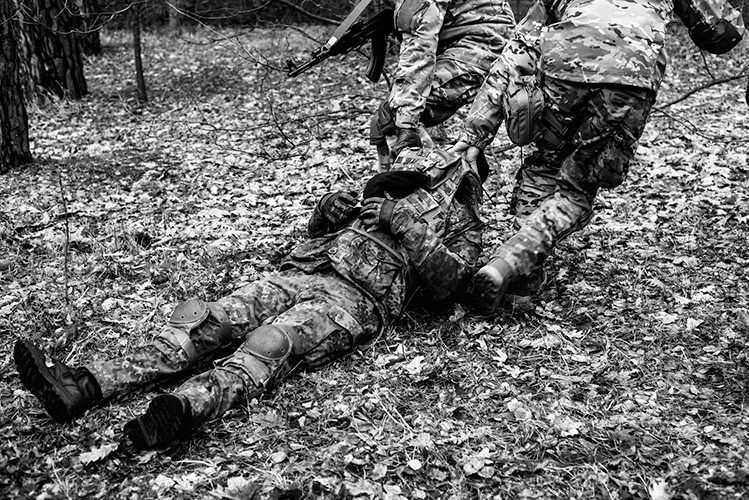
Pasha picks up other berets, drags on himself. The one who shouted to him from above was a young fat nurse in camouflage and armor, with a cross from red adhesive tape-pulls the wounded by the shoulders, someone immediately intercepts him from below. The body falls down, in the arms of the fighters, Pasha holds tightly by the berets, preventing them from slipping away. It is uncomfortable, hard, closely, the crowd swaying, but no one leaves, you have to stomp in the legs, step by step by step to the hospital. Pasha no longer sees small, but notices how the next wounded is lowered from the body down. “Road! - shout ahead. - Road, b ****! " Step by step move forward, carry this alive still burden, rushing to illuminated hospital steps, rise along them. Someone opens the door, faster, screams, here, faster. Pasha suffocates, almost falling on the steps, does not have time behind the front. Two tall fighters drag the wounded, grabbing him under his arms, Pasha runs, bent, behind him, holding his boots. The corridor of the hospital is also filled with the military. Heat, smells of dirty clothes and machine oil. Wet flooring is cowing with clay color of blood. The hospital is poor, non -combined, the walls are hung with posters drawn by hand. The windows are clogged with plywood shields, on massive batteries the floor rags dry. In the corridor along the walls there are a stretcher. On the nearby to the door lies an elderly military - naked to the waist, a dirty body, not washing the skin for a long time, a bloody dressing in the heart area, worn shoes, torn camouflage pants, eyes are closed: probably sleeping. Or pretends to be sleeping. Near the stretcher on the floor there is a bloody bucket, next to the boxes with a humanitarian: it seems that they brought, put and forgot. They drag the body further, by another stretcher, on which a military man lies, covered with a jacket. Pasha is looking closely with fear: he breathes, does not breathe - she does not have time to understand, move on, one of the front toe of the boot opens the door, drag the body into the ward - six beds, not a single free one, two wounded lie right in the middle of the room on blankets. In the corner, someone groans long, a woman hangs over him in a wet coat, whispers something, calms, cries.
- Further! - the front screams, turning around and intercepting the wounded by the other hand. -Come on, come on! - Fiercely screams at Pasha.
Pasha bays away without releasing the wounded. Cannot open the door, is suspended.
- Faster! - shout to him. - Faster, b ****!
Turns, lets go of one leg, opens the door. They get back into the corridor, where it doesn’t know, stands, stands, looks around, and they scream again in the back: go ahead, shout, come on! X*did you get up?! And Pasha runs along the corridor, drags the wounded, feels fiercely hissing in his back, runs, not knowing where to stop. He runs to the next room, hits the door from the toe, looks inside. But there are also bodies on the floor-dirty, exhausted, bloody-lie on mattresses, on blankets, on pea jackets, nowhere to step, so he runs on, along a tight corridor, where someone supports the wall, someone is doing his own, sitting on the floor, they bandage his head, no one pays attention to the pasha, and he paves his chest, he paves the way further and suddenly sees ahead of the bad. Man in a white robe. The doctor understands, for sure, a doctor.
- Hey! - Screaming. - Hey! Dear!
Dear looks around - and Pasha even sucks: a white medical robe floods with blood, and the doctor’s view is not “respected” at all, well, just no “respected”. But Pasha looks at him and repeats:
- Where is it, dear? - Baking in mind his wounded.
And the doctor - it is noticeable how tired, exhausted, even to imagine it is scary when I slept for the last time. And it was obviously going to hide somewhere in a corner and migrate, wait out, sleep at least twenty minutes. And he looks at Pasha with poorly hidden irritation. Yes, which is poorly hidden there - he looks at him like shit. And he is ready to pronounce all this, Pasha, as if suddenly this is “respected”, and something switches him, and he really holds like a respected one, even straightens his bloody, rubs his bristle with his hand and asks: he asks:
- Heavy?
“Normal,” Pasha replies vigorously. - Seventy kilograms.
“Damn,” the respected says. “I ask what's wrong with him?” Serious something? Heavy?
- Dear! - Those who hold the wounded by the shoulders begin to scream. - B ****, dear! Do you not see?! He will die now! Where is it?!
The doctor looks at Pasha by the shoulders, sees those two, quickly thinks something.
- Let's! - speaks. - Behind me!
He speaks calmly, balanced, unlike those two who, along with Pasha, drag the body. And they, too, having heard that he does not hysteria, fall silent, do not shout, they say, come on, respected, bankui. And he goes along the corridor, and all the wounded, all dirty and stunned part in front of him, pass it, expressing his respect to him, respected. And respected in response, too, nods to someone, someone claps on the shoulder, greets someone's hand with someone. His handle is small, dry, the bald head is wide, shiny, well -groomed. The very thin, mobile, hunched over. The robe hangs on it, like on a hanger. The boots are smeared with street mud, and he is all dirty: blood, iodine, black earth. It looks like a passenger that takes a third day at the station, sleeps on chairs and feeds on fast food, but gets home - and everything will be fine: it will be washed out, cleaned, and will sleep. Now the main thing is to solve something with another body, prevent him from dying, trying to pull him out.
Dear passes along the corridor to the end, opens up some inconspicuous door painted with green paint: bring, nods. Everyone hastily pushes into the room and understands that they are in the dining room: several tables, chairs, a window from which, obviously, the patients should give out something edible. And the smell of boiled food, stagnant dirty dishes. Somewhere I recently saw this, Pasha recalls, somewhere it was recently. It seems that I continue to walk in a circle - from canteen to canteen, from shelter to shelter, from boarding school to boarding school.
- B ****, what is it? - shouts one of those who stand at Pasha behind. - What is this?
But the respected does not listen, he is already calling somewhere. And he, a bitch, is a bitch, Pasha thinks, and someone is waiting for his call, because he immediately begins to give instructions to the phone, talks with some Lida, explains something, tells something not to hesitate, advises not to doubt. After turning off the phone and turns to the team.
- Why are you holding it? - He speaks irritably, but quietly, as if saving forces for the future scandal. - Come on, put it.
- Where? “No one understands him.”
- On the tables, where! - finally explodes respected. Still, his nerves are not iron.
- How to tables? - one of those who carried the wounded, a low fat man with a gray hedgehog on a large skull, bewildered. - Maybe it is in the operating room?
“You will get to the operating room two days later,” the respected responds coldly, picking himself together again. - Put, I said.
And they move two tables together and carefully lower the fighter on them. And then a nurse with sheets and some medical instruments runs into the dining room. The fighter is carefully raised, stretching the sheet under it. Dear takes out the scissors and begins to cut a sweater on it-from the throat to the stomach, as if it cut out some kind of applications. At some point, he stops, raises his eyes to the fat man, then at his partner, then on Pasha. On Pasha lingers a look.
“You,” he says firmly and dryly, as if reporting something unpleasant, but inevitable. - You, hold here.
And shows to the sweater. Pasha grabs the sweater, pulls on himself.
“Correctly,” the doctor tells. - Blood has dried up. Now it will hurt.
Moreover, he speaks about this to the wounded man, namely Pasha. It is as if Pasha will hurt. Continues to cut, then abruptly and briefly tears off the sweater from the wound. The fighter screams and throws up with his whole body.
- Hold it! - Dear Pasha screams. - Hold so that you do not fall!
Pasha clings to the fighter in his hand and tries to look away so as not to see the dried bloody meat.
- Do not sleep! - Has his respected. - Hold it stronger!
And Pasha - if you want, you don’t want to - I have to look. The wounded is a very teenager, probably there is no twenty. A naked skull, on the chin of a scratch from the razor: it seems that he shaved in the dark. Sharp nose, dark eyes that he squeezes in pain. Under the sweater of the vest. Heavy army belt, camouflage pants, berets. And the wound under the throat. When it is clinging, blood flows down the vest. Therefore, he holds his breath, as he dives under water. And exhaling, it still breaks into the cough, splashing blood again. And Pasha looks at this blood in fascinated, without taking his eyes, looks at the pale crimson drops, driving into the tissue, at the dark crust, drying around the wound, into the cut flesh through which life leaves the wounded.
“Cut the body,” says the respected. - Do not stand, cut!
Gives him scissors, and he takes out a syringe and some ampoules, begins to mess with all this. Pasha uncertainly takes up the fabric, does not know where to start. Freezes.
“Cut,” the respected commands dryly.
And he cuts. The vests open to the abdomen. The fighter’s skin is white, cold. There is no hair on the chest at all. Pink blood against this background looks especially bright. And it becomes more and more. The fighter swallows the air heavily, it is clear that it is difficult for him to breathe, rolls his eyes, grabs the void with his hand. Pasha grabs his hand, squeezes his hand, now, now, he says, wait, now. Dear turns sharply with a syringe in his hand, leans, drives the needle into the body. The fighter shudders, tries to break out.
- Hold it! - Dear evil shouts. - Hold it.
Pasha is leaning on his body on the wounded, still trying not to crush much. And the respected begins to conjure over the wound, processing it with something, from which the fighter shudders again and begins to cry loudly. Pasha sees him with his whole body, takes his eyes, looks to the side, so as not to see the blood flows from the body. The wounded is jerking, he even begins to ask, they say, no need, do not touch, do not need, but he clings again. Pasha feels his chest strain, but holds, does not let go. The fat man with a partner also look away, they can’t stand it, turn around, disappear in the corridor. Dear something, the nurse quietly says something, she takes out a metal box, opens it, takes out some forceps, holds out the doctor. He takes it without looking, works automatically, as if a shrub in the garden cuts. It is in no hurry, not nervous. Так, будто не сомневается, что все будет хорошо, что все окончится счастливо. Пашу его уверенность тоже должна бы успокоить, но почему-то не успокаивает. Почему-то его начинает трясти, начинает знобить, и запах крови становится все ощутимей, все навязчивей. Хватает ртом воздух, глубоко дышит, старается успокоиться.
— Что с тобой? — спрашивает уважаемый, копаясь щипцами в кровавом мясе.
— Все нормально, — коротко отвечает Паша.
- Exactly? — не верит уважаемый.
— Точно, — заверяет его Паша.
— Ну и хорошо, — говорит на это уважаемый и вставляет щипцы прямо в разорванное мясо.
Боец вскрикивает и начинает рваться из Пашиных объятий. Паша прижимает его, понимая, что еще немного — и не выдержит. Но боец сразу опадает, словно дух из него выходит.
- Dear! — кричит Паша, поворачиваясь к врачу. — Что с ним?
— Ничего, — отвечает уважаемый. — Отпустило его по ходу.
— И что теперь? — не понимает Паша.
— Да ничего, — раздражается уважаемый. — Пусть лежит.
— Он жить будет? — продолжает допытываться Паша.
— А черт его знает, — просто отвечает уважаемый. — Будет, — добавляет, подумав.
И тут ему звонят. Уважаемый лезет кровавой рукой в карман, достает айфон. Проводит пальцем по экрану. Оставляя кровавый след, слушает.
— Так, — говорит. - So what? - asks. - Heavy? А без меня нельзя? Хорошо, — соглашается. — Сейчас буду.
И начинает складывать инструменты. С холодным металлическим стуком кидает их в коробку.
— Вы куда, уважаемый? — спрашивает Паша.
— В операционную, — отвечает уважаемый невозмутимо.
— А с этим что? — начинает паниковать Паша.
— Подержи его, — советует уважаемый. — Чтобы он не свалился. Подержи. Я там закончу — приду, посмотрю его, — показывает он на раненого.
И выходит. Медсестра тоже выходит, даже не обещая вернуться. Паша стоит над раненым, держит его за руку, не знает, что делать. В коридоре крик, беготня. А тут тусклый свет, запах столовки и вот этот пацан на столах. Затих, молчит. Свежая повязка на горле пропитывается кровью.
Паша рассматривает комнату. Кафельный пол, беленые стены. Как в морге. И еще кран на стене, перемотанный тряпкой, как забинтованный палец. И вода, капля по капле, капает в раковину. Гулко и ритмично. До раздражения, до злости. Отзываясь эхом где-то в черепе. Паша пробует отвлечься, но не может: такое впечатление, что капли стараются пробить ему череп. Капля за каплей, капля за каплей. Методично и смертельно. How much can you? — не выдерживает Паша и порывается к крану. Но в то же мгновение раненый хватает его за руку — крепко и хищно.
— Стой, — тяжело шевелит губами. — Стой, не уходи.
Хочет сказать что-то еще, но закашливается, начинает захлебываться, тяжело и прерывисто дышит.
— Подожди, — говорит Паше. - Who are you?
Говорит на украинском, более того — на чистом украинском. Похоже, студент.
— Учитель, — объясняет Паша.
— Местный? — разговаривать парню совсем тяжело, но он говорит, напрягается.
— Со станции, — отвечает Паша.
— Тут что делаешь?
— Длинная история.
— Ясно, — говорит на это раненый, ничего не понимая. — Послушай, учитель, как тебя звать?
— Паша, — отвечает Паша.
— Послушай, Паш, у меня где-то телефон есть. Позвони моим.
- For what? — не понимает Паша.
— Скажи, что у меня все нормально.
— Так сам и скажи, — предлагает Паша.
— Ты что, идиот? — резко спрашивает его раненый и снова закашливается.
Кашляет хрипло и глубоко, словно у него сердце встало поперек горла. Паша придерживает его за локоть, ждет. Боец переводит дыхание, смотрит Паше прямо в глаза.
— Ты идиот? — повторяет вопрос. — Как я таким голосом им что-либо скажу?
— Ну, просто скажи, что ты в больнице.
— Ты что? — снова обижается раненый. — Они даже не знают, что я тут. У тебя семья есть? - asks.
— Есть, — отвечает Паша. — Племянник есть.
— Угу, — говорит на это раненый. — Давай, звони.
Паша колеблется, но раненый смотрит на него твердо. И за руку держит тоже твердо, не отпускает. Тогда Паша лезет в карман его штанов, действительно находит там простенькую «Нокию».
— Какой номер? - asks.
— Последний набранный, — отвечает боец. — Звонил им как раз перед тем, как прилетело. Get.
Продолжает держать Пашу за руку, хотя Паша чувствует, что держит уже не так крепко: сил становится все меньше, глаза закатываются, дышит все более тяжело и прерывисто. Хоть бы не умер тут, думает Паша. Да еще врач этот, куда он ушел? Паша нервничает, находит последний набранный номер, написано «дом», ну вот это он и есть, медлит, думает, что сказать, ничего не придумывает, поэтому просто нажимает.
Боец напрягается, слушает. Гудки идут долго, бесконечно долго. Ну давай, подбадривает Паша непонятно кого, давай, бери. Ну где ты? Давай, он тут сдохнет сейчас. Поднимай трубку, давай.
— Не берут, — говорит бойцу с каким-то облегчением.
Ну правда, думает, что бы я им сказал? Пришлось бы что-то сочинять. Не берут, значит, не берут, думает он и кладет телефон на стол рядом с раненым. Но тот снова сжимает Пашину ладонь.
— Стой, — говорит, — учитель, подожди.
Переводит дух, собирается с силами.
— Набирай. Еще раз.
— Не берут, — поясняет Паша.
— У меня бабушка там, — говорит раненый. — Почти глухая. Она просто не услышала. Давай, набирай.
Паше не остается ничего другого, как набирать. Жмет на кнопку, слушает. И замечает, что боец тоже слушает, напрягается. И что слушать ему все труднее. Да и Паше становится все тяжелее и тяжелее. Хочется сесть и отдохнуть. Чтоб никого не видеть. Чтоб ничего не слышать. Чтоб забыть все эти звуки и запахи. Забыть вокзал, забыть автобус, разбитую дорогу, лунные пейзажи за окном, несчастных людей, бредущих по январским полям, черный простреливаемый лес, темные дома, испуганные голоса. Окна, за которыми нет никакой жизни, перекрестки, за каждым из которых тебя может поджидать смерть. И все это сидит в нем как свинец — тяжело и холодно, тянет его на дно, делает неповоротливым и уязвимым. И капли — капли бьют прямо по темени, отдаются в голове, капля за каплей, будто кто-то издевается над ним, будто кто-то стоит неподалеку и наблюдает за ним, подсмеивается, видит, как ему тяжело, но ничего не делает, не спешит помочь, не спешит взять трубку. Ну давай, давай, ну что ты, просит Паша, ну где же ты? Но никто не отвечает. И раненый совсем угасает, закрывает глаза, ничего не говорит. Только сжимает Паше руку, сжимает, будто просит: давай еще, учитель, набирай. Паша набирает и начинает считать холодно разбивающиеся капли. Считает, сбивается, снова начинает счет, перескакивает, опять сначала, упрямо, настойчиво, чувствуя, что пружина не дает ему дышать, выталкивает из груди его сердце, не дает сердцу биться, вжимается в него — остро и неумолимо. Ну почему ты не берешь, ну почему? Давай, возьми, пока он еще тут, пока он живой, возьми, пока он может услышать, пока не поздно, ну давай. Он же сейчас отойдет, вот прямо сейчас, закроет глаза — и все, больше его никто не услышит, больше он ничего не скажет, еще несколько минут он тут, ему можно что-то сказать, он же не может отойти, ничего не услышав, вот так, на сдвинутых обеденных столах, с перерезанным горлом.
И Паша вдруг ощущает присутствие рядом еще кого-то — кого-то невидимого, кого-то, кто стоит и настойчиво ждет. Так, словно чья-то прозрачная фигура стоит тут, ждет, что-то решает. Кого она ждет? И за кем пришла? Очевидно, за мной, догадывается Паша, очевидно, это за мной, не упуская меня из виду, идет она третий день, это от нее так тяжко несет мокрой псиной, это на меня она охотится, ко мне прицеливается. И вот теперь — самый удобный момент: мы тут одни, больше никого, этот пацан ничего и не заметит, он уже вообще ничего не замечает. Да, именно сейчас, понимает Паша обреченно, именно здесь.
И тут раненый снова сжимает ему руку. Давай, просит, не сдавайся, набирай. И Паша чувствует, как фигура у него за спиной напрягается и обращает наконец внимание на этого пацана, на новую жертву, придирчиво смотрит на него, на что-то решаясь. И как только он, пацан, закроет глаза, как только отключится, как только выпустит Пашину руку — его уже ничто не спасет. Стоп, говорит Паша, так не может быть, ты пришла за мной, при чем здесь этот пацан? Стоп. И снова давит на зеленую кнопку. Давай, повторяет с отчаянием, давай, где же вы все? Где хоть кто-нибудь? Where are you? Никого нет, никого не слышно. Никого не жалко. Никого, повторяет Паша одними губами, никого не жалко. Никого не жалко, никого. Чувствует, что смерть обходит его, отступает, переходит к другому. Гудки растворяются, время вытекает, воздух разреживается. Уже ничего не исправишь, никого не спасешь. Шоссе тянется через снеговые поля. Вокруг столько белого, словно все остальные цвета исчезли, остался только белый. Он тянется, сколько хватает глаз, бесконечная белизна, глубокая и неподвижная, аж до горизонта. Белые поля и черная проталина трассы, по которой он пытается отсюда выбраться, которая должна его спасти. Бежит, пряча глаза от слепящего белого марева вокруг, бежит, таща за собой всю свою усталость, всю промоклость и вымученность. Главное — не останавливаться, не останавливаться ни в коем случае. Ты добежишь, добежишь, вырвешься отсюда, проскочишь. У тебя получится, у тебя все получится. Еще немного, еще совсем немного. Асфальт под ногами глухо отдает эхом. Снеговые поля подступают, как море во время прилива. Белая-белая поверхность жизни. Белое-белое пространство, в котором никто не поможет. И тут он замечает какое-то движение. Какое-то едва заметное колыхание белого полотна, чуть ощутимое вздрагивание, на которое реагирует сетчатка его глаза. Черные точки — одна, другая, третья, четвертая, пятая — вырисовываются на горизонте, увеличиваются, движутся в его сторону, и он сразу чувствует в этом движении опасность, что-то непоправимое, что-то такое, чем все закончится, от чего нужно бежать — как можно скорее, как можно дальше. И он бежит из последних сил по черному каменному руслу трассы. Бежит и ловит боковым зрением синхронизированные злые движения черных точек на белом полотне, замечает, как они увеличиваются, как пульсируют, как рвутся в его сторону, словно реагируют на его тепло. Не смотри, говорит он себе, не смотри, не нужно, просто беги, беги так быстро, как умеешь, сколько хватит сил, сколько осталось у тебя времени, беги и не смотри, приказывает он сам себе. И смотрит. И отчетливо различает темных псов на белом фоне: врезаются тяжелыми тушами в заледеневшее полотнище, выворачивают лапами снежные комья, воют, все острее чувствуя теплый запах жертвы. Все ближе и ближе, все свирепей и азартней, понимая, что жертва никуда не убежит, никуда не денется, что вот она, впереди, на расстоянии нескольких сильных рывков, еще немного, еще какое-то мгновение — и ее можно будет накрыть в прыжке, можно будет вгрызться зубами в горло, вот она, пытается вырваться, пытается перехитрить судьбу. Он уже чувствует запах мокрой псины, слышит, как проламывается снежная корка под тяжелыми лапами, глохнет от их хриплого лая, разрывающего тишину вокруг. Сколько их, пробует понять, сколько же их? Один, два, три, четыре, пять — рвется вперед, бежит, стараясь зацепиться взглядом хоть за что-нибудь, что может спасти или просто отсрочить его смерть. Но пространство пустынно и разрежено, и только белый свет обжигает глаза, и света этого столько, что ничего, кроме него, нет, только свет, только он и больше ничего. И остается только бежать, не останавливаясь, не оглядываясь, сколько хватит сил, сколько будет времени. А сколько у него еще времени? How many? — спрашивает он и начинает считать:
Один
Two
Three
Четыре
Five
Six
Seven
Восемь
Nine
Ten
Света становится все больше, он заливает собой все вокруг, его уже так много, что он заполняет собой все. Так, словно жизнь состоит только из света, так, словно в этом свете совсем нет места для смерти.
Авторизованный перевод с украинского Елены Мариничевой
[1] «Малóй», «мелкий» — так герой романа Паша говорит о своем 12-летнем племяннике, которого пытается вывезти из интерната, оказавшегося за линией фронта.