
Translated material
Autocratic bureaucracy
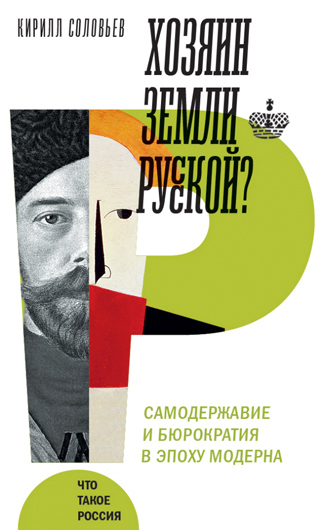
The book of the famous Russian historian, specialist in the political history of Russia at the end of the XIX-early XX centuries, Kirill Solovyov, is one of the first three works that open the popular science series of the publishing house “New Literary Review” “What is Russia”.
The title of the series refers to the famous book by Fernan Brodel “What is France?”, His last, and remaining unfinished work. Her inconceivability, due to such a natural accident as death, turns out to be symbolic-in the impossibility of giving any not even final, but at least a finished answer to a similar question. The answer turns out to be either brief and expressive - but thus uncertain, involving freedom of filling with the most different interpretations, or - if it strives for certainty - incompleable: after all, all more and more new refinement is followed.
In addition to the work of Kirill Solovyov, Evgeny Anisimov’s books on Petrovsky reforms and Vera Milchina about the plots related to the supervision of the French subjects in the Nikolaev era, in addition to the work of Kirill Solovyov, open. The variety of plots, it must be assumed, is completely intentional-each of the authors, being a deep and recognized connoisseur of his topic, sets out it for the general public and is connected by two criteria: firstly, the requirement of accessibility, and secondly, professional accuracy-that is, accessibility should not simplify historical understanding, but, opposite the versatility of the past that is not subject to unambiguous interpretations. In this regard, it is Solovyov’s book that is an excellent example of the genre - including purely stylistically: starting with simple, almost banal theses, describing changes in Russian life that have occurred in recent decades of the 19th century, a torn, almost school textbook, it is becoming increasingly nuanced as they move to the last chapters.
 © New Literary Review, 2017
It makes sense to dwell on the structure of work, since it reflects well the logic of the narrative. Its first pages are devoted to the “modern and archaic” of the Russian Empire at the turn of the century - the subsequent chapters describe the key elements of the empire’s management system, starting with the emperor and up to the level of ministries and the practices of legislative examination, with each step more and more complicating the picture.
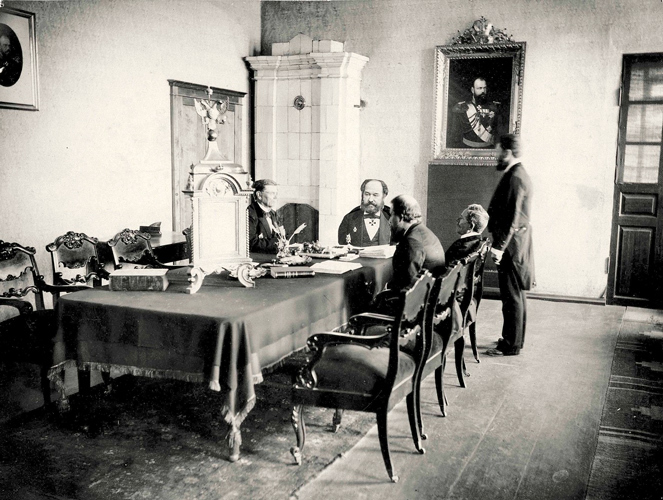
In the legal sense, the Russian Empire was an absolute monarchy - both in the time of Peter I and in the era of Alexander III, but it is clear that the real content of this reign changed significantly in time. In the XIX century, the “European” century of Russian history (p. 13), the Empire’s Office leaned on the bureaucratic apparatus, while Soloviev specifically and in detail dwells on the fact that, unlike widespread prejudices, it is more correct to talk about the “bureaucratized”, but as “unobtrusted”, “undirected” Empire. If we compare Russia with other then European powers, then in Russia by the beginning of the 20th century there were 1,15 officials per 1000 subjects, “in France-7.3 <...>, in the UK this indicator was 8.2, in Germany-6.13, in Austria-Hungary-5.05” (pp. 66–67). Similar, albeit smaller, imbalance will also be preserved, “if, when analyzing quantitative parameters, proceed from the gross national product (GNP). At the beginning of the XX century. In France, there were 8,300 officials for $ 1 billion, in the UK-6300 officials, in Germany-6400, in Austria-Hungary-6300, in Russia-3600 ”(p. 67). The fact that, according to the calculations quoted by S. Velichenko and B. Mironov, is even more curious, the number of bureaucratic apparatus in the Russian Empire per 1000 subjects not only did not increase, but was reduced - in other words, the control network did not become denser in practice: if in 1847 there were 1.42 officials, then in 1915 - 1.3, and in 1915, and in in 1915, and in 1897. This indicator was even less, only 1.15 (p. 66).
As a result, it seems reasonable to assume that the complaints of “bureaucracy” and the real unknoveredness of the empire were two ways of expressing the same reality - after all, the lack of bureaucratic control, the absence or complexity of obtaining information about the situation in the ground, etc., the small number of officials gave rise to “stationery redistribution” and “decisions torn from life” and the same Similar: in the St. Petersburg offices I had to theorizing how to arrange life in the field, also because there was not only no more or less concrete idea of exactly who exactly and how exactly lives “on the ground”, but there was no way to collect the necessary and sufficient information in any institutionalized way, and even if we collect the necessary information, it was necessary to solve another key issue-as well as another key issue-as well as another key issue Through whom these decisions can be implemented:
“The administrative vertical almost did not go further than the provincial city. The district police officer performed police functions and did not deal with management affairs. The leader of the nobility and the Zemstvo chiefs, who were entrusted with administrative affairs, were not state employees in the full sense of the word. The zemstvo was in difficult relations with the governor's power ”(p. 285).
The emperor himself turned out to be clamped between Scylla and Haribda: trying to maintain absolute power, he was forced to rely on the bureaucratic apparatus, which was hosted by Alexander III, and especially Nicholas II try various ways of distance in relation to the built management system. So, despite the complaints repeated for decades for the lack of coherence in the government, that each department has its own “policy” and their actions are poorly consistent with each other, the supreme power in every possible way avoids the idea of the “united government” (Alexander III negatively perceived the word “government” itself), since it was the contradictions among ministers, their mutual struggle gave the sovereign to see alternatives positions, to some extent to control what is happening. The appearance of the “head of government” (“vizier”, as contemporaries often call this option) would mean that the emperor will finally stand face to face with the bureaucratic system, forced to accept the option it developed. However, as Solovyov demonstrates, and without the “vizier” and “government”, the emperor’s ability to pursue his own policy - contrary to bureaucracy - turned out to be more than limited: for example, resistance from the State Council and a number of higher ranks led to significant changes in the university charter of 1884, and further concessions were avoided only thanks to the direct and active will The emperor, of course, only in rare cases capable of so directly and actively interfere with the legislative process.
The unlimited power of the monarch and the super -centralization of decisions related to the first entailed a situation in which the emperor did not actually delve into most of the decisions that he made - he had to rely on the apparatus, these decisions preparing. In a similar situation, the highest government officials were found: if the emperor found himself “in the hands of ministers”, then the latter in the power of his subordinates: so, the Committee of Ministers made decisions on the appointment of pensions to officials, about various allocations, etc., which had to be approved in a lump - predictably that not only opinions could be submitted on behalf of the same minister and about which he himself was not divided by himself sometimes. He already recognized as surprise during the meeting, but also directly opposite to each other. The super -centralization entailed the fact that real decisions were often developed by quite low officials who formally have no or quite insignificant power: the office of the State Council, for example, in practice, largely developed legislative formulations in which the highly approved opinions of the State Council put on the highly approved opinions; They recalled the Minister of Justice Nabokov that, trying to control his department, he gave up a lot of time to oral reports on the cases received, demanding from officials of various details - so that, in turn, lit up, he had to “set frantically” and then, receiving oral commandments, acting according to the minister, not embarrassed by the decision of the Minister, the faint memory of the latter was the faint memory of the latter Well -known.
However, the extremes of the “bureaucratic anarchy” should not be exaggerated: during the time of the reign of Nicholas I, when a professional bureaucracy is being formed in the Russian Empire, the Central Administration demonstrates high professionalism to Nicholas II - including due to the fact that the public service remained the most attractive for most educated ones. The system of higher governing bodies develops its own autonomous logic, including precedents related to legislative activity: for example, the emperor is almost impossible to circumvent if significant new general establishments are accepted by the State Council, despite the fact that the sovereign himself knows that his project will not find sympathy in the State Council. The problem is that in order for the system to at least maintain existing effectiveness, it should have established interaction with the “society”, including through forms of public control, gaining the degree of transparency, in which the rulers themselves needed.
As a result, Kirill Soloviev draws a picture according to which by the beginning of the 20th century the need for more or less radical reforms was recognized by almost everyone - from the emperor himself, resorting to various informal channels in order to get access to information that he does not expect to get from the bureaucracy, and to many of the highest bureaucrats themselves, a lot and willingly criticizing bureaucracy. Indeed, the thesis of the “mediastinum”, the isolation of the highest power from society and from the real needs and interests of the country, was almost universal - while the abstract “bureaucracy” consisted of people who were not only related to the “society”, but also in many respects the last: they formed a system that not only was critical, but also in relation to which they were completely alienated in their optics. Nevertheless, the existing system blocked the possibility of reform until the situation finally gets out of control-and then it turns out that among even the highest dignitaries there are enough supporters of very radical views.
The latter circumstance, by the way, also demonstrates the other side of the structure of the Russian authorities: avoiding “politicians”, thinking only to the emperor the only “politician” in the country, it closed any possibility of political discussion and struggle - even for senior persons of the hierarchy, it was permissible to discuss specific measures and decisions, but not a “general policy”, they should have been bureaucrats - that is, a tool of power that was deprived of their own. positions capable of fulfilling any decision made in the best and conscientious way. They did not require political views - and when the situation radically changed, regardless of the will of the authorities, they found themselves in a political situation, having no experience of political action, sharing those or other representations existing in society without limiting their feasibility and ideas about possible consequences.
K.A. Soloviev. The owner of the Russian land? Autocracy and bureaucracy in the era of modern. - M.: New Literary Review, 2017. 296 p. (series "What is Russia")