
Translated material
Shakhters in contact
In the opposition
 Shakhters in contact
May 18, 2010 Marina Litvinovich
Social networks are the egg in which the needle is stored, and with it - the death of Koshchei. Koschey is not so much Putin as the prevailing public order (not, however, has nothing to do with the order in the sense of harmony). Public order built in Putin’s times involves the lack of a unauthorized and independent civil association and actions and proceeds from the fact that everything that happens with society should be approved and funded in the Kremlin, and then showed in the approved form on TV. Putin’s social action is a thousands of youth army, which is being taken to stand on Academician Sakharov Avenue, which has once again turned in a coffin from such a spectacle. The youth usually personifies the confrontation of some color threat with their standing: the designers, apparently, proceed from the principle of “not to be reduced, so in number” and each time they bring out more and more people, despite the fact that to whom they confront are still unclear and unclear. The personification of the confrontation usually ends with funny youth drinking in neighboring courtyards, and this is despite the fact that all local wine are closed in the morning.
However, as many, including me, predicted, the Internet creates a completely new structure of public space. This has become especially noticeable in the last two years, thanks to the growth and development of social networks. In the Russian, or rather, Russian -speaking Internet, on the sites of VKontakte, Odnoklassniki, Mail.ru, Livejournal.com, millions of new public cells arose - groups, communities, circles, associations. These communities and groups are completely structured by Russian society: the usual city Internet user now voluntarily consists in at least 2-3 communities, but he is not and was never a participant in any public association or group in reality. For a young urban resident, it is considered natural to “be in groups” on the Internet, but completely unnatural-to join the party or become a member of some association. Largely because membership in the Internet groups does not particularly oblige anything, except for the voluntary receipt of information, and the entrance and exit from them are simple. However, an interesting fact: in the event of a threat of any interests of this group, it is instantly mobilized and is often ready to get out of virtuality into reality.
With the advent of social networks, we completely unexpectedly received a huge civil society in Russia, consisting of millions of virtual groups. The construction of a civil society, which everyone has been looking for in Russia for many years, has not helped any state efforts or international grants: this was facilitated by a simple technological leap in Internet technologies-the transition to Web2.0. And it’s not at all scary that the many groups that have arisen in networks are comic in nature, such as a large community uniting those who lick yogurt from the lid. It is enough to look at the lists of public organizations in the United States or in Europe - there are also strange organizations, such as the Fund for the salvation of cows in the UK or the movement of resistance to aliens in the United States. I will say more-if the lids of yogurt begins to threaten something, we can get an active and ready to act a community that stands to protect our interests, albeit such unusual ones.
There are many political, human rights, social communities in the networks. But they are not so numerous. The communities created according to the territorial or fan principle are numerous. Experience shows that in critical situations, it is these communities that become the main sources of information and help people combine efforts and move on to offline actions, that is, in reality. When they decided to take a license from the 2x2 channel, hundreds of fans and spectators who adore the Simpsons and the South Park went out on the streets with posters in defense of the channel. People who are far from politics were organized by public actions thanks to users of the VKontakte network , which initially entered the fan group of the 2x2 television channel.
Operational and different from official information after the accident at the Sayano-Shushenskaya hydroelectric power station could also be obtained from users of the VKontakte network, local residents who organized a group to exchange information about the survivors and dead.

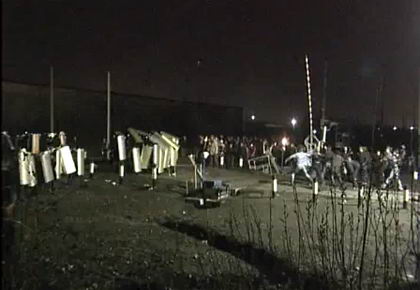
A fresh example gave us the situation in Mezhdurechensk, where after the explosion at the Department of Disruption, a rally, clashes with riot police and censorship in the media the main discussion, the exchange of information and views unfolded in the community “dedicated to the Main.ru website and in the VKontakte group on the same topic. Both communities existed for a long time and united participants on the territorial-professional principle. The first consists of more than 6 thousand participants, in the second - more than 5 thousand. It was in the Mail.ru community online that the first information appeared that clashes with riot police began on the railway tracks. It is these communities that very quickly from the discussion of “what is happening” moved to the discussion “what to do” and, as inevitability, to political topics and conclusions. Words that previously sounded only from the mouth of an unsystematic opposition began to sound from the mouth of ordinary people. This caused an alarm of wrestlers with extremism (EE Center) and the FSB. The administrator of the VKontakte group was called to the organs and took the password that allows you to manage the user profile and groups. The power over the group was captured, its name was changed, the group was made closed (initially the entry into it was free and open), all the information and exchange of opinions was erased. The process of disappearance of information from the group and irreversible metamorphoses managed to fix several users, taking screenshots from the screen.
The group on Mail.Ru still exists, but no one gives guarantees that they will not do the same with it. In fact, the power structures for the first time worked out the technology for the "raider seizure" of the group on social networks. This required “only” to properly put on the administrator of the group so that he would give the password. And “putting pressure” - the security forces can do, it is not a head to work.
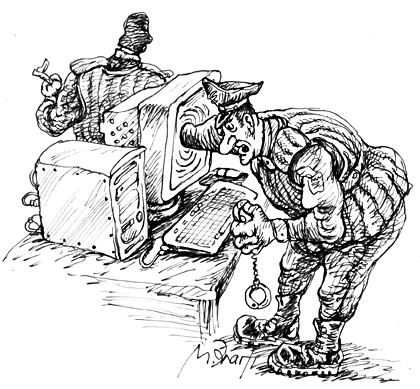
State and power structures have been preoccupied with the topic of control over the Internet for several years. Usually they talk a lot about the fight against pornography, but they are dealing with politically objectionable sites and bloggers. Moreover, the struggle does not go against the “iron”, but against the personality: bloggers are planted and, as we see now, they are in threats with their passwords. Just some “war and the Germans”, and each blogger or owner of the group is a potential radio operator Kat. I think that in the near future the security forces will try to master this new and promising direction of the fight against their own people.
Drawing of Mikhail Zlatkovsky / Zlatkovsky.ru