
Translated material
Self -isolation | Colta.ru
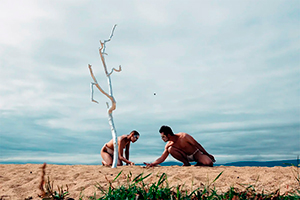
The Radi Sveta festival, which was invented and implemented by Yaroslav and Maria Frantseva, together with his small team and volunteers, is a MIX of competent, organized cultural tourism and final Coup de Théâtre with a series of site-specific performances. Everyone who submitted an application for the first week of September could come to the educational group and paid for a ticket to Lake Baikal and Housing. The performances, to participate in which a group of very different Irkutsk ones gathered-and not only people, were set by Maxim Isaev and Pavel Semchenko from the Petersburg Theater Ahe, directors Elena Nenasheva and Elena Kholodova, choreographer Alexander Shuisky, a sound designers and video operators. These two parallel working streams lived their lives, sometimes intersecting - and surprised at each other. The ideologist of the project is a choreographer, director and curator Yaroslav Frantsev conceived Radi Sveta as an occasion to gather on Olkhon not so much for the theater as for joint practice and meditation. In fact, meditation was - in the mornings on the shores of Lake Baikal, but practiced separately - but the genius of the place was so strong that the meeting of artists and “just people” eventually occurred.
Olkhon is a huge rock (73 km in length), the only inhabited island in Lake Baikal. The coastal zone is divided into plots fenced with ropes - pre -karantine tourists trampled the precious flora. A broken road leads to the village of Khuzhir - but perhaps it is she who holds back the influx of guests. On the island, a rich population of animals and, of course, a lot of fish, but it is no longer possible to catch it for sale - it is prohibited by law. Therefore, local residents can only survive at the expense of tourism. On the fences - announcements: “Excursions in Lake Baikal”, “Rock shaman”, “rafting”. In the former port, there are a row of metal longboats, and behind them the skeleton of a fish factory burned a year ago is blackened. It is here that “Hell” is located - one of the four parts of the festival program.
Radi Sveta producers came up with a project that positions itself as a minimalist and environmentally friendly, but related to contemporary art in its entirety - from veterans of the Russian underground Ahe to young performers. Minimalism on the island where the scope is of key importance is provided, by environmental, local residents and the myth of a place with its mystical flaler are worth. The third word in the slogan of the festival is “creativity”; The artists were responsible for her . In a sense, this triad is an ideal marketing sentence for those who go for retreat, are interested in art and engage in self-improvement. It remains to understand what place the theater took in this combination - and what it generally means in the system of new communications designed to provide a person Safe Place .
Speesfic site, the creation of which Radi Sveta residents practiced a week, is doomed to contact with the place where it is produced, and with people inhabiting this place. The burned -out Lesser fish plant in Olkhon's space landscape is an outstanding location, a beautiful and sad visualization of the deceased past. It was here that four performances dedicated to Dante's Divine Comedy were built here. The introduction was made by Isaev and Semchenko: after washing the wooden platform with a pitchfork, they settled inside with the DJ remote control. The basis of their “forest” was short parables from the “postcards from the other world” by Arminio Franco, composed of “testimonies” of dead people about how, in fact, they died. “I died from a shock. We worked in the cinema and almost everything finished. I just returned from Switzerland and was pleased with everything, ”the measuring voices of Isaev and Semchenko sound from the speakers, reading“ postcards ”in real time and simultaneously set up a complex machine of the performance. The pitchfork, sound samples, pyrotechnics and the final beating of glasses in folded window frames that lead the audience to the next step-straight to the “Hell”, collected by Ahe according to the same principle that Hayner Gozbels professes in their works, only here all this mechanics are equipped with an ironic manner and fundamentally made in the spirit of the hand-made .
The pilot release of the festival turned out to be a litmus piece of paper that showed the problems of the place, its special status - but also the difficulty of interacting with it.
If the “forest” is located on the border of the two landscapes-the living (the veranda in front of the hotel cafe) and the burned out (fish plant), then the “hell” invaded the ash itself, where the audience was invited to enter a narrow length on the broken glass and through a log corridor made as an art object by the architect Totan Kutzuzembaev. Elena Kholodova and Alexander Shuisky Inlapped living bodies into the apocalyptic landscape: half -naked performers growled and moaned in the pits illuminated by red light, others performed “dancing violence” in the skeletons of rooms, the third, crucified, hung on the walls of the former workshop and lay bare backs to the cloths on small elevations. A man with a bush on his shoulders and a high devil in a black cloak moved along this “room of fear”. Gradually, spectators who are in the status of voyeurists, peering behind a variety of transgressive gestures, gathered along the outlined Satanic circle, inside which they pushed the performers in turn to tear to tear the man -bond. Having made a slaughter, the inhabitants of hell calmed down - and led everyone through the second passage, where beautiful dead ships stood under the moon. As it often happens with the theater, including the special website , the journey itself, equipped with a meditative sound design (Karina Ghazaryan) and arranged by the artist (Sofya Koboseva), was quite diverse in the plan of the experienced attractions, but sinned by the unclear of the message: his essence was witty and accurately conveyed one of the audience of Ad. It’s bad to behave. ”
The next morning they were waiting for everyone in the “Cleaning” - a three -hour collection of original performances, collected by Maxim Isaev, Pavel Semchenko and Rustam Imamov, was placed on a travel frame with Haron through Styx. At the entrance to the abandonment (one of the premises of a fish plant, without a roof and with empty eye sockets of windows), each of the spectators received a questionnaire like a visa with a request to note the existing sins. Then they pickled everyone for a long time, as it is appropriate in visa centers, until each of the forty spectators went through the transition from one world to another - in a boat that authors and performers carried on their shoulders. From an abandonment, the audience fell into a spacious room with an earthen floor, gradually filled with visitors transferred from the "waiting room" to the "purgatory". Each beginner was shown a performance, clearly or hiddenly associated with one or another specific sin. A man in a boat could not see that others were sitting near the wall, but, standing or lying in his “coffin”, a fragment intended for him was observed. The team of drivers, frantically and cheerfully performed the cascade of attractions painted with the characteristic of ahe by absurd irony, stood out Lena Sysoeva - practicing the Buto technique, in each of her gestures, she presented an amazing ability to perform a performive presence that informed the authenticity of what was happening. At the end, when the tired porters dragged the last viewer, there was a change of places of terms: the audience performed a number of teams under the audio file downloaded to the phone, and the workns watched them and clapped. Going out, the audience again saw the shore with dead ships - only now they stood under the bright sun.
The last call in Danta was the monumental “Paradise” by Elena Nenasheva - the passage along the mole and the shore of the port of Olkhon with a white horse and the slightly covered with white pieces of paper performers. The choreographer Anna Rumyantseva came up with the most memorable in this project - a system of gestures and “dancing”, accompanied by a montage of the texts of Bukovsky (“when the Lord created love”), Nietzsche (“Birth of a tragedy from the spirit of music”), Irkutnyan Ivan Vyrypaev (“Genesis No. 2”) and an advanced from the Portal Portal. Moving from mola to sand, performers solemnly depicted something metaphorically similar to paradise hugs, separation and compounds, lit a fire in specially laid sand channels, and at the end moved after the central couple. This “paradise” itself was elegant, like an illustration from the children's Bible, but the air, wind, brilliant Baikal water, running affectionate dogs and dazzling light balance its pathetics.
The concept of Radi Sveta , invented by an independent team in the calculation only for its own strength and resources, is located somewhere between the pragmatics of cultural tourism, the school of life and art. It is interesting to reflect on the festival with this mixed optics, canceling the division into professional and “amateur”, residents and who came to breathe Olkhon’s air and learn the dance of guests from Kemerovo and Vladivostok. Local residents were almost not visible at the shows - their closed life remained outside the study of artists, who completely comprehended the greatness of the location itself. In a sense, the pilot release of interdisplinary, site-specific and widely different points in the world of the festival, which collected so many interesting artists, turned out to be a lamising piece of paper that showed the problems of the place, its special status-but also the difficulty of interacting with it. Perhaps it is the theater - in its most radical manifestations, which were shown on Olkhon - is able to make this connection with a real and pulsating life.