
Translated material
Crisis of meetings in Russian exarchate
In society
 Crisis of meetings in Russian exarchate
March 23, 2015 Victor Aleksandrov
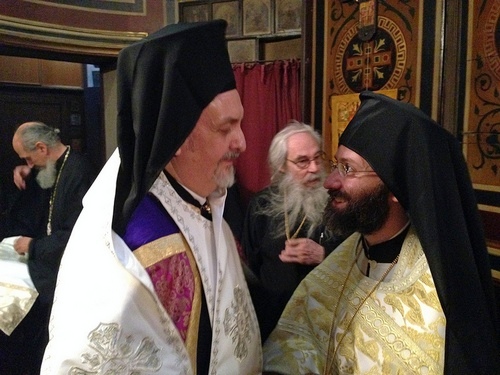
Almost two years ago, the “Daily Journal” already wrote about the crisis situation that developed in the Archbishopic of Orthodox Russian churches in Western Europe (also known as the Russian exarch of the Patriarchate of Constantinople). The crisis arose after leaving in January 2013 Archbishop Gabriel (de Vilder), as it later turned out to be a deadly ill. Unfortunately, with the elections of the new archbishop , which took place on November 1, 2013, the crisis was not resolved. Formally, it concerns a very small circle of people - from the strength of several thousand - however, events in this small church are important for further fate of all modern Orthodoxy.
As you know, the exarchate is a “fragment” of the Russian pre -revolutionary church, which became a separate peculiar jurisdiction after the Primate of the Russian parishes in Western Europe, Metropolitan Evlogius (Georgievsky), as a result of the conflict with Metropolitan Sergius (Stragorodsky), passed in 1931 to the opofinopol patriarch. Honored Glory to the exarchate was brought by his theological school, which gathered the best mental forces of the Russian church abroad; The center of this school was still the existing Holy Sergius Theological Institute in Paris.
In the internal structure of Archbishopia, the principle of confidence (or, according to the traditional Russian theological terminology, collegiality) acted in different levels. He was manifested in the election of the archbishop, in the work of the diocesan assembly, which includes deputies from the clergy and laity, in the existence of the permanent council of the Archbishopiccia and, finally, in the work of parish councils. The starting point for this device was the decisions of the Moscow Cathedral of 1917-1918, the prestige of which was and is extremely high in exarchate. The principle of meeting is enshrined in the charter of the Archbishop. According to Article 37 of the Charter, the Archbishop manages the Archbishopia "with the participation of the clergy and laity, following the principle of collegiality of Orthodox eckelesiology." The meeting regime in Archbishopiccia was not perfect; Nevertheless, he acted regularly. This feature exarchate was different from most “historical” jurisdictions, in the life of which the meeting is present to a very small extent, as a rule, only at the level of regular bishopric synodes. The only close analogy of the Archbishopician among the current Orthodox churches is the Orthodox Church in America, the structure of which also developed under the influence of the decisions of the Council of 1917-1918 and under the leadership of representatives of the same theological school.
Counterattack
What has been happening in Archbishopia since the rest of the Vladyka Gabriel’s peace is a kind of counterattack of that Orthodoxy, which, for various reasons, did not hear the epistles of the Moscow Cathedral of 1917-1918. The meaning of what is happening now in the Archbishopric is to turn the meeting as the principle of church structure.
On November 1, 2013, by the joint efforts of the Locumber of the Archbishop’s throne, Metropolitan Emmanuel (Adamakis) and the Synod of the Patriarchate of Constantinople, the necessary results of the archbishop’s elections were cleverly smart (details here and here ). Those who carefully watched the “elections” have no doubt that Archimandrite Job (Gekha), “chosen” by the archbishop, not only knew about the intrigues of Metropolitan Emmanuel aimed at the construction of him, Job, to the throne, but was in collusion with him. Not being distracted by the details, I summarize only the essence of the trick made by Metropolitan Emmanuel Galli and Constantinople Synod: right in the election hall, Vladyka Emmanuel announced the decision of the Synod not to approve the two candidates of the competitors of Archimandrite Job (of course, they were consistent with the Patriarchy of Constantinople! Unknown clergymen who also serve outside the archbishop. Thus, real competitors Archimandrite Iov were eliminated. When a murmur rose among the elections in the hall where the elections took place, the Lord Emmanuel did not shy direct blackmail, threatening that, if the diocesan meeting was refused, the Patriarch could withdraw Tomos about the autonomy of the exarchate. Those who want to receive autocephaly or autonomy from Constantinople in the future should take this threat seriously: what are the tomos of the patriarch, if they are so easily, at any time, can be recalled! These were the “elections” in Konstantinopol, who caused the flock of exarhat, who had never seen anything like this, deep injury.
Subsequently, the violation of the charter of the exarchate by the archbishop and the Nastatinopol Synod became systematic. Grace Job, appointing and moving clergy, often does not consider it necessary to consult either with the advice of Archbishopicia, or with parishes, or with the clergy themselves, although all this directly prescribes him the charter. Often, clergy learn about their movement by accident. The most egregious case: the deanery of the parishes of the southeast of France, a member of the Council of Archbishopia, and one of the most respected priests of the exarchate, Archpriest John Gate, learned about his shift from the abbess posts by phone from the parishioner (as it should be according to the laws of the authoritarian genre, his displacement occurred shortly after he stood up for one of the abstracts removed earlier and asked for his previously removed abbess and asked Archbishop explain about the systematic violation of the charter). The Synod appointed the Vikar Bishop to the Archbishop (who used, the use of a good reputation), although by the charter the Archbishopric should choose it itself. The Synod and the archbishop simply ceased to observe the charter of the Archbishopian, although it was approved by the Synod itself and Patriarch Bartholomew. In the actions of the Synod and Archbishop, the spirit of command and the Lyublia prevailed. The archbishop advised the flock not to discuss orders of church power. It is invited to believe parishioners and clergy that even the most absurd and not agreed by the decisions, the archbishop makes for the benefit of “mother-church”. The Archbishopian website actually turned into an archbishop’s personal website, where his services, trips and meetings are recorded. In the speeches of the Lord Job, the tendency to identify his opinion with the opinion of the Church is noticeable.
You will not surprise the parishioners or clerks of the Russian Orthodox Church listed: they defeated and heard enough of this, this is their everyday life. But in the exarchate it was not so for decades! Now the exarchate, where freedom and mutual respect has been dominated by many years, is becoming a structure where any cleric can be shifted at any time only because the bishop wants it, and this will be justified by the certain higher good of the church, the essence of which no one is obliged to explain to the parish clergy and laity. This practice in a short time will inevitably lead to the formation of a clergy according to the principle of personal devotion to the bishop. It is easy to predict that this will push away many parishioners from the Church and Archbishopia will embark on the path of transforming lively parishes from the Commonwealth into a dying temple network.
The Archbishop of Job at the moment showed himself to be a man to whom the tradition of meeting in the management of exarchate is not a road and who performs, consciously or unconsciously, an instrument of its liquidation. The explanation of this fact is probably necessary to look in the environment in which his ideas about the church and episcopal ministry developed. Surprisingly (for me, in any case), also that both Vladyka Job and Metropolitan Emmanuel are graduates of the Holy Sergius Institute! For three years, Vladyka Job was even his dean (then, however, he was not re -elected by the teachers of the institute for the next term). Previous, but the fact: the institute at the current stage of its existence is incapable of providing its graduates with vaccination against the Lyublia. The situation is also complicated by the repeatedly demonstrated by the Lord I -personal rudeness in relation to disagreements - this is also a new phenomenon in the life of the archbishopic, with which her flock has not collided.
Nervous practice
The latest events in the exarchate are similar to the attempt of one of the historical centers of Orthodoxy “Go to the counterattack” in the diaspora. In recent years, there have been several such attempts from both Constantinople and Moscow. Probably, such behavior is explained by the banal instinct of possession, which is akin to the imperialist instinct of the state. I will risk, however, to assume that the matter is not only in it. Both the exarchate and the larger Orthodox Church in America are very inconvenient for the historical centers of Orthodoxy: their existence is already quite long - they prove that the organization of the church is possible not only on the principles of uncontrollable relative (the power of the bishop in the diocese) or the uncontrolled self -reproducing oligarchy (the power of the Synod in the Local Church), and also by the Facilities) meeting. This is a nervous both Constantinople and Moscow an example. “Historical” jurisdictions with a chief of nuts feel its danger and, if possible, are happy to squeeze those churches that give this example.
The Union of Archbishopia and the Patriarchate of Constantinople was always a marriage, and crises already occurred in their relations. So, in 1965, the Patriarch of Afinagor, Constantinople, abandoned his jurisdiction over the exarchate, but led by Vladyka George (Tarasov) and the professors of the St. Sergius Institute, the exarchate was not afraid and proclaimed himself an independent church, which intended to ask other churches to recognize its autocephalous. In 1971, the exarchate again accepted the exarchate in his composition.
In the last two decades, the Stalistanopol Patriarchate supported the Archbishopian in its confrontation with Moscow (namely, the resistance of Alexy II’s attempts to unite all the jurisdictions of the Russian tradition in Europe to the Metropolitan, as well as attempts by the Russian government and the Russian Orthodox Church to take away temples in Biarrice and Nice; Alas, I was a success). Apparently, now Constantinople decided that the danger from Moscow has passed. Some observers within the archbishopicia suggest that between the “second” and “third Rome” could be concluded an unspoken agreement on the “division of the spheres of influence”. The death of Vladyka Gabriel became for Constantinople (or personally for Metropolitan Emmanuel Galli - the roles of the participants are not entirely clear here) a convenient reason for conducting the Archbishop operation in Paris. The story of the locomotiveness of Emmanuel and “elections” also leads to sad thoughts about what the decision -making mechanism of the non -accountable synod of the Patriarchate of Constantinople led by Patriarch Bartholomew. It is amazing with what ease the gray -bearded archpastors who are sitting in the Synod are ready to rush into medieval adventures.
Dialogue with a "group chasing private interests"
In an attempt to save the deliberative tradition of Archbishopia, several authoritative figures representing different organizations, one way or another associated with the exarchate, turned to the archbishop with an open letter, where they require the convening of the Extraordinary Diocesan Assembly. The letter was signed by members of the Council of Archbishopiccia Nikita Struve and Mikhail Sollogub, General Secretary of the Orthodox Brotherhood in Western Europe Sophie Cleman Stavra, chairman of the RSHD Kirill Sollogub and professor Jean-Claude Pole. In his pastoral message of February 14, Vladyka Job expressed a public disagreement with a letter, seeing in it the machinations of a “group that haunting private interests”, which enjoy sectarian methods and resorts to slander and manipulations. He expressed his readiness to "give his life for the life of our church."
It is extremely embarrassing to read the passages of the archbishop of the message. This is some kind of immature game in mortal danger! All five authors of the letter are well known in Archbishopicia, and none of them poses the slightest threat to the life of Vladyka Job! Additional tragedy (and comic) is given by his words that the shepherd, ready now, when he does not threaten him, bravely die for his church, a year earlier he did not find the courage to answer the letter of the flock, sent to him shortly after the “elections” on November 1, 2013!
What is the number of disagreements with the lord of IOV? The open letter was signed by five people who worked disinterestedly for decades for Archbishopiccia. Most of the members of the Council of Archbishopia also disagree with the methods of managing Vladyka Job and turned to him and Patriarch Bartholomew with another letter. The message with a request to observe the charter of the Archbishopian of the Bishop IOV was also written by the members of its administration (secretary and treasurer), designed to be the closest employees of the archbishop (according to the Charter, he himself offers their candidates to the Council of Archbishopicia). Nice and the Scandinavian deanery immediately reacted indignantly to the personnel movements concerning their personnel. Finally, the number of the opened letter mentioned above, after it was published on the Change.org website, exceeded 430 people (though there are not only exarchate parishioners among them). Archbishopia is small - about 100 small parishes. A very approximate assessment of the number of one parish of 100 people gives us about 10 thousand parishioners of varying degrees of activity. Most, with the exception of rare minutes of mass rise, are always passively, silent and makes the decision to which it is put. Actively minority. Obviously, Vladyka Job is in conflict with the active members of his church.
But even if only five were dissatisfied, is it not enough to get into a conversation with them? The good shepherd of the Gospel is also followed by one sheep (Matthew 18, 10-14). Vladyka Job declares her openness to the dialogue, but the materials on the site where the “opposition” Ioova collects the documents related to the conflict indicate that this is just a declaration. In fact, the archbishop is trying to avoid discussing the decisions with which his flock is disagreeable and, if possible, to shut up the conflict.
Saint-serge is silent
The voice of the teachers of the St. Sergius Institute is practically not heard in the exarchate in the exarchate since 2013. Yes, they defend their financial and administrative independence from the Archbishop Job and Metropolitan Emmanuel (see their letter of February 2, 2015), but they are silent when they must raise their voice in defense of the Archbishop. Parishioners and clergy in their statements touching the institute touchingly, but its teachers do not meet them public mutual support. In the polemic, regarding the limits of episcopal power, quotes from Scripture constantly arise, links to ancient authors and modern theologians, but the teachers of Saint-Serse do not raise the theological glove. Who would not have to judge how much the New Testament and the fathers quoted by the Lord Job really justify the bishop's authoritarianism, and how just ideologizing propaganda is such citation! The institute was eliminated from the problems of Archbishopric. The liquidation of the meeting in it has not yet forced the institute teachers to get out of a state of rudeness.
Can everything be corrected?
The moral spirit of Archbishopia “Elections” on November 1, 2013 and preceding the intrigues of Metropolitan Emmanuel did great harm. But the injury could be healed. Few people in Archbishopia want struggle and conflicts. The flock is ready for reconciliation. If the archbishop of Job gives her a chance. If he refuses the role of the “great master and father”, whose decisions do not need coordination, and will return to the practice of meeting. Opponents of Vladyka Job in chorus and one by one ask him to observe the charter of the archbishopic, which he is increasingly ignoring - it was in the charter that the experience of confidence accumulated by exarchate was deposited. The gospel does not teach pastors to rule. It preaches the “vertical of power” on the contrary: you want to be more than your comrades in faith - become a servant to them; If you want to be the first among them-become a slave to them (Matt. 20, 26-28).
It is impossible to predict what the outcome of the current crisis will be. But there is simply no other way out, except how to intervene for an exarchate, the activists of the Archbishopian, laity and clergymen. Their serious weapon will be publicity.
Author - Church historian, lives in Budapest
Photo: Metropolitan Gallic Emmanuel and Archbishop of Job. The photo is provided by the author.