
Translated material
Cousin
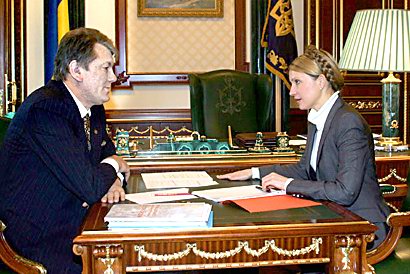
Of course, Ukraine is the most similar to us, the state closest to us. Even closer than Belarusia, since what is happening (produced by the "Old Man") in Belarus is difficult to call state policy: in scale it is more likely to be the actions of a strong tyrant-householder somewhere in a large province in the Russian outback. Therefore, comparing political and economic processes in our countries is very instructive.
In the field of economics, the main psychosis of Russian and Ukrainian society is the same - improper privatization, oligarchs, etc. In Russia, the power of the “terrible security forces” who “saw Yukos”. In Ukraine, liberal populists focused on Europe, market, legal state, etc. came to power. And then Ukrainian liberals begin with the nationalization of Krivorozhstal (a kind of Ukrainian Yukos). But if the timid Russian security forces have been stomping on the carcass of Yukos for a year, then Ukrainian figures have been operating with a revolutionary scope: Yushchenko announced the nationalization of 30-40 enterprises, and Tymoshenko-3000! Can you imagine what would happen in Russian and Western media if Putin had announced in Russia something like that?! And here - calm. Both in Ukraine and in the West. The US Senate, who is discussing the story with Yukos, is calm against Ukraine.
Why? Tymoshenko is prettier than Putin? Or liberals in Russia and in the West does not care at all and give them just something “anti-Putin”? Or just haven't figured it out yet? Yes, it is quite possible the first, second, and third. But another reason is not excluded. Maybe the nationalization in Ukraine and the “cutting of the Yukos” are really different in essence, and not the names of the participants?
What is the difference? If in Ukraine (starting with the same “Krivorozhstal”) truly open, transparent auctions for the sale of nationalized enterprises with the full participation of foreign (first of all, of course, Russian) businessmen will be held; If, according to the results of these auctions, the rights to property by new legal owners are finally staged; If large enterprises do not get stuck in the pocket of the state - if all this happens, it will be possible to say that in Ukraine there is not another redistribution, not another rewriting of property and building a system of new kickbacks, but really the creation of the basics of a normal economy.
Is this possible? The future will show. So far, Yushchenko-Timoshenko, who declared a large-scale war with corruption, has a well-known credit of trust. Not only from the Maidan, but, which is very strange, even from some investors and politicians. The Russian government has no credit of corruption issues - neither from the crowd, nor even more so on the part of investors.
The situation with political reform is even more entertaining. Here we also go in parallel paths-roads, but here we are also significantly different.
The idea of reform, which is not lazy about in Moscow today, is simple: the president is depriving real powers, they go to the premiere, the prime minister becomes, of course, Putin, this time without limiting the deadline - and it is clear that only for this porridge is cooked. “The price of the issue” is the redistribution of the Constitution, in particular, the rejection of the popular presidential elections. By the way, the transition from the presidential to the parliamentary republic is the same crime of which Khodorkovsky was accused of the preparation of (buying votes in the Duma in order to carry out such reform). Now that Khodorkovsky is sitting reliably, you can realize the idea.
And in Ukraine, as you know, something similar has been done: the powers of the president are greatly cut, the powers of the prime minister are significantly increased. So, again, we solve the same problems with the same methods?
No, here - puffs. I don’t know how with nationalization, but we have political reform in them - exactly the opposite.
Our reform if it is carried out, then for a particular person, with one purpose - observing decency before Europe, to maintain personal power. The reform in Ukraine was carried out on the basis of real acute political clashes during the transfer of power. And Tymoshenko definitely does not shine to be the prime minister "unlimitedly long." In Ukraine, direct presidential elections are preserved. They are taking steps to the separation of powers - we are doing everything so that this separation is not, that all power remains in one fist.
But the most important thing is not even these goals. Much more important methods.
I don’t know what Yushchenko, Tymoshenko and their team are like people. But I see that they are forced - for now! - Drive open policy. They took a very high credit of popular confidence in democratic policy. And they have to - so far - pay on bills. It is likely that they will soon repeat the path of another great populist - Yeltsin. But for now - no.
We have a closed policy. The credit of confidence was almost exhausted, but it was originally (2000) not under a democratic policy compromised by Yeltsin, but under a sovereign policy. And the sovereign, of course, turned into a banal-bureaucratic one.
And now there is a very interesting experiment. Or Ukrainian Yeltsin - Yushchenko - will go bankrupt and all ends with the arrival of Ukrainian Putin. Or Ukraine will show us not where the crayfish winter, but how democracy is growing.