
Translated material
Europe and the Maidan
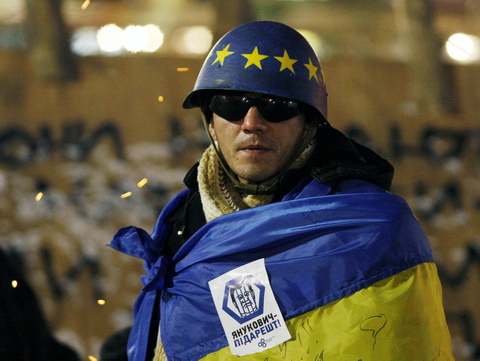
One of the results of Vilnius for European diplomats and officials was an understanding of a simple truth that Russia is not a root of problems in relations between the EU and Ukraine. That is, Russia is of course part of the problem. But Viktor Yanukovych’s attempts to explain everything by the fact that he, they say, had been fought with Moscow pressure for three years, did not work and did not bring him European money or sympathy. Because after everything that happened after the assurances and statements of Kyiv about the European choice, which turned out to be a banal trading for money and for the EU refusal to free Tymoshenko, the Europeans suddenly reached that the problem was in the Ukrainian leadership itself. Whose policy, with all his intrigue, corruption and the predatory attitude of the neighboring circle of the president towards the country's economy, in fact, makes Ukraine so vulnerable in the face of external pressure.
However, insight came to Europeans with a great delay. Accordingly, there was no “Plan B” at the disposal of Brussels. And when, after a cruel raid of Berkut, a wave of protests rose in Kiev in Kyiv, with a dream of a European choice that was not indirectly connected, the European Union was far from being able to at least somehow determine its position.
I must say right away that, from the point of view of the Maidan, she borders on betrayal. And the disappointment of protest participants can be understood. Many of them were waiting for at least personal sanctions, at least Yanukovych’s premises in the same category with Alexander Lukashenko, which did not happen. But you can understand the behavior of Brussels. Unlike Lukashenko, Yanukovych for Europe, a legally elected president who will lose legitimacy only if he loses the election or proclaims himself a winner as a result of a falsified popular will. The consensus regarding the translation of the Ukrainian president from one category to another, until a certain critical feature in the use of violence is crossed (until it is crossed), no.
But this does not mean that there is no position at all. Some of its key elements are quite obvious. Firstly, the EU really strives for the peaceful and political settlement of the crisis. A civil war or even a power confrontation between a low level on its borders is definitely not needed by Europe. It is enough to imagine a sabotage on the gas pipeline leading to the EU. Therefore, I repeat, in the case of an escalation of violence by the authorities, sanction is quite likely.
Secondly, the EU would not want to play a disconnecting role in the already disconnected country. He would rather like to repeat the experience of 2004, when European diplomats became intermediaries and guarantors of settlement. And the point here is not only in the rather sad experience of cooperation with the “orange” authorities, which turned out to be a continuous disappointment for the West as a whole-is it not an explanation that with such a readiness, if not with a sense of relief, the West accepted Yanukovych in 2010? It is rather that the EU believes that winning elections is a business of local politicians, not external forces. For comparison, you can look at the neighboring Moldova. There, the pro -European coalition may well lose the parliamentary elections next fall, but nevertheless, Brussels is in no hurry to give out gifts to the current government - in the form of a visa -free regime, for example, and meticulously requires the fulfillment of all consistent obligations. Before that.
Thirdly, the readiness to sign the Association and Free Trade Agreements confirmed. With the current government, of course. But subject to the fulfillment of well -known conditions. Honestly, the second part would have to be clearly brought to the attention of Kyiv earlier, and not create the impression that Europe needs more than Yanukovych. Perhaps then it would not occur to him to bluff. But, in any case, it is better later than ever.
Finally, at least for now, it became noticeable that the desire to publicly sort things out with Russia on the Ukrainian issue was weakening. However, in the light of what was mentioned at the beginning of the article, this is not surprising. After the EU senior officials finally stated that they were not going to participate in an auction for the Ukraine Lot, and even more so to interrupt someone’s bets, it would be pointless. Europe does not like to play geopolitical games. Its task is to contribute to slow internal changes in neighboring countries, understandable and accepted population.
All this does not look like a special operation to overthrow the legal government.
Photo by ITAR-TASS/ Maxim Nikitin