
Translated material
People and walls
As you know, Pushkin wrote a phrase from Count Nulin “Strange rapprochement” on the night of December 14, 1825. And this December, after almost two centuries, without fourteen, it occurred almost the most strange “rapprochement” in modern history: two rulers - Vaclav Gavel and Kim Jong Ir were almost simultaneously over the threshold of the world left. If you recall Pozner's famous question, borrowed by him from Marseille Proust, "Coming in front of God, what will you tell him?" And to assume that such an audience took place (which, by the way, is completely excluded), then each of these two, without saying a word, could answer that he tried to make his people happy. But in different ways: one-inspiredly affirming freedom and human dignity, the other-both freedom and human dignity with the persistence of the maniac eradicated. And in this among modern dictators almost had no equal.
About four years ago, when I worked in the Security Service of the Munich Airport, one day I conducted passport and visa control of passengers flying away by the Luftanza flight to Beijing. In anticipation of the announcement of the landing, the people drank coffee, made the latest purchases in Duty Fri, some, having settled right on the floor closer to the sockets, wrote something in their laptops. But there was something completely strange and not caressing the eye in this familiar picture. With fifty people in red tracksuits, they sat motionlessly in the chairs, dropping their heads and looking at the floor. They did not look around, did not get up from the places, did not talk and, it seemed, did not even move. When the landing was announced, and my colleagues and I began to check their passports and landing, people in red suits continued to sit silently on benches, snuggling tightly against each other. One of the women of the Asian appearance, when her turn came, gave me a stack of several dozen passports, moreover, tied around elastic bands.
“These are passports of our athletes from the Korean People's Democratic Republic. We return from competitions from Romania through Munich and Beijing in Pyongyang, ”she said. The most amazing thing was that she spoke Russian. It turned out that this woman with a bunch of passports is a translator, but she does not know any foreign language. She was just lucky that she came up to me. Because then it took all the eloquence accessible to its understanding to explain that the passports must be distributed to the owners, otherwise they will not fly anywhere. The demand plunged the translator horror. She literally prayed: "No, no, no, this is impossible!" But here, as a dozen and a half of the North Korean “people in civilian clothes” formed from the ground. They grouped on the sidelines and began to quietly, but energetically discuss the situation. The landing ended, and they had to make, apparently, a responsible decision. And they accepted him! People in gray suits ordered their wards to get up, surrounded them with a ring, holding hands around the perimeter, but everyone was given a passport only a step before control under the alert supervision of the accompanying those who accompanied. Of all the feelings at the moment when I met with the eyes with quiet young people in red costumes, I felt only a feeling of great awkwardness: what they treat them like this - worse than escorted criminals, and I can not do anything. And no one can ... and we all involuntarily were accomplices of this obscene action.
Yuri Galanskov, one of the first Russian dissidents, in 72, long before Magnitsky, at the age of thirty -aged, he was healed to death with prison “doctors”, in his unfinished story he wrote: “I know that the only way out of hell is an adamant desire to get out of it ... It doesn’t matter where, it is important to leave hell.”
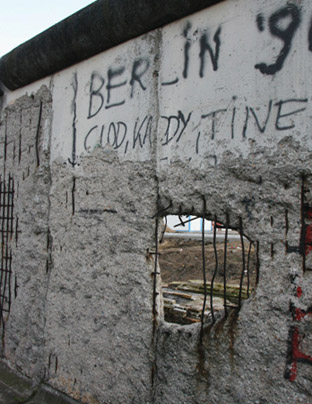
In the past year, it turned 50 years old by the construction of the Berlin Wall, which was not only a symbol of scolded freedom, but also a monument to the irresistible desire of people to “get out of hell”. According to the Government of the GDR, when trying to cross the Berlin wall, 125 people died. Russian historians talk about 192 dead. According to information from a number of Western sources, the number of those killed while trying to flee to Germany exceeds a thousand people.
In the Stasi Prison Museum in Berlin, I had a chance to talk with the guide of the museum Mike Frenol. He is only 44 years old now. He spent six years and two months of them in this and other prisons of East Germany. Perhaps it all started with a name, because his father called him in the English manner, because he was a fan of Rolling Stones. The first time Mike was imprisoned when he was only 17 years old. A border guard officer came to their school and began to talk about the fact that the Berlin wall is an anti-fascist border protection. "Why are there, at the wall, they shoot at peaceful people?" Mike asked. For this question, he received the first six months of a prison term. He was already released by a convinced fighter with the regime and took up the composition of leaflets - appeals to fellow citizens. So outside the prison he was lucky enough to stay for a long time. Having freed himself a second time, he began to think about the details of the escape to the west. And again he was captured and planted.
When Mike served the third term (already 1989), he headed for the beer right from the gates of the prison. Strangers sang at the tables, joked, hugged, laughed. "What's happening? What are you happy about? " The former convict asked. “There are no more walls! She is not forever! " - shouted back to him. “Not true. I was born with this wall, and I will die with it. The wall will survive us all, ”Mike muttered angrily, thinking that he was played. The next day, early in the morning, he still went to the wall. And suddenly he realized that he had come to West Berlin with his feet. He sat on the road, clasped his head with his hands and for the first time in his life realized what to cry with happiness: he survived the wall, turned out to be harder than her.
Former prison workers come to the Stasi Museum quite often. Many of them live in neighboring houses, because the apartments were allocated to them near work. According to the museum’s employees, almost all of which in the last century were concluded by this prison, former jailers behave extremely aggressively, interrupt guides, shout that everything they are talking about, and that the day will come, and they will return back as the prison staff. They still think that this is a mistake - after all, their wall was built forever.
“There can be no question of democracy as long as the authorities insults the dignity of citizens, crushes justice, the media and manipulates the election results.
But the greatest threat to Russia would be the indifference and apathy of people. On the contrary, they must tirelessly achieve recognition and observance of their rights and freedoms. Opposition structures should be united, form a shadow government and explain their program to people throughout Russia, ”Vaclav Gavel addressed these words a few days before his departure in his interview with Novaya Gazeta. He knew what he was talking about. The walls erected by tyrants are not as hard as it often seems. Now what has recently been a Berlin wall is crumbling even from the easiest touch. I know this for certain, because I bought a small piece in a souvenir store at Unten-Der-Linder in just two euros and now I have a wonderful material evidence of the decency that evil is an indestructible substance.
Photo by RIA Novosti