
Translated material
Church and the intelligentsia
In society
 Church and the intelligentsia
September 10, 2012 Alexey Makarkin
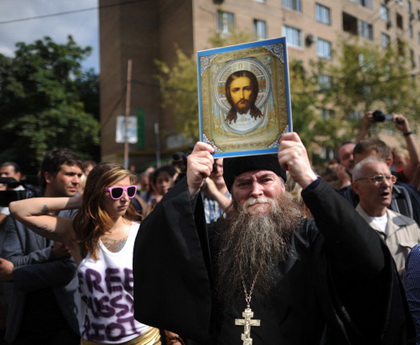 The Pussy Riot case inflicted a strong blow to relations between the church and the intelligentsia. More precisely, its liberal part, which traditionally prevails in a Russian educated society. The church is accused of reactivity and cruelty, aiding the ruling regime and revenge. We add to this the last scandalous cases with the clergy who drive on foreign cars, knock down road workers and beat the old women during a road conflict.
In the information space, a frightening image of unbridled inquisitors is created, from which any decent person should stay away. The reverse sequence is also possible - a person, in these conditions, remaining a child of the Church, ceases to be a liberal and turns into an accomplice of the persecutors.
What can be said in response to such statements, frequent lately?
First. Radical anti -iclikals, proclaiming incompatibility of the church and democracy, actually close with their implacable opponents - supporters of clericalism, dreaming of the restoration of the “dominant church” and the Byzantine symphony between the church and the state. So the departure of the liberal intelligentsia from the church will be able to delight Dmitry Tsorionov and his associates, pursuing Pussy Riot supporters and sometimes by misunderstanding of normal Orthodox missionaries and volunteers. Which for the most part are ordinary peaceful people who do not open their hands in public places, but engaged in spiritual enlightenment. Which do not tear down T -shirts from Aeroexpress passengers, but go to the children to hospitals and shelters, release books (often quite high quality), and repair temples.
Second. The crisis in the relationship of the Church and the intelligentsia is not the first time, intellectuals often perceive the church superficially. For example, at the beginning of the twentieth century in the liberal environment, it was not quite “political correct” to testify to their faith, and the “Vekhovites” were in a clear minority. The church was perceived only as the totality of soulless officials, black -hundredth fanatics and drunken “priests”, similar to the hero of the Perovsky “procession on Easter”. Moreover, there were both the first, the second, and third - but are they only? At the same time, the Optina elders, outstanding scientists, and simply modest provincial clergymen who honestly fulfill their duty were in the church. When the church became persecuted, only the clear minority of its ministers renounced her, abandoned the dignity. On the contrary, hundreds of church figures are now ranked from the saints-from the metropolitans (“church bureaucrats”, according to critics) to ordinary laity-who did not break into the Cheka-GPU-USVD during interrogations, did not sink themselves and did not slander others. By this, they proved that they lived for the sake of Jesus, and not the bread of Kusa.
Is it possible to say responsibly that now the whole church consists of persecutors and immoral subjects? Or even that there are most of them among church people? Of course, no - this would be no less untruth than those numerous accusations (often engaged and therefore deeply unfair) that church critics put forward in relation to liberals.
Third. Sometimes you have to hear that it is indecent to remain precisely in the ROC religious organization, and you can believe in God outside the Moscow Patriarchate. It is pointless to object to the last part of the statement. But let's look at alternative options. You can go to one of the many small groups operating in the Russian territory and sharply criticize the church (as, by the way, each other). But in each of them there are a lot of their internal conflicts, often their supporters “clap doors” and accuse their recent colleagues in almost all mortal sins. And the ideology of these organizations is often capable of scaring any liberal - compared to them, the Moscow Patriarchate can be considered a model of tolerance. Going to another canonical church is problematic if only because objective difficulties arise with participation in worship and parish life (not to fly in Paris, Athens or Tbilisi each time).
Of course, there is an even more radical option - to go to another denomination that looks more progressive. For example, to the Catholics, whose church has undergone fundamental changes after the second Vatican Cathedral. But for a long time, such a neophyte will remain a Roman Catholic-after all, Catholics also have their own scandals and certain requirements for personal life, which look, from the point of view of European radical critics, as “inconsistent” as the principles that are guided by the Orthodox Church. Finally, you can “just believe” at home without going to the temple - but then a person deprives himself of the opportunity to participate in the sacraments and worship and, in fact, loses its connection not only with the “organization”, but also with Christianity.
Fourth. In the Orthodox Church, there is no principle of the “accuracy” of the Patriarch, who, incidentally, is not the “head of the Church”, as is sometimes believed (the head of the Church is Jesus Christ). And do not confuse the holiness and title “Holy”, which is a sign of traditional respect for the Primate. Moreover, do not count about. Vsevolod Chaplin or Fr. Dimitri Smirnov expressors the position of the whole church, despite the high administrative posts they occupy. You can stay in the church - and at the same time critically relate to the decisions of the priesthood. And express your point of view - of course, not allowing insults and not provoking split. The church is not totalitarian, there are different parishes in it - there are conservative ones, there are liberal ones. And the believer can choose the parish that is more comfortable for him, where he feels “his own”. If necessary, the arrival (and, accordingly, the confessor) can be changed - if a dissonance arises in the relationship.
Another thing is that in the relations of the Church and the intelligentsia there is a deeper problem. The church is conservative by definition - even more liberal Protestant denominations cannot usually “keep up with progress. And if they “catch up”, then they are on the verge (or beyond) of the loss of Christian identity. This is a big and serious topic, far beyond the specific “Pussy Riot case”. It seems that modern culture and Christian values are not fundamentally incompatible - despite the fact that both radical critics of the Church and their extremely conservative opponents who dream of returning the Middle Ages are confident in the opposite (here we again see the “close” of irreconcilable opponents). However, the forms of a combination of Christianity and culture, of course, are not unchanged - as, by the way, this was in the previous centuries. Another thing is that in specific cases it is not always easy to draw a line between acceptable and unambiguously impossible, although it is not necessary to dramatize this issue unnecessary. Following Christian principles itself can suggest the right decision. For example, in the Pussy Riot case, the position of rejection of the defiant action in the Cathedral of Christ the Savior and the condemnation of the cruelty of the state in relation to girls is quite Christian.
Fifth. The church is part of society and is confirmed by the same vices as society as a whole. It has power, and corruption, and other vices in it. But critics of the church usually do not tear with public life, do not go away from temptations, but remain completely socialized modern people. Maybe you should humble the feeling of your own impeccability - and not make emotional decisions, not make hasty statements that may offend other people and at the same time not to contribute to the achievement of truth.
Author-First Vice President of the Center for Political Technology