
Translated material
Tigipko phenomenon
Around Russia
 Tigipko phenomenon
January 19, 2010 Alexey Makarkin
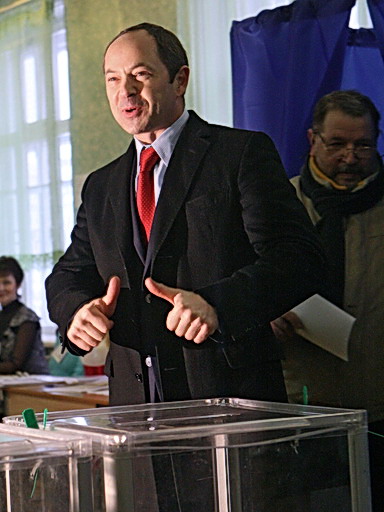
The results of the first round of elections in the Ukrainian president could be highly likely to be predicted in the fall - Viktor Yanukovych firmly occupied the first place, while Yulia Tymoshenko, finding himself in conflict with the most part of the elite, was more and more behind him and was forced to bear responsibility for the economic crisis. The question of who would become the third - Sergey Tigipko or Arseny Yatsenyuk was much more unclear. In the first half of the year, the answer to him seemed clear - of course, Yatsenyuk, but in the fall the initiative intercepted Tigipko, whose popularity began to grow rapidly.
The question of the third candidate was not so much in the context of the second round, although most observers analyzed it precisely taking into account this factor. The fact is that the electorate of this candidate - whoever he is - is quite peculiar. This is the Ukrainian middle class, which voted in 2004 mainly for Viktor Yushchenko as an honest and competent professional who is able to bring Ukraine to Europe without spoiling relations with Russia. Now such a characteristic of the outgoing Ukrainian president seems quite strange, but five years ago it was very popular and had serious reasons. After all, it was about an economist, a banker ("Father Hryvna"), a former premiere. Yushchenko’s voters could hardly assume that the priority of his presidency will be the creation of a national myth based on the West Ukrainian tradition, not separated by the country's population. As a statesman of Yushchenko, he constantly played a destabilizing role in Ukrainian politics, dissolving on the verge of the foul of the Rada in 2007, strictly conflicting with two of the three premieres (the exception was obedient and unpopular Ekhanurov) and becoming Persona Non Grata for Russia.
The collapse of the electorate Yushchenko led to the fact that a significant part of his former voters was in a state of search. Neither Yanukovych nor Tymoshenko could seriously attract this part of the Ukrainian population. With the first, everything is clear - the Ukrainian middle class (excluding part of the eastern voters voting from the "eastern" patriotism) is not ready to support the former prisoner, a "man from the east", associated with crime since the 2004 election campaign. With Tymoshenko, a little more complicated - the middle class of Ukraine could potentially vote for it, but this is prevented by the perception of the current prime minister as an authoritarian populist capable of provoking even more chaos in the country's already extremely stressful life. This is one of the reasons that this electorate will be very difficult to encourage to vote for one of the finalists. However, Tymoshenko has a little more chances for this, but there is hardly a total of a total of votes - rather, many supporters of Tigipko can ignore the second round. The second reason is even Tigipko, for which these voters voted, does not manage this electorate, who decided to support it only shortly before the elections.
The middle class of Ukraine seeks to influence political processes. It is relatively small, but is able to sex around the candidate who attracted his sympathy. Yatsenyuk’s mistake was technologies that scared off this very demanding voter-when they tried to make a “front-line soldier” fighter from a young technocrat (even Yatsenyuk called his political movement the front). The gloomy stylistics of visual agitation at the first stage of the campaign (even before the registration of candidates) only added problems for him. Against this background, Tigipko acted confidently, avoiding mistakes, preserving the restrained, confident style, which was fully consistent with his image and the expectations of a potential electorate. A native of the Komsomol business (like Khodorkovsky in Russia), he was the Minister of Economics, the head of the National Bank, an entrepreneur. He has a non-cardal image-in different years Tigipko collaborated with Yanukovych (he was the chief of his election headquarters in 2004), and with Tymoshenko (in the 90s in Dnepropetrovsk and recently as a free-sized adviser to the prime minister; he left this post shortly before the election). Thus, he did not appear “out of nowhere” - in 2004 he was even considered as a possible candidate for the presidential post from the authorities. At the same time, Tigipko retained autonomy from both current leading players in Ukrainian politics-both due to careful distance from their most controversial actions, and due to his own identity-a large businessman, the head of the financial and industrial group, who officially left entrepreneurial activity only before the current elections.
Tigipko is focused on a long game - so now he does not want to publicly support any of the leaders of the race. His calculation is for future parliamentary elections, where he can lead one of the leading fractions; And this is possible only to preserve independence (recall General Lebed, who quickly destroyed his political career after a seemingly profitable electoral transaction in 1996). Tigipko’s experience confirms that Ukrainian politics began to leave the “fatal triangle” Yushchenko-Timoshenko-Yanukovych. Yushchenko has already become an outsider - in the election he was ahead of Yatsenyuk, who, with a low election barrier, has a chance to hold his party to parliament. The current leaders of the race in the medium term will replace new politicians who now take places in the second row and either begin to go out in the first, or only think about it. And the phenomenon of Tigipko in this regard seems significant not only for the present, but also for the future Ukrainian policy. In the context of a pluralistic competitive political system and wide opportunities for party construction, they have real chances for this.
Author-First Vice President of the Center for Political Technology
Photos of RIA Novosti