
Translated material
Mayakovka. Half a century later
In society
 Mayakovka. Half a century later
September 8, 2010 Vladimir Kara-Murza (ml)
It's me,
Calling for truth and rebellion,
Not wanting to serve anymore
I tear your black bonds,
EXTENDED FROM LIP!
Yuri Galanskov, "Human Manifesto" (1960)
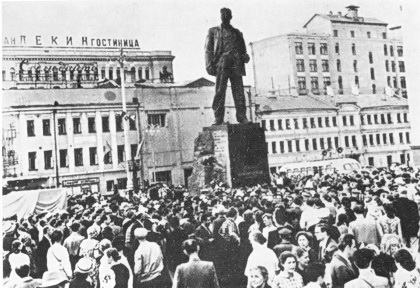
Half a century ago, in September 1960, a countdown of the history of the democratic movement in the USSR began on Mayakovsky Square. The tradition of poetic readings arose earlier, after the opening of the monument to Mayakovsky in the summer of 1958, but only in 1960 the youth "gatherings", as the warriors and Chekists called them in their protocols, acquired a political character. “In those days, it was very difficult to find like -minded people,” recalls one of the “instigators” of Mayakovka Vladimir Bukovsky. - There were many of them, but you could not hang the sign "Everyone who does not love Soviet power, come here." It was necessary to find some such sign. And I thought it was a very good trick, dexterous, because formally we do not commit any crime - we read poetry. And informally, of course, only those who do not love Soviet power will come to listen to forbidden poets. ”
Together with the works of Akhmatova, Mandelstam, Pasternak, Tsvetaeva, poems of young authors sounded in the square - for example, the “human manifesto” Yuri Galanskova. "People! / Leave, don't ... / stop comforting me. / Anyway among your hell / I have nothing to breathe! / Greetings meanness and hunger! / And I, fallen to the ground, / spit into your iron city, / full of money and mud. ” Contacts were tied on the “lighthouse”, the first samizdat spread, underground political and philosophical circles were formed. Every weekend hundreds of people gathered here. “It was an beginnings of the formation of civil self -awareness in Soviet Russia,” recalls Eduard Kuznetsov, a regular participant in Mayakovsky readings. -There were many talented people, for real. Very talented, honest people. There was the color of Russia. ”
The authorities did not suffer from Kramol for long in the center of the Soviet capital. “We were called in the city committee of the Komsomol, and in the police room often with us ... some people were not talking in police uniform,” recalled the artist Vsevolod Abdulov, who read Tsvetaeva, Pasternak, Samoilov on Mayakovka. -They said that our readings interfere with the street movement, the crowd gathers ... Moscow after all, they say, a hero city. They offered us some kind of club-take it, repair and, please get together, read poetry. ” Soon we moved to open repression. “There were fights with the authorities, the authorities tried to disperse,” Bukovsky says with a grin. - They used mostly Komsomes, Komsomol operational detachments were allowed to be on us. But the people took the arms, stood, guarded us. They launched cleaning machines, bulldozers on us. And nothing came out with them, we still defended this matter. Then they already tried to catch us at the end, beat us, kicked us out of universities. ” In 1961, the participants of Mayakov’s readings Eduard Kuznetsov, Ilya Bokstein and Vladimir Osipov received camp terms for “anti-Soviet agitation”. Then Vladimir Bukovsky was first arrested, who was to spend 12 years in camps and prisons. Yuri Galanskov was arrested later, in 1967. On November 4, 1972, he died in the Mordovian camp.
Mayakov readings were torn, but the area itself became a symbol of civil protest. It was here that in the mid-60s, the Smogists gathered, after the self-immolation of Jan Palach, in January 1969, Moscow students with the poster “Freedom of Czechoslovakia!” Came out, here in March 1990, riot police dispersed the banned Demsoyus rally and here, already in September 1991, thousands of people along with Vladimir Bukovsky and Galina Oldovoitova were happy and sipping, sipping, grinding. Noting the victory over the GKChP and recalling Yuri Galanskova, whose ashes were transported to Moscow in those days. With a rally to the triumphal Bukovsky, he began his campaign in the 2008 presidential “elections”.
Today, this square, surrounded by a fence (even the Soviet government did not think of this), again became an arena of the struggle for civil rights. Someday, in the not so far future, it will certainly be called the Square of Freedom. In the meantime, time and place - all the same. Triumphal. 31st. 18.00.
The author is a historian, publicist, member of the Federal Political Council of the Solidarity movement
(Photography from the archive of the NIPC "Memorial")