
Translated material
"Echo of Moscow", Lesin and Gromov
In society
 "Echo of Moscow", Lesin and Gromov
February 26, 2014 Julia Latynina
Three weeks ago, when the rain attack began, my friend, who came from Davos, joyfully greeted me with the words: “Wow, we ran into the rain. And in Davos, everyone said that the "echo" would be the first. " To which I replied: “And they aimed just in the“ echo ”.
It was a holy truth: “rain” actually got caught by accident. The “amateurs” program, in which the unfortunate question was asked about the blockade of Leningrad, is being addressed with the “echo”, and, as they say, when Putin, traveling to the Piskarevskoye cemetery, was shown right in the car the printout of the “rain”, it was said about the following: “The“ echo ”does!” To which the main allegedly looked and said: “And“ Echo ”has to do with it? The question is “rain”. And I had to wet the rain.
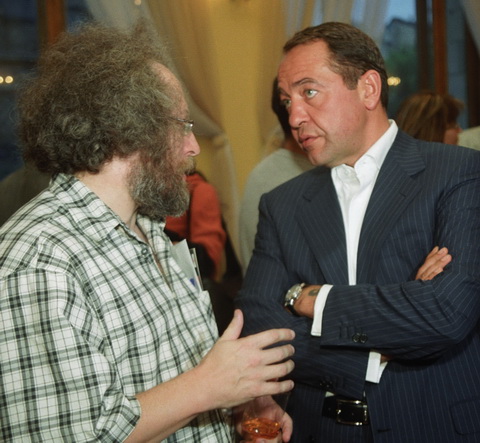
So it was or not, who knows, but this bike well illustrates one feature of the situation: the problem of Echo of Moscow is not the result of Vladimir Putin's command. Putin has the opportunity to close the “echo” without any tricks. In the end, he can simply call Venediktov and say: "Go away." The problems of Echo are the result of the personal conflict of Alexei Venediktov and Mikhail Lesin, in October last year appointed by the head of Gazprom-Media. Well, and a couple of interests, of which the main ones are called Alexei Gromov - a man who, according to rumors, every week, together with Lesin, played cards in a narrow circle in Rublevka and who, in fact, resurrected Lesin from political nothingness and contributed to his ascension to the very top of the media Olympus.
Lesin’s appointment itself had nothing to do with the Echo of Moscow. In Russia, the time has come of monopolies controlled by friends of President Putin. Monopolies of gas, oil, media. The media monopoly is the Kovalchuki brothers.
For several years, they concentrated control over the largest non-state television channels in their hands, having bought Ren-TV, the Fifth Canal, 25% of the STS-Media and 25% of the Channel One, and in addition, the Russian News Service, Izvestia and LifeNews.
At the same time, the fact of Gazprom-Media (in fact, the former Mediamost of Gusinsky) formally belonged to the structures of Kovalchukov, but in reality was controlled by Gazprom. This happened thanks to his general director Nikolai Senkevich, who, in addition, was considered the man Dmitry Medvedev.
The removal of Senkevich and the appointment of Lesin (whom, I remind you, it was President Medvedev with unprecedented sharpness who fired from his advisers “for non-compliance with the rules of civil service and behavior ethics”, according to the pressing formulations that leaked to the press) and meant the “Gazprom Media” control under the control of Kovalchuk. The purchase of Prof Media followed at the end of November completed the formation of a media monopoly in general terms.
The monopolization of media assets was accompanied by a monopolization of the advertising market. The fact is that the “Internet Internet” sold by Kovalchuk in June 2010 controlled about 70% of the television advertising market, and the lion's share of the rest was controlled by Alcasar, who sold NTV advertising.
It is difficult to say what exactly the Kovalchuk brothers were guided by, at the head of his super-chief of the former minister of the press, it seemed that it had long had fallen from the administrative deck and had serious risks in the West because of the “sixth protocol” and the war for NTV. Perhaps the recommendation of Gromov played a role. Perhaps they were pleased to put Lesin in the place of Medvedev’s man. Perhaps he played a role in the fact that the former Minister of Press and the former shareholder of the Video International, waging a war with NTV, even then planned to create a media-advertising monopoly on the basis of Mediamost. (Of course, he hardly assumed then that he would create it for Kovalchuk.)
In any case, it is easy to notice that the “echo of Moscow” in this whole story was completely on the fifth roles. It was about the creation of a media and advertising monopoly of giant scale, about managing huge streams of money - and not about such trifles as an independent radio station in his policy, the chief editor of which is an unsurpassed diplomat, not inferior to the Kremlin in fundamental things of things, and has special relations with Putin. In fact, Putin is the censor of Venediktov.
However, in addition to the tasks entrusted to him by the shareholders, Mikhail Lesin has a rich personal story. Immediately after his appointment, “Echo of Moscow” became the object of a number of intrigues, the last of which was crowned with success. I mean an extraordinary meeting of shareholders, who appointed Echo CEO Ekaterina Pavlova, wife of Alexei Pavlov, deputy chief of the press service and information of the president. Pavlova worked at the VGTRK producer and chef “Vesti”, and then on the radio station “Voice of Russia” as deputy chairman for broadcasting.
“Echo of Moscow” fought back quietly, preferring not to voice problems, but to solve them. Medium wars and public persecution - such as a campaign against Viktor Shenderovich, within which porn with his participation was demonstrated on state television - just his opponents were engaged in, exciting in the West the most unflattering association for the Kremlin.
Why the defeat of the Echo is needed by Alexei Gromov - it’s clear. He is set to control the press, and it is hardly pleasant to him that he is not controlled by the “echo”, not he, Gromov, but Putin personally. Why does Mikhail Lesin need it is also clear. A person who has returned from political non -being is usually inclined to use a newly acquired administrative resource for revenge and satisfy personal ambitions. It is not entirely clear whether Putin and Kovalchuk need it. In the end, if the Echo of Moscow is defeated, no one in the world will write off this on personal frustration of the former minister of press. Everyone will consider Putin personally responsible for this.
Photo by Svetlana Sokolova (ITAR-TASS)