
Translated material
Shivta
Around Russia
 Shivta
November 1, 2012 Julia Latynina
In South Negev (not in the north, which has long been turned by the Israelis into an orange garden) - there is a city of Shivt’s nabateev.
South Negev
The history of mankind is a lot of identical bricks that are simply laid in different ways. The distribution of grain to the Roman plebs, for example, strongly resembles a modern Welfer.
The history of Nabateev is amazing in that this is the piece of history that crawls out of classification. This is such a grammatical exception to the rules of history, such as writing the words “tin”, “glass”, “wooden”.
Nabatei are Bedouins, Arabs, who lived in antiquity in Negev in places where the paths of caravans, carrying Mirra and Ladan from Saudi Arabia in Gaza, where Mirra and Ladan were loaded on ships and sent further to Rome and pr.
Let me remind you that the temples of that time represented, from a hygienic point of view, the Chicago cattle -beams, and Mirra and incense were necessary. If in the temples it had not smelled of Mirra and incense, then you would smell of you-Sami-SUSH-what.
Therefore, with the advent of Islam, this branch of the economy (and with it the culture of the Nabateei) died out by itself. There was no longer the goods that were valued more than gold and which had an economic meaning to take several months on camels through the desert. Nabate cities simply disappeared. The city of Shivt, for example, was destroyed by an earthquake in the 10th century. And he was not revived. This is the Pompeii desert. There are no other cultural layers from above.
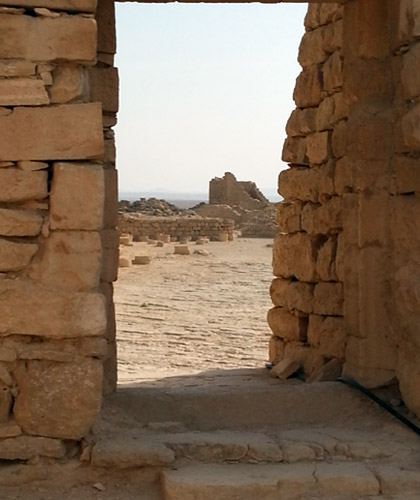
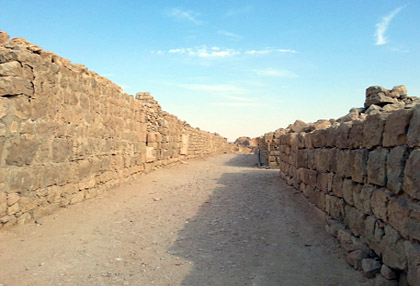
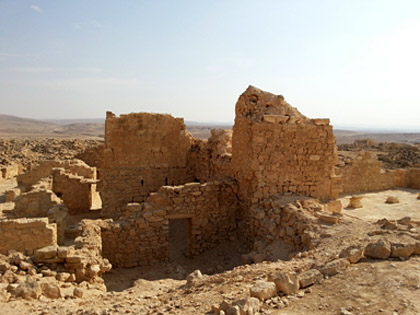
The only cultural layer of Shivta is not excavated and not entered
Initially, the power of guide conductors relied on wells. The fact is that in the Negev desert, with its limestone mountains and steep slopes, rains are going on - moreover, real floods happen there in winter. And if you collect such a stream in a well, then this water is enough for the caravan for the whole year.
Let me remind you that the word "well" in Israel means a completely different hydraulic structure than in Russia or Great Britain.
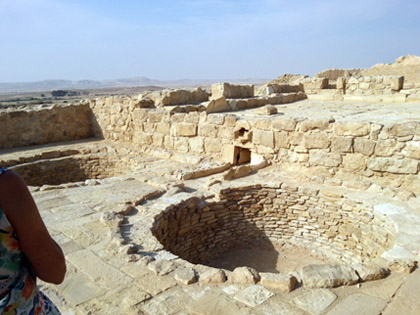
In Russia, a “well” is a hole in the ground in which water gathers. In Israel, the “well” is an underground container, a tank, dug in a waterproof limestone and filled during winter rains using a cunning groove system. (Remember how the brothers threw Joseph into the "empty well" in the Bible?)
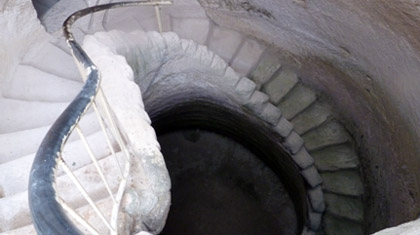
The ancient calcareous well, of course, is empty, because the groove system is destroyed. Photography is given for example
At the top, limestone is very dense, cubs from rains and sun, it is difficult to hammer it, and the upper hole of the well is very small, like a neck at the jug. But below it expands into a huge container. (To get out of the empty well Joseph was really difficult.)
And taking into account the fact that the nabatei covered the hole of such a well with a stove, it was simply impossible to find it in the desert without a knowledgeable person.
So, the nabatei for a long time were classic nomads, they were forbidden to have, to report some Jewish official of the 3rd century. BC Three things are “housing, private property and engage in agriculture”, they accompanied caravans and terribly rich in this.
And in the 1st century BC Something happened to the alarm: they took up agriculture and began to base cities. This is a completely unique story, because the Bedouins (like the Eskimos) belong to the number of peoples that, as an idealist-ecologist would say, are completely inscribed in the environment and merged with it and which, as the pragmatist would say, live in conditions so borderline for humans that the conditions of their existence do not change millennia, and any change and technological progress are perfect tables.
Bedouin lives in symbiosis with his camel. He spreads the tent from his skin, drinks his milk and picks up his cakes in order to make food for himself on dried shit. He did this 3 thousand years ago, he did this 50 years ago. Any change in these primitive technologies, close to the instinctive habits of bees or foxes, threatens the collapse of the population.
Nabatei were an amazing exception: they took up agriculture in the desert, where nothing grew before them and after them for 1000 years. They circled the future field in the desert and before the rain (which could pass 1-2 times a year) opened the passages in this dam so that water from all the surrounding mountains gathered inside the dam and was supplied with an olive growing there. For irrigation of one hectare of the desert, dozens of has of the surrounding mountains were required. They stacked pyramids of stones in the desert, on which the dew was probably condensed and grape vines probably grew.
Now, after 2 thousand years, the Israelis are building the same dams in Negev. This is called "the study of ancient techniques of desert agriculture."
But the most amazing is the cities of Nabateeev. And these cities are the goal of my story, because it is precisely due to the extremity of the conditions on the example of these cities that it is very clearly visible what the human city is. That the human city arises when people live not just together, but when they live together. That this is the whole, which is more than the amount of its parts.
Shivta is located in exactly the same way as the city of Krymsk. This is a city located in the desert, without a single source of water, without springs, built in a bowl of hills and mountains. In the middle of this city there are two ponds on the square.
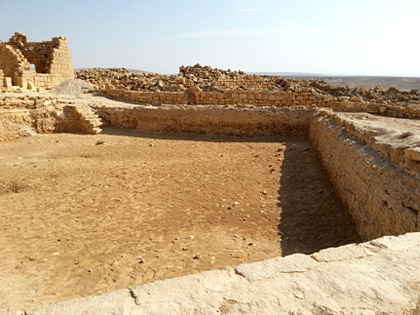
Pond in the square
And the cunning system of grooves, according to which flows (similar to the one that destroyed Krymsk) flowed into these ponds and wells that were dug up in every house.
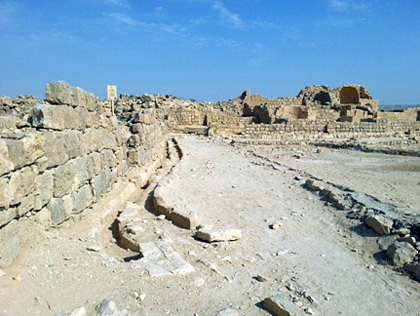
Ponds in the square and grooves leading to them
These ponds and hydraulic structures leading to them are a reminder that the inhabitants of this city could only contain them in order only together. Each individual city dweller in this city did not have the opportunity to survive.
Shivt did not have a fortress wall. The desert was the most reliable wall for the inhabitants of Shiva. And the continuous outer wall of the city simultaneously served as the back wall for houses.
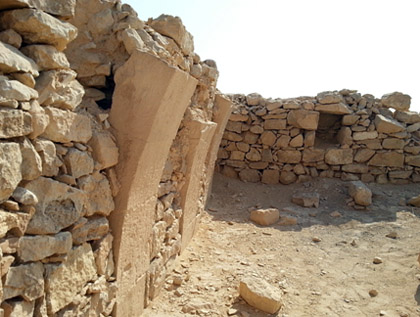
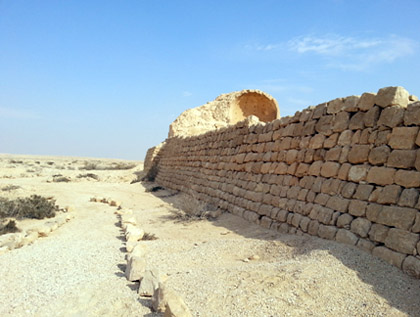
The outer wall of the city, which is part of residential buildings
And again the same principle: each individual citizen built a house, one wall of which became part of the common city wall.
There are many amazing things in Shivt, in particular, two winery. For the very grapes that was grown in the desert, where only thorns are growing. The winery was apparently private, but the grapes were clearly not bought: it was processed. In the winery behind the city, there is a tributary room - where the berries were given juice, and this juice flowed through the cunning system of grooves first in one hole for fermentation, and then, when it was filled, to the other.
And next to this crippled room are eight rooms for baskets, the purpose of which is intuitive. Abdullah brought, for example, five baskets and dumped them into a crippled room, and he is allowed to scoop up ten jugs of wine from the pit, and Vasily brought 7 baskets - and he due to 14 jugs. The output of the wine to the basket, of course, was known.
Winery
And here again the same principle: a combination of private and public. Grapes will be useless without winery for everyone. The winery for everyone will be useless without the owners of the grapes.
As I said, Shivta is located in the desert and was destroyed a thousand years ago by an earthquake. There are no cultural layers from above, there are very few precipitation, sand too. Despite the fact that the city was not specially dug up, you can safely walk along its pavements, which are not even brought by sand.
Of course, the city is all melted. All that the inhabitants themselves did not take away after the earthquake - clothes, jugs, Lari, boards, chests, then dragged the Bedouins in 1000 years. They plunged this city, like a vulture plugs carrion. One skeleton remained from the city, this skeleton is completely intact and not buried.
The Talmud has a definition of a city according to which the city should have ten signs. Among these signs, in addition to the court, the synagogues and the cash desks of mutual assistance are mentioned by a public toilet, but the ruler is not mentioned there.
The city is such a place whose inhabitants participate in his fate, because if they do not participate, it will die.
This is, in fact, to the fact that our Russian cities are not cities, and this is one of the reasons for the monstrous apathy of the population and the catastrophic results of the elections of city authorities.
The city of Khimki, where 28% of voters appeared in the elections, unlike Shivta, is not a city. The elections in Khimki were a parody of the elections because Khimki is not a city.
You can, of course, say to me that not all cities of the world are not water. But Shivt is just an extreme example, there are other ways to participate in the city’s inhabitants in its fate.
The easiest is tax payment. The whole point of modern Community in the West, like 500 years ago, is that it lives from local taxes. Residents of the city of Khimki do not feel themselves taxpayers. And the city of Khimki, in turn, receives money not from residents, but from a higher budget.
Imagine that every inhabitant of Hymik would have paid 13% of his salary not at all, but specifically to the budget of Himmok, and there would be no other sources for this budget. Then it would be elections.
P. S. The author thanks the amazing Zoya Brooke for the wonderful trip to Israel, as always.
Photos of the author