
Translated material
Cyril and Church
In society
 Cyril and Church
July 22, 2009 Alexey Makarkin
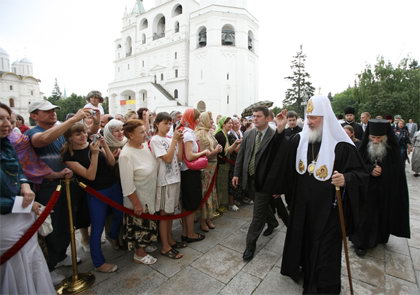
Soon the first six months of the Patriarchate of Cyril, the current Primate of the Russian Orthodox Church, will be fulfilled. You can summarize some results that turned out to be very contradictory.
Let's start with the actions of the patriarch. In the personnel sphere, he “advanced” several consecutive supporters who actively participated in the organization of his election campaign (among them Archbishop Ilarion, Archpriest Vsevolod Chaplin and several others). “Pushed” to the secondary position of his only competitor to Metropolitan Clement. Then, Bishop Jerome, the father of the Lord of Clement, who managed the Oryol diocese, was removed from his position. The official reason is the conflict between the ruling bishop and part of the clergy and parishioners of the diocese. Under the previous Patriarch, the church leadership in such cases usually took the side of the bishop, if it was not about completely scandalous stories that fell into the “yellow” press. Now the Patriarch supported the opponents of the bishop, although there was no emerging scandalous in this conflict. This step can be a signal to other supporters of the loser of the candidate, who so far retain their posts. It is noteworthy that Bishop Panteleimon, a long -standing employee of the current Patriarch, who previously managed the Maykop diocese, became the new Oryol bishop.
In public space, the new Patriarch is the opposite of his predecessor. He spoke at the stadium in the presence of thousands of young people, many of whom had never seen with their own eyes not only the Patriarch, but also the “simple” bishop. Made the attention of the media's attention about the causes of the economic crisis and about the victims of the Great Patriotic War as redemption for the militant godlessness of previous years. He held the first in the modern history of the Synod "Outbound" a meeting in St. Petersburg. He appointed the preparation of a new textbook on the “Fundamentals of Orthodox Culture” of such criticized by ultra -conservatives of theologians as Protodiacon Andrei Kuraev (one of the most active supporters of Cyril in the pre -election period) and Archpriest George Mitrofanov from the St. Petersburg Theological Academy. Attracted the attention of many secular people as a bright speaker and an energetic person - an image not characteristic of the highest church hierarchy of our time. As well as, by the way, to modern Russian politics (we recall at the same time the professional election campaign conducted by Cyril in front of the Local Council). The upcoming visit by the Patriarch to Ukraine, no doubt, will only confirm this impression. The trip of the Primate of the Russian Church to Constantinople continued the course of Alexy II to dialogue with the Ecumenical Patriarchate, in the development of which Cyril also participated as the head of the church “foreign policy” department.
However, the Patriarch’s personal qualities do not solve - and they themselves cannot solve - problems facing the church (they are well known: weak missionary and social work, insufficient influx of youth, etc.). Moreover, the number of these problems may even increase. The new team, which came to the management of the Church, consists of people of action, not only brought up in a church tradition, but also ready to "promote" it in public space. And here they may encounter a negative perception of their position from a significant part of believers and the population as a whole.
The fact is that under Patriarch Alexy the Church was extremely careful in expressing its own position on “acute” issues. This was due not only to the immobility of a significant part of the higher clergy, but with the real state of the flock, the features of its mentality. Take the “classic” type of believer for the Russian Church of the last decades - “church grandmother”. Now, as a rule, this is not a woman who is accustomed to going to the temple since childhood and for many years that kept her main relic in the chest - a photograph of the bishop shot in the Stalin years, whose sermons she remembered until the end of days. Today, the majority of “church grandmothers” are normal Soviet people who until the 90s did not think that they would come to church. However, the collapse of the USSR, the loss of familiar work or a sharp reduction in salaries, a beggarly pension, the drama of loved ones (died at a hot point, drank, went missing in peacetime) led to a strong stress, after which such people found themselves in the church - perhaps the only place where they were ready to warm, where they could again feel in demand. This applies not only to "grandmothers." Retired officers who lost their usual status and yearning for the “Cold War”, former party activists, after the dissolution of the CPSU, tried to find new idols went to the church. And then the new generation - young people who dream of great theocratic Russia, crushing the corrupted post -Christian West and take revenge for the defeat of the Soviet Union.
For these people, the collapse of the USSR is a tragedy (often vital), and the persecution of the church in the 30s is a distant story, perceived detached, without deep interest. If they revere someone from that era, then the Holy Matron understandable and close to them, and even then passing from the mouth to the mouth an apocryphal story about the meeting of Matronushka with Comrade Stalin. The illustration on this subject was recently removed from one of the temples of the St. Petersburg diocese, whose rector (now the former) did not hide his veneration of the Generalissimo. But this is only an “extreme” case - many of its like -minded people do not give up an open call to the Holy Principles and continue to calmly go about their business. If the canonizations in the church would be carried out by voting, then one of the first candidates for saints could well be Marshal Zhukov, who did not frown not only strangers, but also his soldiers, but mythologized both in the late Soviet and in the post -Soviet era.
Similar views get along in the minds of many modern parishioners with the lack of rigorism in the household sphere, which is not surprising. The Soviet Union of the Brezhnev period was a kind of consumption society (only poor than the West), which was not recognized as an official ideology that condemned “philistinism” and “things”. However, the prevailing values in society were material well-being (the famous "triad" apartment-dacha-machine), career, health. In this, the Soviet man was not much different from the Western-except perhaps the double individualism due to the underdevelopment of civil society institutions, stuck under himself by the party. The collapse of hopes and the associated forced coming to the Church often does not lead to a coup in the minds of “warm -up” people - although, of course, there are exceptions.
So the sermon addressed to the flock was restrained for many years: the church tried to bypass sharp corners that could cause dissonance with the opinion of the flock. At the same time, in a narrow circle, one could say more frankly, as well as to publish serious books with a small circulation. For example, about the experience of the Pskov mission, operating on the territory occupied by the Nazis with their consent and under their control. For the "average" believer, such a missionary is not a hero; For him, “their own” are Soviet partisans, even atheists. Only some priests (for example, Archpriest George Mitrofanov) have long been raised in their sermons and articles uncomfortable topics. The words of Patriarch Kirill about the victims in the war as redemption for godlessness can be understood and accepted by traditional believers, who took all the misfortunes that fell upon Rus'-Russia for many centuries. But for the Soviet - on the upbringing and culture - a person who is convinced of the righteousness of his ancestors, such perception often becomes impossible, and the words about redeeming seem to be an insult.
Even greater disputes in church circles have already caused a strict assessment of Stalin’s activity, given by the new head of the department of external church ties of the Patriarchate by the Archbishop Ilarion. Recall that he called him a monster and a spiritual freak who unleashed genocide against his people and quite comparable to Hitler. Such epithets are quite consistent with the church understanding of the role of the dictator, in which many believers were ruined - from bishops to parishioners - and the church itself was put on the brink of death. Its complete destruction was prevented by the non -goodwill of the tyrant, but the war and the need to respond to the discovery of thousands of churches on the occupied lands from the sanction of the Germans. However, for the Soviet man-especially traumatized in the storms of the 90s-Stalin is, if not a hero, then at least an outstanding person "with his pros and cons." The same thing even more applies to pseudo-church national patriots, admiring Stalin for external expansion, the destruction of the Bolshevik elite and anti-Semitism of recent years of reign. The comparison of the leader with the Fuhrer looks unscrupulous not only for many current Orthodox, but also for those in power. The question arises: will the Vladyka say the subject of consideration on the recently created “Falsification Commission”?
It is possible that in line and other surprises. It should be noted that the head of the newly created department on the interaction of the Church and the Society of the Moscow Patriarchate, Archpriest Vsevolod Chaplin, is known to him the point of view that the true Christian should prefer death for faith in such values as the survival of a person in the modern world, comfort, prosperity, health, success. This is also the orthodox position of the Church, backed up by the tragic fate of the martyrs who went to death for the sake of their faith (including in Stalin Russia). But at the present time, such views are dissonated with the moods of people who came to the church for comfort, and not martyrdom, looking for a kind of comfort in it, which they could not reach outside the church fence. Most often, church leaders therefore preferred to circumvent this topic, focusing on the moral teaching of the Church, which does not contradict the usual humanistic values.
The Church under Patriarch Kirill tries to speak more firmly with society, which is an unconditional plus - honesty is better than omissions, albeit dictated by good intentions. But she should be prepared for the fact that her position may not be accepted not only by people far from her, but also by a significant part of a superficially church flock.
Author - First Vice President of the Center for Political Technology
Photo from the site www.patriarchia.ru