
Translated material
History about geese
In the village, no one dies of his death. I mean animals living in the yard. Maybe a dog or a cat also has a chance to calmly go into another world, but the rest do not. The pig will be stabbed when its time comes, the goat will be clogged when it stops giving milk, and the death of the chicken comes when it stops carrying eggs. This is inevitable, it is difficult to imagine a “pets cemetery” in some village.
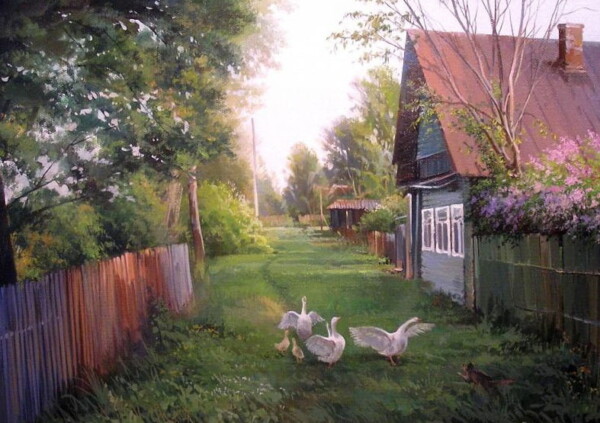
My grandmother used to have a lot of living creatures in the yard. Two goats, a lot of chickens, rabbits and pigs. There was also a stupid dog and a very wayward cat. All of them lived the term allotted by him, and then became some kind of delicious dish. With the exception of the dog and the cat, of course.
From the courtyard to the courtyard, a set of living creatures does not change much - everyone in the village hold chickens, many breed rabbits for the sake of meat, and a cow will replace a goat in a large family. Surprisingly, in the village of my grandmother I almost never saw geese. In the mid-90s, the collective farm, focused on the breeding of cattle, completed its existence, its lands were sold to farmers and they were mainly planted on cereal crops. Also on the wreckage of the collective farm at the beginning of the zero, a private enterprise was opened to breed geese, but this is not count, people in the village in the yards still had almost no geese.
If you think about it, then geese are extremely unpretentious creatures - they are much smarter than chickens, they can stand up for themselves and are extremely similar to the sheep in their behavior. The latter also has a leader who leads his Otaru. You can just let goose go to the yard and they will go to look for food for yourself. If there is some kind of reservoir near, let's say a pond, then the geese will calmly walk on its shore, and come home in the evening, walking after their leader.
The only geese that I saw in the village besides those that were on the farm is the geese of Grandfather Boris. He was an extremely peculiar person-he once served in prison, he lost his ear there, but successfully married a very kind woman and moved to our village with her. It was somewhere in the early 80s. For some time he worked on a collective farm on equipment, and his wife worked at a rural hospital, but after the collapse of the collective farm, work for him was gone and he began to drink very much. Then probably everyone began to drink strongly.
Many drank before that, since there were not so many entertainments in the village of the 90s, but, according to the stories of my woman, the men began to sleep right then. Add to this that people began to massively drive moonshine, turning it into currency on the level of diesel fuel, and get the very sad appearance of the beginning of the zero. The wife of Boris remained a paramedic in the hospital, they had no children and they just survived their age in a small house.
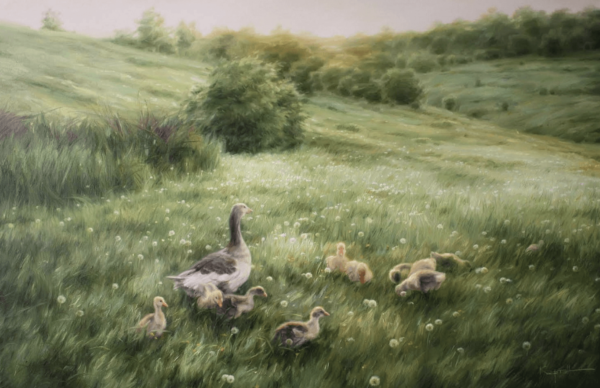
I already said that Boris drank heavily, but it was not his biggest problem. A big problem was that in a drunken frenzy he had a wild desire to burn something. Usually it was his house, along with his wife calmly sleeping in him. As a rule, his attacks did not end with anything terrible and always stopped him in time. He definitely did not like it. But there were another bright spot in his life besides his wife - geese. He loved them as his children.
The luxurious goose of Gosha, the leader of the pack and just a macho in the world of geese, and the three beautiful goose beauties are constantly following him. Boris loved and in every possible way protected them from his cloak friends, who often attacked goose feathers, hoping to make fishing floats from them. In a few houses from my grandmother there was a drunkard named Serega, who was once bit Boris because of the notorious feathers.
Time passed, rural alcohol did not particularly contribute to the long life of Boris and at some point in the spring he died. He just fell asleep and did not wake up. His wife was burning for some time and realized that it would be hard for her to live in the village alone. She had a sister to whom she decided to go. She did not have a large farm at that time, and the old house did not represent a special value, so nothing kept it there.
Nothing but geese - she could not let them under a knife, even when she was offered to prepare noodles from them for the wake and forty days of her husband. In the end, she walked near her neighbors and my grandmother bought the whole set of geese.
At first, it was not clear at all what to do with it - the goose eggs were not suitable for food, the geese themselves simply go throughout the district, and in the evening they return to the barn to sleep. At some point, a strong-willed decision was made let the bird on meat. It was very sorry to chop the heads of the goose to his father, although there was no strong attachment to them-in the village all the living creatures should benefit and die with his death is an unacceptable luxury. So by the beginning of winter, Gosha remained only with one goose.
At that time I was often sent to the village, since she was not far. Mass gasification of the villages in my area then has not yet begun and at home in its most part they were heated with firewood and coal. Usually in late autumn, when all things in the garden were completed, several firewood machines and a couple of tons of coal were bought. This was more than enough for the winter to heat our house. Firewood, as if vaccinated, was brought with drinking, but not chopped - just thirty kilogram oak stumps. The task of breaking them is not particularly difficult - you put one stump, on it the other, you hit with an ax and so you continue until the logs received will not be suitable for the size of the size.
Very meditative work, but the main thing is not to damage. I crossed a lot of firewood in childhood. Usually in my partners they gave me the same drunken Seryoga. He was not old, it seems the same age as my father, but he looked so -so - very thin, his legs obeyed with difficulty, and his face was in wrinkles. With all this, he very skillfully pricked firewood sitting, telling me stories from his youth. Not my grandmother paid with food and a small amount of money. He, as a rule, lowered them into cigarettes and moonshine, sold by an old woman at the end of the street.
I remembered one of these days associated with firewood very well. Timely, we did not have time to beat the firewood at the end of autumn and they were thrown by snow. I was sent to the village during the school holidays to solve the problem with firewood. The plan was slow with Serega to prick firewood throughout the day, and when it was dark I would go to pass Megaman 4 and read Gogol's Taras Bulba.
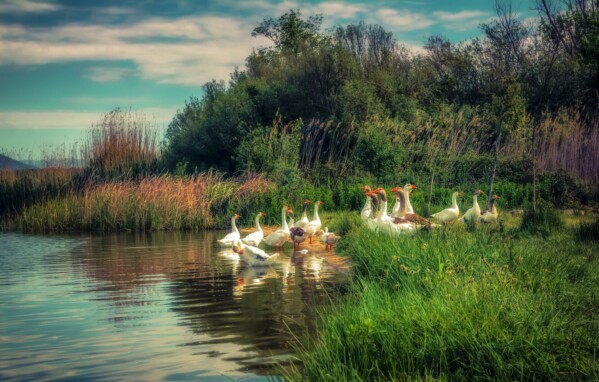
By that time, Gosha was left alone, since the last goose was frying for the New Year. He just walked sad in the yard, fingering snow with his red paws. He had a separate corner in the barn of rabbits, in a box with a bunch of hay. He was not at all afraid of people and on the first day when we began to stab firewood came to see what we are doing on its territory. Serega began to talk to him, recalling the deceased Boris, and Gosha answered him with a very sad naked. At some point, Seryoga took a piece of bread from his pocket and treated them Gosha. He quickly ate him and sat down next to Serge.
He spent almost the whole day there, occasionally bouncing off the logs flying in his direction. On the second day and in my pocket there was a piece of black bread for Goshi. He also with great pleasure ate a hotel and made us company until the evening. He came every day, we fed him bread and, probably out of boredom, he stayed with us.
Time passed, Gosha increasingly spent time with people. He was like a cat by his habits - it was enough to feed him and he remained nearby. He was nearby when in the spring the whole family cleaned the foliage in the garden, was nearby when things were done in the garden, was next to any activity in the yard.
Everyone in the family, leaving the house, remembered that it was necessary to feed Gosha with bread. This went on for several years. Already no one thought, let the favorite Gosha under the knife, even on the contrary, we thought after one of the winters to buy him a goose from the farm.
Winter is over, spring came and Gosha was depressed. He less and less came out of his barn, climbing his box with hay was difficult for him and it became clear to him that he would end soon. Maybe it was old age, maybe some kind of goose disease, maybe something else, one way or another it was necessary to do something. Now we came to him, lifted him in a box and fed bread. One day, his father went to the rabbits, and Gosha did not raise the noise from his seat. It became clear that Gosha was everything. We thought for a long time what to do with the body - no one ever buried the geese.
In the end, my father and I dug a hole in the wasteland between the yards, made the lid on his box and buried it in it. Goose Goshi probably had a beautiful and interesting life. I doubt that geese were once buried in the village, since it is an unacceptable luxury to die in a village for living creatures.
#History