Translated material
Again a deuce
The government abandoned the idea of doubleting GDP
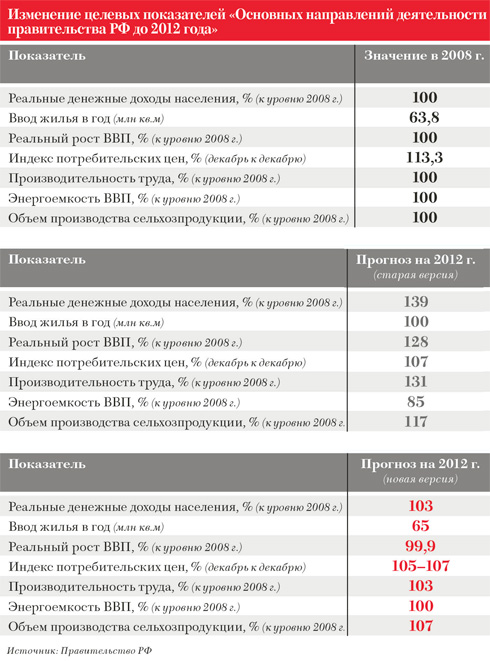
Farewell to doubling. Prime Minister Vladimir Putin adjusted the main areas of government’s activities until 2012, approved by the Cabinet of Ministers in November 2008. The government abandoned the ambitious tasks of doubling GDP and a sharp increase in population incomes. The New Times got acquainted with new economic plans
The history of the emergence of amendments to the main areas of government activity for 2009-2012 is almost conspiracy. The document was signed by Vladimir Putin on November 2, but published on the White House website almost two weeks later. At the same time, no press conferences of the ministers of the economic bloc or high-ranking officials of the government apparatus, without which no presentation of such a significant document is complete, was not in sight this time. However, this does not have to be particularly surprised: since the beginning of the crisis, the government adheres to the unspoken rule, according to which positive news is promptly and loudly voiced, and negatively, as possible, is silent. In the latest amendments - almost continuous negative.
Strategy without tactics
Recall that the previous edition of the main directions was approved by order of the Government of November 17, 2008 - already at the height of the crisis. True, then the authorities believed that it was not worth paying attention to the crisis, so the targeted macroeconomic indicators for the next four years proceeded from the ambitious tasks of the strategy of long-term socio-economic development of the Russian Federation until 2020. Now government officials are forced to admit that most independent experts stated a year ago: the bully plans for Russia turning Russia by 2020 into a country included in the five world leaders in the volume of GDP, made by energy -efficient and high -tech economies, will have to be put into util.
A cross is put on the plans to doubling GDP for 10 years. This goal was set by the former President Putin in 2003, and as economists calculated, to achieve it required annual GDP growth by 6–7%. If in the "fat" years of oil abundance this problem was solved at the very least, then according to the results of this year, the government expects to reduce GDP by 8.5%. Now it is clear: the fairy tale of doubling will do without a happy ending. In the new version of the government document, the clause on “the ability to increase GDP by at least 6–7% per year” is not mentioned at all. And instead of the task of increasing GDP in 2012 by 28% of the 2008 level, the goal is now indicated by the decline in this indicator within 0.1%.
Minus performance
As noted by the Economists of the World Bank (WB) in the “Report on the economy of Russia” published last week, even the modest task is to tighten the GDP by 2012 to the level of 2008-it is achieved only on condition that the government will rely on a new growth model. “It should be more focused on increasing labor productivity, new advanced technologies, more efficient use and placement of investment and labor resources, direct foreign investments,” said the co -author of the report economist Sergey Ulatov.
However, in the government itself, no hopes for increasing labor productivity are imposed. If a year ago in the main directions it was planned to increase this indicator for 4 years by 31%, now the landmark is just a “plus” 3%.
Meanwhile, just recently, on November 6, the Minister of Economic Development Elvira Nabiullina, speaking to the State Duma deputies, said: “The Government program“ Strategy-2020 ”involves a gradual transition to an innovative economy in order to increase labor productivity. In the case of the incarnation of the plan, labor productivity should increase by 4-5 times. ” It seems that in the government the left hand does not know what the right one does: after publishing amendments to increase at times, there is no need to speak - the score goes on a share of percent per year.
This forecast was called the chief economist of the Finams Management Alexander Osin: “Such labor growth rates are unacceptable. Of course, we can suppress inflation next year, but the structural shortcomings of our economy will not disappear from this and we will not get movement in the right direction. Therefore, the state will have to activate efforts on the growth of labor productivity. ”
They forgot about modernization
Other significant socio-economic parameters that the government want to achieve by 2012 are not in the best way. The growth rate of real disposable cash incomes of the population is reduced: 3% instead of 39%. The ambitious plans for housing input were folded: in November 2008, the construction of 100 million square meters was predicted. m, now - 65 million square meters. m. The target indicator for the growth of agricultural production production is reduced from 17% to 7%.
But the most noticeable changes in the updated plans of the government underwent indicators of an innovative increase in the efficiency of the economy. In particular, the energy intensity of GDP in 2012 should now correspond to the level of 2008, while a year ago it was planned to reduce it by 15%. Plans for diversification of the Russian economy are seriously adjusted. In November 2008, it was supposed to increase the export of machines, equipment and vehicles over 4 years from $ 23.5 billion to $ 36 billion. In the new edition, this goal is not at all in the White House.
Some progress can be found in only one planned indicator: the government hopes to bring inflation to 5–7%by 2012. However, economists of the World Bank, unlike the Russian authorities, consider the decrease in inflation in Russia rather a negative factor. “It reflects a sharp decrease in internal demand and the continuation of the credit crisis,” says Sergey Ulatov.
In connection with the adjustment of the tasks of the government until 2012, the targeted guidelines of strategy-2020 are already completely unrealistic. After all, in order to achieve tomorrow's shining heights, one must somehow move through today's deep ravines. Meanwhile, Julia Trucheaeva, the chief economist in Russia and the CIS Merril Lynch, notes that the expectation of positive in the Russian economy is associated exclusively with external factors: the restoration of world demand and the international financial system, as well as an increase in oil prices.
And the World Bank warns that in the coming years the Russian economy should not be hoped for restoration of growth if the government does not accelerate institutional reforms - primarily the reform of the public sector, social sectors, the judicial system, the financial infrastructure, the protection of property rights. However, in the updated plans of the Cabinet of Ministers, nothing of the kind is listed.