
Translated material
Happiness according to plan
Vladimir Putin at the Congress of United Russia chose not to talk about politics, but about the economy
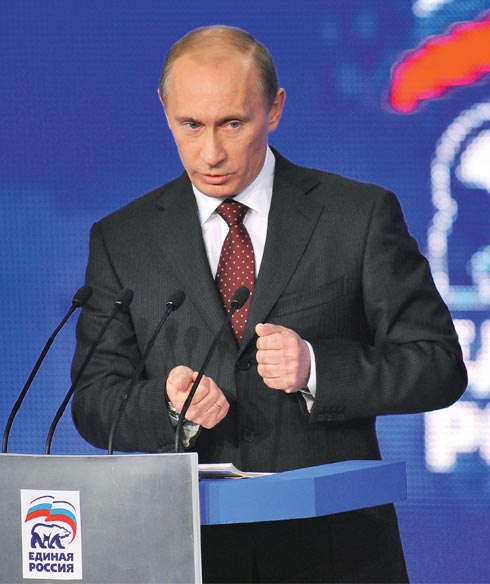
Photo by Dmitry Aleshkovsky
The speech of Vladimir Putin at the Congress of United Russia, the leader of which he is, in essence, the enumeration of specific economic measures, which are either already executed by the government or will be realized in the near future. What is in this speech - populism, and what is really and feasible - The New Times was understood with the help of experts about Putin’s pensions: “In ten days, the base part of the pension will be increased by 31.4%. In 2010, the growth of pensions will be 46%, and the average old -age labor pension will exceed 8 thousand rubles. We will no longer have older people left, whose income does not reach the living wage. ” Danilov-Danilian: Putin correctly set priorities: he focuses on social support for the population in a crisis. In most developed countries, during the crisis, the pensions were not indexed, and in some places even decreased: thereby pensioners were at least in an equal position with other categories of workers, who had salaries fell. And ours even won. You can argue about whether the Russian government is in force in the conditions of a budget deficit, but it clearly pursues a policy aimed at active support for pensioners.
Maslennikov: Next year, almost half of the federal budget will be spent on pension needs. The question arises: due to which pensions will be paid in 2011-2012, when there are no sovereign funds (backup and national well -being) in the country, the funds of which by that time the government intended to spend? There are no guarantees that in 1-2 years the economy will grow enough to give the budget money to fulfill increased pension obligations. As for the average pension size of 8 thousand rubles, much will depend on what pace the inflation will grow. If 10% per year, then the old people will not come out of their poverty and half of their pensions will be forced to pay for housing and communal services.
About the Putin’s old -time disposal program: “Any citizen who will put his old car for ten years or more years in util will receive a check for 50 thousand rubles and will be able to invest in the purchase of a new car. At the same time, it doesn’t matter which car he is going to purchase - domestic or foreign, the main thing is that it is collected in Russia. ” Maslennikov: This is a completely new and very important measure for stimulating internal demand. Similar programs for the disposal of old cars played a role in supporting the auto industry of many European countries and in the USA. But 50 thousand rubles may be an insufficient incentive in order to invest them in the purchase of a new car - this will only be clarified in practice. And frankly, I do not think that this measure will help AvtoVAZ: I believe that most buyers will give preference to foreign Russian assembly models - the Ford Focus type.
Inflation “Judging by the current situation, inflation in 2009 will be 9.6%, which will become one of the best indicators since 1992. Back in 2008, its level was 13.3%. The tough anti -inflation course will continue. ” Delyagin: In Russia, for 2.5 months, official inflation was zero. But if in mid -November it amounted to 8.2%, and according to the results of the year it is planned to be 9.6%, then a sharp acceleration of inflation is ahead - by 1.3%in a month and a half. And a tough anti -inflation rate means that money will not be allowed into the economy, that is, there will be no funds for modernization and people will have to tighten their belts.
Unemployment “Unemployment in Russia has been declining for several months: from 7.1 million people in February to 6 million in October. However, the situation in the labor market is still intense. Next year, we allocate another 36 billion rubles of budget funds to the employment assistance programs. ” Krichevsky: I would not in a hurry to accept the official figures for a decrease in unemployment on faith. We understand that part of it is hidden. The heads of enterprises, in order not to have troubles with the local authorities and the prosecutor's office, prefer not to dismiss people, but transfer them to incomplete employment, send them to unpaid leave, etc. The question is how much organizations have enough financial reserves for such a policy. And in this sense, the allocation of 30–40 billion rubles does not solve anything: we do not hear about large -scale programs of resettlement of people from the single -industry towns or mass retraining of those who have lost their jobs to new specialties. And the fact that the funds allocated for these purposes will be mastered for these purposes will have no doubt: the branches and branches of employment services will probably acquire a more front -line form.
On the available housing “The Program of the Fund for Assistance to Reform Housing and Communal Services was designed until the end of 2011. With its effective functioning, I consider it possible to extend it at least until January 1, 2013. In 2008-2009, more than 10 million Russians were improved. Until the middle of next year, 150 thousand people will be guaranteed to move from emergency housing to new apartments. ” Nemtsov: This fund is a state corporation. Gosque corporations are the most thieves' structures of all possible. And it is clear that Putin’s statement about the support of the Housing and Public Utilities Fund is Pink towards Medvedev, who wants to liquidate the state corporation. There is an echo of the inner subcover struggle. In addition, it is impossible to understand how the money of this corporation is spent and how to judge the effectiveness of expenses. But everywhere we see dilapidated houses without any repair. I would liquidate this corporation: all the same, the money will not reach the renewal of the housing stock.
The mortgage “While the mortgage system is poorly developed, because the loan rates are high and now is 14-15%. In order for a mortgage to become accessible to a large number of people, the rate, according to experts, should fall to 10-11%. The Government of the Russian Federation intends to use about 250 billion rubles to support a mortgage in 2010. Part of the pension savings under the control of VEB will be invested in reliable mortgage bonds of Russian banks. ” A very important measure. In past years, few funds were allocated to support a mortgage - about 60 billion annually. 250 billion rubles are already very good, but still not enough: about 600 billion rubles are required for this area. In any case, the mortgage will become more accessible.
Banks hold the percentage of mortgage loans so high, because they lay in it all their risks associated with the service of “bad” debts. The volume of the latter is about 1 trillion rubles. This problem can not be solved only by the infusion of money: other steps are required to clear the balance of banks from “bad” debts. Perhaps Web will have enough funds to support banks with “bad” mortgage loans (according to my data, their level in the largest banks reaches 17-18% of the total loan portfolio), but they will clearly not be enough to lower the rate to the intended 10-11%.
We will send 324 billion rubles about road construction “to roads in 2010, taking into account budget loans. This is slightly lower than in 2009, but more than in the successful 2008. The volume of budget loans for the construction of regional roads increased by 25 billion rubles - up to 50 billion. ” Krichevsky: Comparing the costs of road construction with 2008 is not entirely correct, because then the regions simply did not allocate any budget loans for these purposes. The statistics of recent years shows: despite the fact that $ 10 or more billion is allocated annually for road construction, the length of roads in the country is practically not increased. But the cost of their creation increases sharply. According to the development program of the Russian transport system until 2015, the average construction cost of 1 km of roads is $ 17.6 million. This is 2.6 times more than in the EU, 3 times - than in the USA and 7.2 times - than in China. And let's say, the construction cost of 1 km of the fourth transport ring around Moscow is estimated at $ 600 million. According to consensus estimates of experts, corruption in the field of road construction is 20–40%. This means that annually from 60 to 120 billion rubles is assigned by corrupt officials. And the next year will not be an exception, because the prime minister talks about the allocation of the next 300 billion rubles, and does not set the task of increasing the road network by a specific number of kilometers per year.
On the military-industrial complex “In 2010, the state defense order will be increased by another 8.5%. This will amount to 1.175 trillion rubles. I consider the increased state defense order to the most important tool for modernizing both the defense industry and related industries, an incentive for the emergence of promising scientific developments, the production of new materials, and the component base. The defense industry has always served as one of the locomotives of the technological development of Russia. ” The role of the military-industrial complex in the modernization of the country should not be overestimated. Since Soviet times, the best experts have been working in the defense industry, but there have always been big problems in the civil sphere in the civil sphere. We can say that the collapse of the Soviet economy was largely predetermined by the lack of this technological transition. It is not without reason that during the time of Gorbachev, when they tried to establish a conversion at defense enterprises, a joke was born: “Whatever you collect, the Kalashnikov assault rifle comes out.” Modernization should be focused on the consumer market - on improving the quality of goods and services, on reducing energy consumption, etc., and not into the armed forces. Defense cannot be a locomotive of modernization - she has completely different goals. Of course, this trillion, which is released for state defense orders, will be mastered, but this has nothing to do with the improving the standard of life of the population due to the introduction of innovations and modern technologies.
Mandatory certification of goods “today mandatory certification is subject to 78% of goods sold in the country. At the next government meeting, we will reduce such a list by about one and a half times, although this is not enough. In the EU countries, only 15% of the products are required for mandatory certification. ” The authorities tried to carry out deburisting at the beginning of Putin’s reign, but then it turned out that even more bureaucratic barriers arise. It's like the dragon’s heads: they cut off one, but three new ones grow. The regime itself is based on bureaucracy: over the years of Putin’s reign, the number of officials increased by 600 thousand people. Accordingly, the costs of the state apparatus also rose, for example, for special services - more than 10 times. Naturally, these people need to eat something, so the reduction in the list of certified goods will be accompanied by an increase in the number of inspections.
The theses of the Prime Minister were commented on by the politician Boris Nemtsov, the adviser to the Institute of Social Development Nikita Maslennikov, the head of the Institute of Problems of Globalization Mikhail Delyagin, the supervisor of the Institute of National Strategy Nikita Krichevsky, chairman of the Committee of the Comrade and Industrial Policy Anton Danilov-Danilian