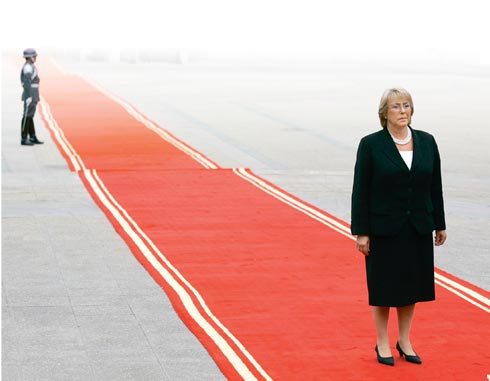
Chile says goodbye to the President with lord. Michel Bachelet finishes a 4-year stay as President Chile. She could become an indisputable favorite in the presidential election on December 13, but the Constitution forbids her to run for a second term. Whoever goes to the seanor for the shift - recognized The New Times Michel Bachelet is destined to go down in history. In 2002, she became the first in Latin America a woman-minister of defense. And three years later, for the first time in the history of his country, he was elected President Chili. Before the Bachelet were on the continent and other women-presidents. But, as a rule, famous husbands helped them. The Bachelet, a divorced mother of three children, achieved everything herself (and this is in a Catholic country where divorces were prohibited 20 years ago). But this is not the main thing. Chile chose the Bachelet because her success, starting from the very moment she took the post of head of the military department, symbolized the revenge of the dictatorial past. From Michelle Bachelet, the daughter of the Air Force General, who died in Pinochetes, who herself visited there, after which she was forced to live in exile - first in Australia, and then in Germany, they were waiting for competent decisions. Chile, unlike most of his neighbors in the continent, was not used to either military coups or social experiments. Pinochet not only planted and pursued. He also tidied up an empty treasury inherited from the populist of Salvador Allende.
A record for a staff before leaving the Presidential Palace of La Moneda, Michel Bachelet set another record in Chile's history: she has an incredibly high rating. According to the ADIMARK GFK public opinion Center, among the poor in the population, it reaches 83%. But everything began far from cloudlessly. A month after its inauguration, in April 2006, the Bachelet collided with the massive manifestations of students of secondary schools and students, dissatisfied with both the conditions of education and the lack of social benefits. One of the main requirements was free travel in public transport, the entire system of which turned out to be absolutely ineffective. The rating of the Bachelet rolled down. Difficulties, then she will say, helped her gather and take power into her own hands: a new law on education was developed and adopted in Chile. Analysts associate the new increase in the popularity of the Bachelet in the last year and a half mainly with its economic policy in the midst of the global crisis: 69% of the Chileans, according to the recently conducted survey of public opinion, are ready to put the “five” to the authorities. They managed to save and postpone billions of dollars for a rainy day in conditions when the country's income from copper exports fell by more than a third - mainly due to competent investment investments abroad. Last year, Chile for the first time in its history has become a pure lender, and now the government predicts 5 percent economic growth. Leaving, Michel Bachelet leaves the country confident in itself and in his president. How long?
Chile's pure country is one of the most free from corruption of the countries of the world. According to the study of the World Bank, Chile, and one of the world leaders in the effectiveness of public administration. Moreover, this is radically different from all other Latin America countries. The non -corruption of the power system allowed Chile to successfully implement many social protection programs, launched, by the way, even in the days of General Pinochet and then adopted by the legally elected rulers, including the same Bachelet. And now its political opponents even propose to expand these programs by including the middle class. In particular, Sebastian Pigner, one of the largest businessmen in the country, who is sometimes compared with the Italian Prime Minister Silvio Berlusconi, made such an initiative. After all, Pignera is also a media machine: he has a 100% shares of the Chilevision channel, very popular and influential. Today, Piner is a presidential candidate with maximum chances.
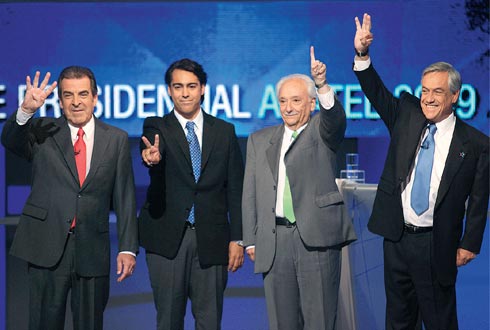
“Berlusconi” and other Pignera is running for a conservative camp, on his side-a powerful media resource and a personal fortune of $ 1.2 billion. In 2009, Piner, according to the Forbes magazine, occupied the 701st place among the richest people in the world. In 2004, he already made an attempt to become president, but lost his charm, gaining only 24.4% of the vote. Now, among his rivals, there is neither the Bachelet nor its charisma, but there is a ruling coalition of socialists and Christian democrats Eduardo Frey Ruis-Tagle, who served as President Chile in 1994–2000, the son of an outstanding Chilean politician Eduardo Frey Montalva. “Experienced, but insanely boring”-this is how Chilean commentators speak about Free Jr..
Another contender is Marco Enrices-Omins. He participates in the race as an independent candidate and has almost no chance of success, although he tries to pull the electorate with populist statements. Until June 2009, Enrices-Omini was a member of the Socialist Party, but left it, after his colleagues decided to nominate his unified candidate from the left coalition, not his, but Freya. In the conditions of the political system that has developed in Chile, with its stable rivalry of two powerful camps, conservative and left, even small batches are doomed to live on the sidelines, and even to be an independent candidate ... Michel Bachelet has repeatedly indicated that such a system is outdated and needed political reform. Now Eduardo Frey is exaggerating the same topic. But in order to implement this item of his program, he must win on December 13.
All presidential candidates (from left to right): Eduardo Frey, Marco Enrices-Ominami, Jorge Arrathei and Sebastian Pigner