
Translated material
Manual food
Philosophy and practice of pilaf
The taste of the silk path. Pilaf is a favorite dish of warriors and emirs, ordinary shepherds and great sultans. It must be able to not only prepare it correctly, but also it is correct - and then he plays the role of a comforter and unification of people. The philosophy and practice of pilaf was studied by The New Times 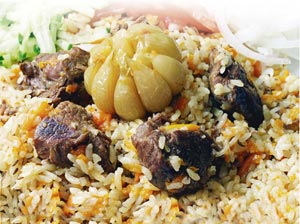
If you have money, then eat pilaf, if you have no money, then eat only pilaf.
Uzbek proverb
And now the Uzbek pilaf is on the table in a huge bowl, hot, as if alive, risinki from risinki in it separated,
meat and fat, black droplets there and huh can be seen barbaris delivered from Tashkent, and garlic heads,
Juicy and preserving the aroma peek out of yellowish scattering of rice. And what a spirit! Such a spirit that in the villages under
Samarkand, understanding people are probably now facing Moscow.
Vladimir Orlov. "Altist Danilov"
Tell me, what is difficult to prepare such a seemingly simple dish, like pilaf? But what is the choice of the recipe. Moreover, the well -known saying of Venedikt Erofeev is also applicable to pilaf: "Life is given to a person once, and it must be lived in such a way as not to make a mistake in the recipes." A correctly selected pilaf recipe is a guarantee that pilaf will come to fame. The old Turkish saying says that there are so many types of pilaf as cities in the Muslim world. As for the whole world, we can’t judge, but that almost every Central Asian city has its own recipes for making pilaf - that's for sure. Ferghana pilaf (Kavurma Palov) differs from Samarkand (Sophie, or Sofaki Palov), and Bukhara (Mayic Palov) from Khorezm (Chalov). Yes, they have the names, look at which, as if you were moving along the silk path. Historical and geographical such pills.
The differences are sometimes very significant, they relate to rice, meat, and cooking method. Each cook, of course, considers his recipe the most traditional and most correct. Some argue that meat is only lamb, others believe that you can do without meat at all. If you arrange demonstrations, both of them will clearly confirm their case. But still, the main thing in the preparation of pilaf is the experience and some branded wisdom of a separate chef, which are usually not written in table books. It remains undoubted that pilaf, as a rule, is prepared by a friendly company. Moreover, the main cook, aka Murza Pilaf, must vigilantly ensure that the process is not violated, so that the proper sequence of laying the ingredients is observed. Moreover, the traditions of pilaf go into the depths of centuries ...
Divine food according to legend, the story of pilaf began with Tamerlane himself. Once, the iron chrome, bypassing the troops before going to bed, heard the conversation of two warriors who worried: how to survive without food in a campaign on Ankara. The path was long, and Tamerlan was not going to sacrifice the speed and suddenness of the attack with food. Mullah helped Tamerlan, who prompted the ruler to get out of this difficult situation, an unusually satisfying and nutritious dish. “We must take a large cast -iron boiler. It should be so old that the fat from the previous food oozes on the outside and lights up from the flashes of the fire that falls on it. In this boiler, it is necessary to put the meat of unstable, but not very young lambs, selected rice, swelling with pride, which will be eaten by bold warriors, young carrots blushing with joy, and a sharp bow, stinging like a sword of highly respectable Emir. All this must be prepared at the stake until the smell of the prepared dish reaches Allah, and the cook will not fall into exhaustion, because it will try the divine food. ”
From one portion of this dish, the soldiers gained strength for several days. This is how, thanks to pilaf, it turns out, the army of the lame Timur won the victory. And his warriors praised the wisdom of their emir and on every halt they prepared the dish that he liked. How did the mullan learn this recipe - the legend is silent, only it was sent out from above ...
The warriors of Tamerlana, probably, was really just preparing pilaf. When lamb and cauldron are running underfoot, and there was only one recipe ...
The fact of taste exists, as is commonly believed, two main types of pilaf. Uzbek, when rice is cooked with meat in one cauldron, and when rice and meat are cooked separately, which for some reason is considered Azerbaijani. The preparation method in one cauldron is certainly authentic. It is also more common: it combines rice and zirvak - lamb, yellow carrots, onions with red pepper and zira fried in oil. Such pilaf is prepared according to the technology adopted in Central Asia.
Tajiks and Afghans in the preparation of pilaf were more liberal, because both options combine. For “separate” pills, rice is most often cooked in large amounts of water, broth, and in some regions even in milk, after which they are thrown into a colander. Then they are laid in a cauldron, leave to finish, allowed to soak in oil and, leaving a cauldron on a cooling plate, ensure that the rice “infuses” to “infuse” properly and turns from simply boiled rice into puddles. In our opinion, this is completely no pilaf. This way and the Guryevskaya porridge can be called pier, the preparation process of which is no less laborious ...
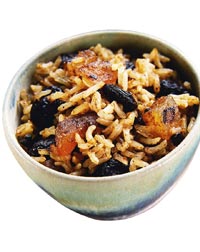
Nevertheless, pilaf can be prepared without meat (some still love to add prunes and dried apricots). It is possible from chicken, and indeed from different birds. Pilaf and fish are prepared. Pilaf made of sturgeon and beluga - we are not afraid of this word - Divine! It is the most delicious, the most delicate and, alas, not accessible to everyone. Those who tried such pilaf may not be upset because he had never eaten marmalade or did not drink champagne! Yes, and the grain component in the pilaf can be not only rice, but also wheat, a mash (“golden beans”), peas, corn, etc. In other words, the current variety of pilaf recipes is far away from the apparent simplicity of the Tamerlanov recipe ...
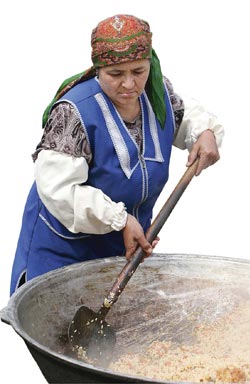
Four stages have interviewed plot, amateurs and professionals, on the topic "What is the main thing in pilaf?" And having processed the answers, we, possessing considerable experience in making pilaf, can say that the preparation of pilaf consists of four main stages: oil rolling, preparing a zirvak, laying rice and bringing pilaf to readiness. And the last, the most pleasant thing is eating.
Kazan. Traditionally, pilaf is prepared in a cast -iron cauldron. Anyone who knows what pilaf is, he knows what a cauldron is. The rest is better to eat this dish in the nearest dukhan. Because everything is done in the cauldron and only in it. In the cauldron of cast -iron, and in no other. However, other cauldrons simply do not exist!
Meat. Exclusively - lamb! Pig from pork - a frank perversion, should be punished by excommunication from cooking for life.
It is believed that it is best to use the back of the lamb, without bones, but pilaf, which is used and ribs, is also good. To get an authentic pilaf, it is necessary for fatty lard or, for lack of this, interpretation fat. Kurdyuk is finely chopped, melted and sniffed. The cauldron is heated strongly and vegetable oil is added to it. During the overhalation, dark smoke first appears, then it becomes white (the bulb thrown into the oil neutralizes the bitter substances contained in oil), after all this is laid out cut by medium pieces and lamb cut through a towel and begin to fry. Some reformers offer first fry the meat in a pan, then transfer to the cauldron. It should be noted that in the preparation of pilaf there is no place for the reformation. Conservatism dominates here! When fried meat, add salt, spices.
Spices. You can buy a set for pilaf. However, we do not like the presence in most sets of saffron, which gives pilaf a specific aroma and intensively yellow color, which fundamentally changes the taste of rice, which acquires an Indian accent. Therefore, the minimum set of spices consists of pepper (black and red), Zira, barberry. A special stale pilaf will have if you add turmeric called in Central Asia Zarchava there. They bring turmeric either before laying rice, when the zirvak is completely ready, or three to five minutes until the pilaf is ready, when the water boils almost completely. And when the meat is ready, they put there ...
Onion. Online. Choose better than medium size, clean, wash, cut into strips. Reformers say cubes. Shaitan, as you know, hides in small things, from onions cut into cubes and all misfortunes begin! When the bow acquires a pleasant golden hue, it's time to lay ...
Carrot. Here again, the whole thing is in the cut, in the cut and again - in the cut. And of course, in quantity. There should be a lot of carrots! The color of pilaf depends on it. If there are more carrots than meat and onions combined, then success should be expected in plastic production. And the carrots are cut only as long and as thin as possible. Carrots cut into circles - disaster! After each bookmark, you need to try on salinity, and also mix everything thoroughly! If it is slightly dried, this is not inherently, then the rice will take excess salt.
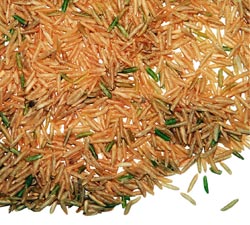
Rice. Long and large rice is preferable, well, say, the Uzbek “girl” - 1 kg (you can take a good long Indian or Pakistani rice). The use of brown rice gives it already by the very Far East ... Thoroughly sort out the rice, rinse under running water so that the water becomes transparent! While frying meat is on, onions and carrots, the rice should be soaked in warm water for two hours.
So, when the meat, onions and carrots that make up the zirvak are brought to cooked oil, when you tried and are satisfied, the rice is laid out on top, aligned and poured with water by about two fingers. Now the cauldron must be tightly closed with a lid and, remembering the whims of his stove, set the “fire” so that it is not necessary to add water. In no case do not interfere! Draw through, from the surface of rice to the bottom of the cauldron, holes and again close the lid. Shortly until it is full of readiness on top of rice, 2-3 garlic heads should be put.
The food unites with his hands ... When the pilaf is ready, put everything on a dish, serve hot cakes, chopped green radish, tomatoes, herbs, green tea. It is not recommended to drink vodka, otherwise you will not understand what pilaf is ...
So, pilaf is ready and even eaten. In a peaceful state, it is always useful to think about the origins of pleasure, that the main thing in culinary art. The philosophy of pilaf is concluded not only and not so much in the good quality of the original products, in the skill of the cook and even in the correct cut and dosage. Pilaf is never prepared for one person. This is a patriarchal food that serves to rally and unification. Such notes are still strong in the specifics of cooking, when someone cuts onions, someone carrots, someone sorting out rice, but especially convex in the process of eating pilaf, when everyone sits around the unifying dish. By and large, the food unites even more with his hands. Wash your hands and try. Wipe your fingers on a robe (if you are in a dressing gown ...) is optional. In a word, languor, fried, soaring ... As one cook used to say and was right, by the way. And without all this, pilaf is not pilaf.
Tajik pilafs using cooking technology are very reminiscent of traditional ones. Tajiks are often added to the usual composition of pilaf, but peas (chickpeas), having previously soaked for 10-12 hours, quince (sliced with slices or small cubes and without a peel). And the main difference - instead of meat, minced meat are often used.
The minced meat for Dushanbin pilaf is 500 g of meat, 5-6 eggs, 5-6 onions, 2-3 garlic heads, 0.5 teaspoons of red pepper. Prepare minced meat (twice pass through a meat grinder) from meat, onions, garlic. Salt, add 1 raw egg. Roll the minced meat thoroughly.
Boil eggs boiled. Form the cakes from minced meat and wrap eggs (whole or halves) in them, roll them in flour and fry them in a separate bowl in overed oil for 2-3 minutes. Until the formation of thin golden crust. Put the eggs prepared in this way in a ready -made zirvak. Add rice and continue to continue the pilaf preparation using ordinary technology.
Baku pilaf with dried fruits 3 cups of long -grain rice (basmati), chicken, onions, eggs, 250 g of ghee, 500 g of dried fruits (dried apricots, raisins, prunes, figs), 1 tbsp. spoonful of Zira seeds, 1 tbsp. spoon of barberry.
Rinse rice thoroughly and dry. Boil 2 liters of water, add 2 teaspoons of salt, pour rice and cook it until it becomes slightly soft. Remove to a colander. Lubricate the cauldron with stomped oil. Beat the eggs and pour into a cauldron. Put the rice in layers there, pouring each layer with stomped oil (about 150 g). Cover the cauldron with a lid and put on a very small fire for 20–25 minutes, until a crispy egg crust forms below. Remove the cauldron from the fire and wrap it in a blanket. Wash dried fruits, dry and fry for 5 minutes. In 3 tbsp. tablespoons of ghee. Pour 1.5 cups of boiling water and simmer over medium heat until soft (fruit gravy should remain in the pan). Cut the chicken with portioned pieces and fry in the remaining oil along with a finely chopped onion until cooked, 30–40 minutes. When serving, put the rice with a slide on a heated dish, placing broken egg crust and pieces of chicken with onions on top. Dry fruits can be served separately.
Instead of eggs, you can cook a kazmag, that is, a thin layer of fresh dough. When shifting half -boiled rice from the pan to the cauldron to further bring to readiness the bottom and wall of the cauldron is lined with a saucer, which is prepared in the same way as the dough for the noodles. Roll the dough into a layer of 1–1.5 mm thick and coat with oil, then put on it rice. In the process of preparing rice, the kazmag not only protects it from burning, but also turns into a crispy delicious crust, which is lubricated with melted oil, sprinkled with cinnamon.