
Translated material
The bridge is separated
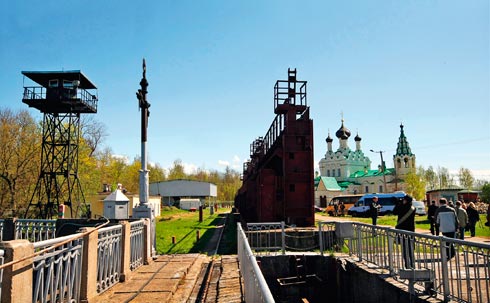
“The Separation Bridge” - since 1992, the state border between Estonia and Russia has been held on it, which was actually sharing a single city - now Russian Ivangorod and Estonian Narva. And such a border - if not geographical, then emotional - lay in all the Baltic countries. How the border pillars got up between people - I recognized The New Times
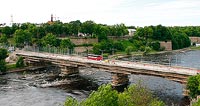 |
| The bridge "Friendship", aka "Bridge", split the life of the Narvytsy and Ivangorodtsev in two |
Victor is already drinking a second mug of beer and with each sip is becoming darker. They met Irina in March 2003, and in April he made her an offer. He is an Estonian citizen, Russian by nationality, a resident of the Estonian Narva, she is a Russian citizen and a resident of Russian Ivangorod. Physically, they were divided by the bridge across Narva-River: in Soviet times, power christened it with a “friendship” bridge, and in recent history the people renamed the “separation bridge”. The bridge is easy to cross, it is much more difficult to overcome the state border passing along the bridge.
Love with a visa and without
“Ivangorod and Narva for me are one, you know? - Victor hardly retains endurance. “A lot of Estonians and Russians will confirm: these two cities seemed to be connected by one dome.” So it has happened since Soviet times: one public transport, one sewage system, Ivangorod goes to work in Narva, Narva in Ivangorod. So the parents of Victor also lived: a house in Ivangorod, work - in Narva. Mother is a membrane at the famous Krenholm Manufactory, father there is a locksmith. Soon they received a three -room apartment in Narva. In modern times, Russian Narvityan Viktor Korchagin was easily given Estonian citizenship. "
Separating the two cities fused, like Siamese twins, the border deprived them of the right to a full -fledged life
“But the new wife set the condition: we will live in Ivangorod.“ Without problems, ”Victor answered.“ The main thing is that we have love. ”For the sake of this love, he sold an apartment in Narva, moved to Ivangorod and went to work in a neighboring state every morning. Everything would be fine, but only the Blue Estonian passport was quickly“ damped. ”Three months of daily passage across the border - so there was no living place in it. Over 6 years of marriage, Victor changed about 15 passports.
Once in July in the morning of 2008, he, as usual, went to the territory of Estonia: it was necessary to once again change his passport and get a Russian visa. The passport was made quickly. And in the Russian visa they unexpectedly refused: “You exceeded the limit - 180 outputs were laid for six months, and you have more,” Victor said. And sent to the consulate. The official, to whom Victor got to the reception, without changing his indifferent expression, said: the visa was refused. “I have a wife there, you know? - He tried to break through. “Let's get settled in a good way.” But the consulate employee rested. And then Viktor was handed over to the nerves: “I grabbed him by the scruff and shook it properly,” he was compressed by his fists, and now, when remembering it, he was squeezing about it. From that moment on, the locksmith Viktor Korchagin was blocked by the Russian visa forever.
For some time, he and his wife met on neutral territory, for example, on vacation in Turkey. Having made a successful career in Russia, Irina did not seek to move to Estonia. And gradually the time and distance did their job: in 2008, Victor and Irina divorced. “And what about love? - he asks and orders the third mug of beer. “The Russian Federation blocked my love.”
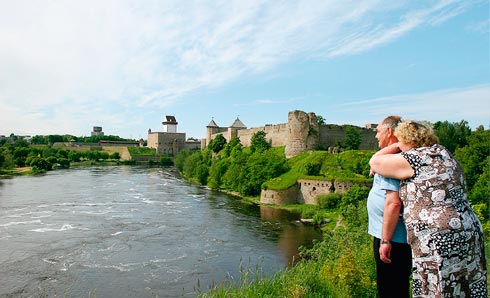
Residents of Ivangorod with longing look at such a close and at the same time distant Narva shore
In hostages by the border
The border lay through almost every family of Ivangorod and Narva. When in the late 90s the Estonians tightened the rules for being on their territory, Ivangorods Nikolai timidly offered his beloved wife: “Dear, how are you looking at temporarily divorced?” She agreed: a fictitious marriage with a Narvityka gave her the opportunity to work in Estonia - he was engaged in adjusting unique equipment, which simply was not in Ivangorod. They divorced: “I knew that it was a formality, but still closed in the bathroom and roared,” Lida admits. Nikolai married the accommodating Narva acquaintance, worked and earned in Estonia, but each time after work he returned to his Ivangorod house, to Lida and Children. Only in 2006, after Nikolai received a residence permit, did they play a wedding again: laughing, Nikolai and Lida show a photograph of their new marriage-by that time their grandchildren were already born.
Grandchildren and children, brothers and sisters, mother -in -law and test, scattered on both banks of the Narva River ... The border turned this territory into a “zone”: permission for a short date, standing in lines, inevitable separation - and so until the next meeting. To see many people often, they can’t afford: they live poorly on the other side of the border. “I have aunt and brother live in Narva, my parents are buried,” says Tatyana Anisimova, an employee of the Ivangorod Art Museum. “But where do I go with my salary of 5 thousand rubles?” Visa - € 35, insurance, invitation, notary services ... Yes, and is not very pulling there. "
“The first time after the appearance of the border, people still had some internal resistance to new circumstances,” recalls Marina Akishina, a resident of Ivangorod. “But over the years of communication, they began to dissolve: not everyone goes through the test and passport regime.” According to Marina, for most today a reason for a date is only birthdays, big holidays or funerals. The mother -in -law of Marina lives in Narva: to see her grandchildren, she had to prove the kinship for a long time.
The Russian visa that she received is valid for only a year. But often a 65-year-old woman cannot use it: she cannot stand for 1-2 hours in line on the Russian-Estonian border.
The line at customs is the main symbol of the current border reality. Separating the two cities fused, like Siamese twins, the border deprived them of their right to a full life. Both the Ivangorods and the Narvites turned into hostages of the border, which in paradoxically became not only by homelessness, but also by a source of existence.
The smugglers are involuntarily
“24 hours a day. Always on sale. Low prices. " For knowledgeable people, these signs do not require explanation: in numerous unsightly stores and stalls on the Russian border, cigarettes and vodka are sold. In Russia, they are 2-3 times cheaper. For example, a pack of Winston in Ivangorod will cost 30 rubles, in Narva already in 40 Estonian crowns (about 100 rubles). Since two years ago, Estonia tightened the rules - she allowed to carry only two packs of cigarettes and a bottle of vodka across the border, the people connected fantasy. “You see, a woman with a baby carriage? - whispers to the correspondent The New Times a neighbor in the queue for customs. - In the stroller is a double bottom, in it there are blocks of cigarettes. No one will check the stroller with the child, they will be wounded. ”
Both the Ivangorod and Narva live smuggling. Women sew special bandages for piercing vodka and hide them under clothing of the 60th size, hide cigarettes in loaf of bread. One of the last inventions is pneumatic “bazuki”: a fishing line is tied to the cartridge, fired towards the Estonian shore, where they catch and pull the fishing line on its “Russian” end - hermetically packed blocks of cigarettes. Last month overnight, cigarettes were transported to Estonia for 47 thousand rubles, local residents were told by The New Times. However, no one was able to beat the record of the ingenuity of the 42-year-old resident Ivangorod Alexander Maksimov, a disabled person of the 2nd group: he managed to pump alcohol in Estonia on his owned alcohol pipeline, for which he escaped with a confiscation of 900 liters of alcohol and “subjects of administrative violation”, as it is listed in the judicial protocol.
Local authorities look through the fingers at smuggling. “This is an absolutely normal situation,” says Mikhail Stalnukhin, chairman of the city assembly of Narva. - Wherever the boundaries of states converge and there is a difference in prices for goods or services, people use it. And God forbid that they have such an opportunity. ” “Of course, it is bad that the border in such an unsightly form,” admits Vasily Kapriyanchuk, the head of the Ivangorod municipality. “But the inhabitants of Estonia come to Ivangorod and leave money here, which in one form or another are reinvested in the city’s economy.”
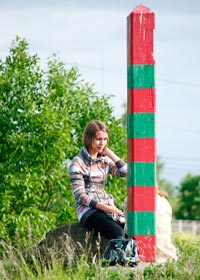 |
| Ivangorod youth believes that life in Narva is better, and Narva - already from school strives for "big Europe" |
Life in disgrace
If it weren’t for the smuggling, Narva and Ivangorod would probably have blazed rebellions or just empty. The main city -forming enterprises closed on both sides of the border. “The biggest problem in Narva is unemployment,” says Yuri Mishin, chairman of the Narva Union of Russian Citizens. - Narva fell into the Estonian authorities into disgrace. The largest enterprises are ruined. " The oldest Krengolm Manufactory, which Russian investors claimed, sold the Swedes: as a result of abbreviations from 13 thousand workers, about a thousand were left. The second most important enterprise in Narva - the famous Military Plant "Baltic" practically died: at one time it supplied the entire northern sea route. Today, instead of 6 thousand, 600 people work here.
"
Often can not see many things: they live poorly on the same side of the border
"
As a result, Narva today is the poorest city in Estonia. According to independent trade unions, unemployment reaches 40%. The most popular shops in Narva are for the sale of second-hand clothes. And a recent survey among students of the final class of the Narva humanitarian gymnasium, one of the best city schools, showed: only 2% are going to stay at home, the rest will look for work in Tallinn or abroad. In 2009 alone, about 4 thousand young citizens of Estonia went to work in Europe. The most popular areas are Great Britain, Germany, Finland.
In Ivangorod, the situation is not much better. Who was able to get to customs and in the border worship. The ancient flaxseed factory, founded in 1845 by Baron Alexander Stieglits, at death: only about 100 people work here. One hope for the South Korean factory under construction, which will produce spare parts for Hyundai cars: there are 750 jobs, which the Narvites are already looking forward to. “The city is deeply subsidized,” Vasily Kapriyanchuk complains, “this year the budget is only 70 million rubles, the city credit debt is 26 million.” Ivangorodites are waiting for winter with fear: the whole city is one decrepit boiler room, from 32 streets of Ivangorod - 21 without gas. “After Narva in the early 90s blocked us water and gas, Ivangorod began to be called a hero city,” says Andrei Timofeev, a deputy of the city assembly. - Today, a gas pipeline in Estonia passes through Ivangorod. Maybe we’ll still spend our gas at first? " In a fit of despair, the Ivangorod deputy Yuri Gordeev in May proposed to convene a referendum on the accession of Ivangorod to Estonia. The appeal was signed by 660 people. "How else to attract the attention of the authorities to the city?" - the deputy asks.
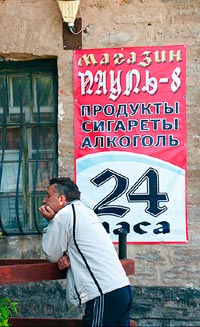 |
| On the Russian side of the border, vodka and tobacco is cheaper |
Feel like an occupier
In Narva, the idea, of course, is considered Bredova. Although the city has 90% of Russians and only 4% of Estonians, the local authorities should skillfully maneuver between the interests of the Russian population and the policy of the Estonian government, which considers the Soviet period by occupation, and Russians, respectively, by the invaders. One of the last skirmishes-about the initiative of the chairman of the Narv City City Board Mikhail Stalnukhin, who wanted to erect a monument to Peter I in the center of Narva. Upon learning of this, Estonian Prime Minister Andrus Ansip said that Peter I was an executioner, a killer and a usurper, and a monument to such a person has no place in Narva. As a result, the bust of Peter I was put in the window of one of the administrative buildings, the historical dispute was extinguished.
Pastor Villa Yuri, rector of the Alexander Lutheran Cathedral in Narva, also insists on the word "Occupant". “We have not survived this pain yet, too little time has passed,” says the pastor, recalling the deported Estonian population. “The people who were in the camps are still alive.” According to Villa, to have a monument to the Soviet soldier in the center of Tallinn - "it is like eating a monument to Hitler or Genghis Khan on Red Square." To serve in the Russian -speaking Narva for the Estonian pastor and his wife Tuuliki organist is a test: “In order to feel like an Estonian, sometimes you have to go deep into the country,” they laugh.
However, paradoxically the pastor and his wife are affably communicated with the Russians. “We are cherished and called“ our Estonians, ”the pastor laughs good -naturedly. For 10 years, the villa has been restoring the Alexander Lutheran Cathedral, which was destroyed in 1944 in 1944: when, due to the crisis, the European Union stopped funding, the pastor turned to local business. Estonian business refused to help. But Russian businessmen from Narva responded: for example, the owner of a local furniture factory made windows, doors and stained glasses for free.
So Russians and Estonians live in this strange border territory - divided and simultaneously constrained by the general history. They live as if in Estonia, but as if in Russia, as if enemies, but as if friends, as if relatives, but as if not quite. In the Russian -speaking Narva, the absurdity of the absurdity is added to signs and price tags exclusively in Estonian. And the Russian customs, for its part, prohibits the Demon of dairy products from Estonia to Russia. Now the Estonian cottage cheese, which the Ivangorites love so much, can only be eaten on the other side of the border.