
Translated material
Smoke of the Fatherland
Why in Russia do not fight smoking
Smoke of the Fatherland. The year was able to foal, how Russia joined the International Convention to Combat tobacco. But in order for it to work in our country, nothing has been done. The New Times tried to understand why 
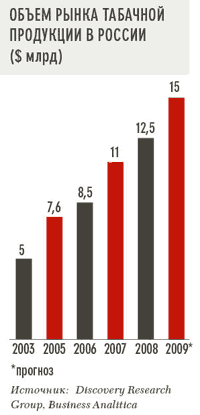
The Russian authorities also show anxiety in words . But the fact remains: the tobacco market in our country is “developing dynamically”, the number of smokers is growing, primarily due to adolescents and young women. The share of smokers among Russian men is stably high - 60–65%, and among women it has grown from Soviet times from 7–9%to 25-30%. The medical fact that smoking is not just a bad habit, but a kind of drug addiction, a disease that kills at least 400 thousand Russian citizens annually, is not as realized in the country. Smoking exacerbates an already extremely difficult demographic problem, prevents economic development. The damage consists of the costs of treatment of diseases caused by smoking, for the elimination of the consequences of fires, should also take into account losses due to a decrease in labor productivity, early disability and death. If, in addition to all of the above, to take into account that 95% of the Russian tobacco market belongs to transnational companies - British American Tobacco (BAT), Philip Morris International, Japan Tobacco International - and the tobacco leaf in Russia on an industrial scale is not grown, that is, measures are not grown against Tabakprom will not damage domestic producers, the question arises: why in our country the laws against smoking have not yet been adopted? After all, there is such experience in the world, it is reflected in the WHO framework for the fight against tobacco (RKBT)
The whole world, the preparation of the Convention took five years, each of its provisions was agreed at meetings of the intergovernmental working group in Geneva. The final text was approved on May 21, 2003 at the World Assembly with all 192 states - members of the organization, including Russia. This is a unique document that legally binds the countries that sign it to bring national legislation in terms of the production, distribution and consumption of tobacco, in line with the requirements of the Convention. The most important of them: increase of excise taxes; Protection of people from tobacco smoke, prohibition of inscriptions: “with low resins”, “lungs”, “soft”; mandatory application of warning inscriptions that occupy at least 30% of the main surface; the introduction of a complete ban on tobacco advertising, the fight against any forms of illegal trade in tobacco products; prohibition of the sale of tobacco products to minors; Assistance to those who decided to abandon smoking, etc.
The Convention was opened for signing on June 16, 2003, but Russia for more than four years refused to visize this document. She joined the Convention only a year ago, in April 2008.
The regulations were not subject to this should be followed by amendments to Russian legislation. The correction was subject to at least the Federal Law “On Limiting Smoking”, “On Advertising”, the Tax Code. However, nothing of the kind happened, and in the near future it is not planned.
The law “On the restriction of smoking” in the current version is more correct to call the “Law on Smoking Resolution” - it lists public places in which smoking is prohibited, but with the reservation that the ban does not apply to places specially designated for this purpose. What are these places and how they should be organized, is not stipulated. Thus, the school principal can hang a “place for smoking” next to the teacher’s sign and calmly smoke in the corridor with students, without violating the law.
The law “On Advertising” does not prohibit the advertising of tobacco products, but only limits it, therefore, male, female and teenage magazines, metro and other public places are full of tobacco advertising. The volume of the market for advertising tobacco products in 2008, according to the Association of Communicative Agencies of Russia (AKAR), amounted to 228.7 billion rubles.
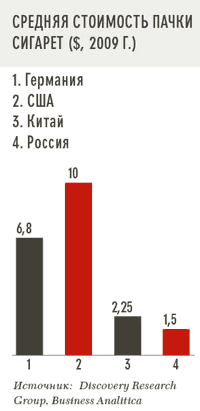
The Convention states that "... price and tax measures are an effective and important means of reducing tobacco consumption by various groups of the population, especially youth." There are also relevant international recommendations on excise taxes - they should be at least 50% of the cost of a pack of cigarettes. In Russia, at the moment, excise taxes on cigarettes with a filter - 150 rubles. With 1000 pieces plus 6% of the cost, which is approximately 20%. As a result, the smoother in Russia is the cheapest in Europe. The cheapness and a large number of outlets make a smoke easily accessible, in particular, for children, since fines for the sale of cigarettes to minors are negligible and practically not used.
In other words, the provisions of the RKBT still have not been reflected in domestic legislation. Moreover, in December 2008, the Federal Law “Technical Regulations for Tobacco Products” was adopted, which directly contradicts the RCTB and the current Russian legislation. He was lobbied, he was tobacco manufacturers. The inscription on packs, “with low resins”, “lungs”, “soft”, “soft”, the technical regulation legalizes, which is prohibited by the convention. Moreover, there is a conclusion of the Ministry of Health and Social Development of Russia (letter dated 01.25.08 No. iv/37216-16-5) on the contradiction of technical regulations to the Law "On Technical Regulation", in paragraph 7 of Art. 7 of which it is indicated that “... the technical regulation cannot contain requirements for products that harm the life or health of citizens ...” Thus, tobacco products are now not at all subject to technical regulation.
There is no smoke without fire, it should be recognized that tobacco manufacturers have developed an effective strategy for protecting their deadly industry in conditions of constant external pressure. Recognizing the availability of problems caused by smoking, they strive to participate in the discussion of these problems, skillfully “lusting” the topic and inclining legislators to implement obviously inefficient measures. That is why the opening facts of cooperation with representatives of the tobacco industry of some Russian deputies who are actively involved in the formation of the “tobacco” legislation cannot but be alarming.
Thanks to the decision of the American court on the disclosure of internal documents British American Tobacco, it became known about the contacts of the concern’s employees with Olga Beklemishcheva, who in 1996-1999 served as deputy chairman of the State Duma Committee on Health. The purpose of the contacts is “torpedoing” proposed by the deputy N.F. Gerasimenko of the draft Law "On the restriction of smoking tobacco." An employee of Bat Russia V. Aksenov in one of the published reports reported his meetings with O. Beklemishcheva and her promise to “kill” the bill at an early stage. The law was adopted in 2001, but thanks to the efforts of the tobackers, the most effective norms contained in the project were removed from it.
One of the active participants in the discussions on the problems of smoking is Gennady Kulik, who in 2002-2007 the position of chairman of the State Duma Committee on Agrarian issues, and currently - deputy chairman of the State Duma Committee on Budget and Tax. He was one of the initiators of the project “Technical Regulations for Tobacco Products”. From the declassified documents, Bat is known that Gennady Vasilievich has repeatedly participated in events and meetings held by the concern.
Ivan Savvidi, a member of the State Duma Committee on International Affairs, is one of the initiators of the “Technical Regulations” and mitigating amendments to the Law “On Limiting Smoking Tabaca”, from 1993 to the election in 2007, he served as the general director of the Don Tabak company.
In the course of parliamentary debt, a member of the State Duma Committee on Economic Policy and Entrepreneurship proposed legitimizing the long -term measures to be ineffective in the world to divide public places into zones for smokers and non -smokers, and in the media was repeatedly expressed against the introduction of a complete ban on smoking in public places - a really effective way to protect the rights of non -smokers. In 2006–2008, he was the president of the Russian Association for Public Relations (RASO), uniting PR specialists, whose members are branches of companies such as Philip Morris International, British American Tobacco and Don Tabak. On the official website of Philip Morris International, it is not without pride that Raso was the recipient of donations of this company.
We are far from the idea of doubt the decency of the above legislators, but we cannot but assume the presence of at least a conflict of interests in the consideration of anti -tobacco legislation. Meanwhile, one of the most important provisions of the framework convention is that “the parties act in such a way as to protect their policy from the influence of commercial and other corporate interests of the tobacco industry ...”
According to the International Association of Journalists (International Consortium of Investigative Journalists), obtained as part of the Tobacco Underground research, a smuggling of more than 24 billion cigarettes is supplied to Europe annually, which accounts for 7% of all European legal imports.
Ph.D., Associate Professor, Head of the Association "Healthy Regions"
Tver