
Translated material
Shoot the volcano
Experts offer ways to combat Eyayafyatlaiokudl.
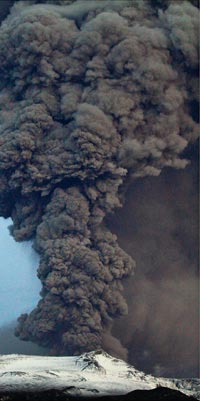
The Icelandic volcano Eyayafyatlaiokudl, giving Europe a small respite, "raising" towards the North Pole, again creates problems - not only in the sky over Europe, but also in the sky over the Atlantic. For two months of eruption, the volcano threw 250 million m3 ash into the air and took out $ 1.7 billion from airlines from airline pockets. What else to expect from a volcano and whether it was possible to stop it - The New Times asked experts
Eyufyatlaiokudl “earned” on March 21 and at first did not cause any particular concern. On the contrary, Iceland expected it to earn money: “I flew to the conference in Reykjavik on March 23,” says Moscow student Natalia. - Literally all hotels were littered with advertising, offering to admire the eruption. By the end of the conference on a rented SUV, we went to the volcano by ten. They got from Reykjavik in two hours, having drove about 150 km. ” The whole tour cost Natasha in € 180. Having paid € 500, she could get to the eruption of a helicopter and even go down to the glacier that covers the top of the volcano, and already observe how and how nature breathes. “From afar, the volcano was a steaming mountain - nothing special,” she says. “But the closer you get to him, the more interesting.” It is best to watch the eruption in the evening: you can see how the volcano throws huge pieces of stones and lava hundreds of meters up. ”
Living crack
“Eiyafyatlaiokudl is a crack -type volcano: Magma pours through a crack in a slope, and not through a crater on top, like“ classic ”volcanoes like Vesuvius or Fuji. It is a pleasure to work on volcanoes of a cracking type, because lava is very effectively funds on them and you can come close enough to the faults, 20-50 meters. That is why such eruptions are adored by tourists, ”said Raenrich Shteinberg, director of the Institute of Volcanology and Geodynamics, in an interview with The New Times.
Eiyafyatlaiokudl is a large mountain 1666 meters high, covered with a glacier on top. Actually, it has a problem. While the hot lava poured through the crack on its northeast slope, it was just beautiful, especially since there are practically no residential villages in the vicinity of the volcano. This lasted three weeks. But then the crack began to lengthen and at one end went under the glacier: on April 14, the funding magma began to melt the lower layer of a 200-meter ice crust. As a result, the effect of the “hot frying pan” was obtained, on which water fell: pieces of ice fell into a crack, which is why the volcano began to erupt the pillars of ash. “The temperature of the lava is 1110–1150 ° C. The ice boils in contact with it, and the lava, on the contrary, is rapidly cooling, cracking and fragmented, forming a lot of ash particles that rush into the atmosphere. This is the so -called freest type of eruption, ”Steinberg explained.
Closed sky 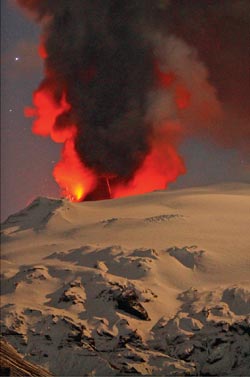
So on April 14, an Icelandic volcano from a beautiful natural phenomenon turned into a mere nightmare for hundreds of thousands of air passengers in Europe. Three days later, 17 thousand out of 22 thousand flights were canceled, which every day rise to the sky of the Old World, 282 out of 337 transatlantic flights. “The flight by plane from the capital of Iceland to Oslo takes an average of two hours. But this time I had to get to Norway for a day: five hours of summer to the Irish Akureiri Airport, ten hours of waiting for departure in Glasgow, three hours of flight to the capital of Northern Ireland, and finally - Oslo! ” - A resident of Reykjavik Sara told The New Times.
The extra two hours of flight of the aircraft cost a airline from $ 5 thousand to $ 10 thousand, depending on the type of aircraft. Therefore, in two months of eruption of Eyayafyatliokudl, the costs of the industry, including losses from the tickets and other additional expenses, approached $ 2 billion, and the clouds of ash became not only an obstacle for intra -European and transatlantic air traffic, but even for flights to North Africa and Canary Islands.
Foamy ash
“A long flight through the ashen clouds of the vessel’s body is likely to withstand,” Professor Mai Chudetsky explained The New Times. “However, the ingress of ash particles into the air-reactive engine, the dimensions of which are from 20 to 40 microns, leads not only to the aircraft set of additional weight, but also fraught with stopping and destruction of the engine.” This happens as follows: along with air, the ash particles enter the compressor, the purpose of which is to increase the pressure inside the engine. The centrifugal force throws them to the periphery of the compressor, where they accumulate, due to which the engine weight increases if the plane flies in a volcanic cloud for a long time. “However, ash particles also fall into the combustion chamber where kerosene is injected, where they are oxidized under the influence of high temperature and beat along the turbine blades. Then, along with hot air, they find themselves in a snot and as a result “lick” the engine wall. Such an erosion effect leads to the destruction of the entire structure, ”the scientist explained.
Fortunately, air preferences caused by an awakened volcano are still able to avoid. However, the case of Boeing 747, which belonged to British Airways, which on June 24, 1982, was felled from England to New Zealand. Flying over the Indian Ocean at an altitude of 10 thousand meters, the aircraft fell into the cloud of a volcanic ash, thrown out by the Indonesian volcano Galunggung. The engines stopped working, and the civil side began to plan, decreasing within 13 minutes to 3.5 thousand meters. At an altitude of 3 thousand meters, the pilots were able to launch engines. Boeing landed safely at Jakarta Airport (Indonesia), none of the passengers and crew members were injured.
What to do
How long will the volcano will “work”, so far no one knows: Icelandic geophysicists and volcanologists, who are actively quoted by the British press, are not taken to predict his behavior. The last time he woke up in 1821 and calmed down two years later.
“Volcanoes, like Icelandic, can erupt for several years,” Heinrich Steinberg “consoled”. - A similar type of volcano in Kamchatka - a Tolbachik, who woke up in 1975, worked for a year and a half. Therefore, there are two options: either wait until all the ice itself falls into a crack, or do it artificially and so stop the explosive phase of the volcano eruption. The latter is much cheaper: according to my rude estimates, the whole operation will cost $ 10 million. ”
To do this, the Russian specialist offers to drill several tens of meters of the glacier along the fault (the exact depth needs to be installed on the ground after clarifying the size of the crack), lay the explosives on both sides and collapse the glacier: “The explosions will occur for another or two days, but after that the lava will practically stop in contact with water. So, you can significantly reduce the emissions of ash into the atmosphere. ”
Professor Chudetsky, who was designing the head parts of ballistic missiles, scored three options for solving the same problem for The New Times. First: to put near the volcano very strong missile engines, which with powerful air jets will raise particles of ash to a large height, where aircraft do not fly. “Theoretically, this is possible, but almost difficult to feasible: the volume of the ash is too large.” The second option is similar to the precipitation management procedure, which is practiced by the Moscow authorities on big holidays: the clouds of ash can be brought down with the rain, the scientist believes. “The third option is the most practical and quite feasible: it is necessary to construct special propellers for engines of civilian vessels that will discard the ash particles and prevent them from getting inside,” says Chudetsky.
According to the volcanologist of Steinberg, on our planet from 700 to 1200 existing volcanoes, and more than half of them pose a potential threat to the aircraft, like Eyufyatlaiokudu: “The main lesson of this natural cataclysm - volcanists need to not only predict eruptions, but also follow the behavior of cracks that run in such problematic places. After all, we all knew about the upcoming eruption and suggested that it would go calmly. It never occurred to anyone that a crack could go under the glacier. ”
Yuri Chudetsky offers to insure air passengers who fly along the routes along volcanic zones (Japan, Philippines, Taiwan, Aleutian Islands, Kamchatka, Kurille and others), and insurance money to improve the technical methods of combating ash emissions and designing protective devices for engines. “This type of environmental insurance will help us be prepared for extreme behavior of nature,” the scientist believes.
Anecdotes about the volcano
Such was the last desire to die in the crisis of the Icelandic economy - to dispel its ash over Europe.
The Iceland government announced that if Europeans still do not agree to pick up a 4-millionth debt to them, a more powerful eruption of the volcano is scheduled for the end of May.
From the diary of an Icelandic student. “My friend and I decided to go to see how Eiyafyatlayokudl erupted there. First, by the train we got to Hwannadalsnukur, then on the way to Kaulvafedlsstad, from there on a ferry - to Westmannaeyar. Together went towards the snipedlsyokudl on foot. They sat on a peasant wagon and reached Brunhouleskirky. Well, there is already a stone's throw to Eyayaphjatlaiokudl. Nothing special - a volcano like a volcano! ”