
Translated material
Feast of Kolyada
What is hekuba? In Moscow, as part of the Golden Mask festival, the triumphal tour of the small theater from Yekaterinburg took place. Kolyada Theater showed seven performances, among which there are real masterpieces 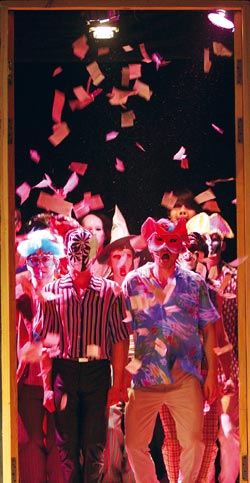
Nicholas Kolyada in Moscow love. His plays are in many metropolitan theaters, he is one of the rare playwrights who write luxurious roles for age artists. Lia Akhedzhakova, who has played in the “Contemporary” “Persian Lilac, who was delivered by him by his play, has not missed a single Moscow tour of the“ Kolyada Theater ”, has repeatedly been to Yekaterinburg and, at the first call, was thrown to defend her beloved playwright and director. And there is always someone to protect it from.
DIY “Kolyada Theater” is one of the first private theaters in Russia. The theater is located in the center of Yekaterinburg in a wooden old house - a monument of architecture of wooden architecture of the 19th century, which local authorities provided the team three years ago, selecting the previous building. For many years, a tiny theater has been a place of pilgrimage for theatrical gourmets for many years. There are no ultra -modern technologies in the theater, everything is created with its own hands: scenery, costumes, machinery. The actors are all professional, no amateur performances, receive 7-9 thousand rubles a month. Kolyada publishes the Ural magazine, maintains a seminar in drama, holds festivals of young playwrights. Actively promotes the modern play. He himself only writes about what he knows, but he knows what he sees around, what lives, without inventing or dramatizing anything. The essence of his theatrical aesthetics is in the game itself, in theatrical magic, which is from nowhere. To ask him why so, and not that way, is pointless. He will smile at an apologizing smile, look somewhere at the ceiling and will quietly answer: “I don’t know ... I thought.”
Lukovy, of course: there is nothing accidental in his performances. He masterfully owns the space of the stage and seems to be able to cope with any scale. At first glance, his directing seems to spontaneous, improvisational, mobile - all this is not so at the same time. Performances have a rigid design, despite the incredible liberty of interpretations. But this design, invented by a hunch, or in the painful search for an adequate language, is woven from the finest threads of relationships and actions. Kolyada always starts with pagan campaigns, with animal growls, with ritual round dances, as if previously freeing artists, releasing demons of acting from them, and then masterfully builds dialogs - swiftly, with spontaneous unpredictable reactions, twisting thought and emotion into a tight knot, which only the heroes themselves are able to unleash - that they can easily and at ease.
“He can do everything” Oleg Yagodin - the prime minister of this troupe. Almost the entire repertoire plays. Khlestakov, Hamlet, Podkolesin, Lopakhin, Bashmachkin, Romeo, Stanley Kovalsky. Kolyada says about him: “He can play everything. You see - everything! " The buttons are thin, blond, mocking, mobile - like on hinges. It cannot stand still. Even if you just need to stand in a pillar, it cannot. Here Hamlet stands in the corner, watches the endless bacchanalia of the courtyard and ink and ... gnaws his nails, busily spitting scraps to the floor, like a husk from seeds. Here is Stanley Kovalsky (the hero of the drama “Tram“ desire ”) enters the house - and stands for a long time in the doorway, spreading his legs wide. In a red suit, hands in pockets, a cheap carnival mask covers his face. Only sharply, nervously twitch the shoulder to the beat of the frantic music coming from the street. After the performances, Yagodin still rushes to the club and sings his songs with his group “Kurara”. Looking at him, you understand how important a sense of rhythm is for the artist. The rhythm is the God of the role. Take it, hear - your role. Yagodin always guesses unmistakably, so he plays a lot and always differently. In Gamlet, the path from a boy from the crowd to the ancient hero lives. In the "tram" desire " - ruthlessly reveals the bestial nature of man, creates the image repulsive and terrible, carelessly discarding all the natural charm. The energy of this artist is so powerful that it seems to be ready to pierce, cut the air like a laser beam of hyperboloid. You sit, look with envy - eh, Moscow would be like that! Such tough, wrong, "male" artists of a unit. That was Viktor Avilov, such as Alexey Devotchenko. You can’t call it anymore.
"Ermolova - on stage!" With such a name, going to the artist is already a feat. "Ermolova - on stage!" - Announces the PRCRAGE, and you can already burn out with shame. She “burns”, spending herself mercilessly, as if playing for the last time. Irina Ermolova - artist of the Yekaterinburg Academic Drama Theater. She played Katerina Izmailova there, and then somehow quickly switched to comic roles. Kolyada returned her to the pedestal of the tragedy, seeing in her the actress of ancient scope. Tall, large, thoroughbred, it is as if created for the heroines of ancient Greek tragedies. Why did he see in her a fragile “butterfly” Blanche Dubois? He went crazy, stubbornly stood his ground: only she. And really - only she. The frightening of her beauty, which has already received all the blows of fate for her, she hides the chisly face behind dark glasses, beautiful hands - in narrow long gloves, a luxurious hot body wraps up in endless silk and feathers. And still, her passionate nature breaks out - a fountain of frantic uncontrollable sensuality, desire for love, crazy fear of loneliness and death. The woman was amazing, a mixture of purity and vice, innocence and debauchery, which the executioner, which overtook her, dragged into his lair, Stanley Kovalsky. He drags on the ground by the leg and looks, not blinking how shamelessly her wedding snow -white dress lifts up.
The death of seriously the performances of Kolyada - about the confrontation, about the unequal struggle, about the deadly battle of man and the crowd. About how scary to break out of a thousand of your own kind, how scary and how important it is to take a step aside or risk breaking through a flock that rushing towards you. Dissent as a special case becomes a philosophy and a conscious choice and never brings happiness. So the young Hamlet dies, struck by the opening of his “I”, unknown to him before meeting with the ghost of his father. The naked, defenseless, crouched in the embryo pose under the Earth poured on the ground dies. So they will break, mutilate and throw them into a landfill, like an ugly doll, a beautiful blanche. Blessed romantic Miron Miroy, a teacher from a provincial town (the hero of the "nameless star"), will end his life in lack of money and loneliness. All of them are part of the soul of Nikolai Kolyada, a lonely and strong person who can change the world with the help of multi -colored rags, empty tin cans and a dozen people infected with his talent.
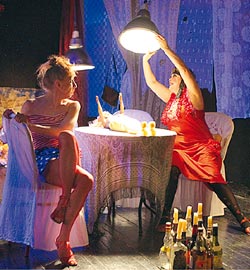
From which I created the “desire” “desire” “Lamps” I bought in the Electric Provers store for Malyshev. First, one, then (I liked them) three more.
A bathrobe bathroom (here he, like Mephistopheles) bought a contemporary a year ago in the Theater-some woman came there to trade in something Chinese, with bags, and the theater is being persuaded to buy four such robes for women on March 8. I bought, but not to women, and gave it to a costume. And it came in handy.
The dress of Ermolova brought someone to the theater, wedding, old.
The paper was brought from asbestos printing, trimming.
We had hats. I bought panties for guys a hundred rubles in the market.
From litter, dirt-something has grown.
I look: beautiful, infection. "
(From the diary of Nikolai Kolyada)