
Translated material
Put on the counter
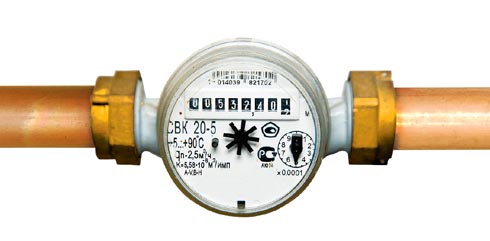
The Muscovite Muscovite Tamara S. decided to put the counter after once again paid for utilities: the amount for hot and cold water for two went off scale for 3 thousand rubles. “I thought: it is better to spend money once, but then everything will pay off,” she told The New Times. Tamara was not even frightened by the fact that as many as 4 risers were installed in her house of Stalin's building: 2 pipes with cold and 2 with hot water for each apartment. For four counters - one for each riser - she gave about 7 thousand rubles. For the overlap of the risers - another thousand. For annual service - 900 rubles. When the day after installing the counters, she returned home from work, the kitchen was in an akle watermate: the master unessally screwed the device. A repeated challenge plumbing cost another thousand.
The whole idea with the meters cost almost 10 thousand rubles. But that's not all. “I have the feeling that nothing is spinning there,” Tamara points to the counter, standing under the shell in the kitchen. - See? There are insignificant volumes. I enter them into the payment system on the Internet, and that issues: “The figure is incorrect. The value is less than the previous one. ” For three weeks, Tamara has been waiting for representatives of DEZ to test the instruments. But public utilities are in no hurry. In the meantime, in order not to save the debt, Tamara introduces a figure that arranges electronics, even if this figure and more that shows the counter. “What to do? - Muscovite spreads his hands. “All the same, 1700 is not 3 thousand that I paid before.”
Pay the story for a neighbor indicative: many would be happy to save, but do not know how to approach this. According to various sources, water meters today installed 5-10% of Russian households. So the ultimatum of the Ministry of Regional Development is clearly not the best solution to the problem.
Although housing and communal services experts have no doubt that accounting devices really allow saving. If the Muscovite’s apartment does not have a water meter, the calculation is made from the standard of 384 liters of water per person per day. “This means that each of us, from the baby to the old woman, pours water water every day,” explains
Igor Podgorny, head of the Energy Efficiency Program "Greenpeace Russia" . “It seems absurd, but we pay for such a volume.” That is, Muscovites are overpaying more than two times: according to confident estimates, the average consumption of water per person per day in the capital is 150 liters.
There is another payment scheme - according to the indications of a common house meter: in this case, the entire volume is distributed between all apartments according to the number of registered residents. But this is a bad savings: if you spent 100 liters and a neighbor 500, you still have to pay the same way.
However, the installation of apartment meters is not affordable for many families. On average, this requires 5 thousand rubles, and the payback is approximately 1 year. * * According to the calculations of the Unified City Service for the installation of water meters (Moscow), when paying according to the standards of water consumption, citizens pay an average of 750 rubles. per person per month, when paying for the testimony of a water meter - 390 rubles.
“To take money from citizens for installing meters is illegal,” says Dmitry Yanin, chairman of the board of the International Confederation of Consumer Societies (Confop) . - A person has a counter or not, the water does not become more clean, tasty, safe from this. We regret that the Ministry of Regional Development decided not to coordinate this issue with organizations of consumer protection and Rospotrebnadzor. ”
According to Yanin, Confop supports the idea of mass installation of meters, but not for a simultaneous fee: “It would be correct to oblige suppliers of the service to install meters conventionally for free and within 10 years to include a fee for this in the tariff. For the consumer, this is not so painful. ” Such a system operates in Europe, confirms Irina Genzler, an expert of the city economy direction of the Institute of Economics of the city . “In the West, the costs of installing metering devices and their maintenance are really“ sitting ”in the tariff,” the expert says. -When people pay there for a cubic meter of water, they give part of this money to compensate for the costs of the installation of the installer of the device. It’s just not distinguished by a separate line in the payment. ” It is possible that this experience will also be in demand with us: as Anatoly Popov, deputy minister of regional development explained, may be allowed citizens to install counters in installments for 5 years: 100 rubles will be added to the rent monthly.
Dubious savings
“He began to pay for the water more? Your neighbor is to blame! He put a water meter. Pays less - but you don't! " The poster with the unpretentious skim of The New Times discovered in the service of the "one window" of the Moscow Nagatinsky Zaton municipal district. When asked how the counter can be installed, the girl in the window waved towards the hall: “Choose. We have advertising of different companies here, call and find out where cheaper. ” Of the three companies, one offered the installation of two meters at a preferential price: 3.5 thousand instead of 4.5 thousand rubles. When asked whether it is possible to put a counter of another company found, for example, on the Internet, the dispatcher answered in the affirmative: “The main thing is that she has a license of a mosvodokanal.”
“In Moscow, the situation with competition is normal, there are more than 20 companies-residents of meters,” confirms Anatoly Golov, co-chair of the Union of Consumer of the Russian Federation . - Competition leads to fair prices (from 1 thousand rubles from the meter), customers lure discounts, offer both service and different services. In St. Petersburg, the prices for meters are from 500 rubles and above. But in small cities where there is no competition, the full of arbitrariness of installation companies, which are usually closely related to local authorities and resource suppliers. ” Dmitry Yanin confirms: the meter installation procedure is opaque. “Daes and management companies often illegally promote specific firms and refuse to register counters that are sold on the Internet or ordinary stores. We are faced with the fact that in Russia the price of a meter can vary 5-6 times, ”says the head of Koru.
But this is still half a bastard. According to the same Ministry of Regional Development, the fixed assets of housing and communal services in Russia are worn out by two -thirds, and in individual municipalities - by almost 90%. Due to rusty pipes in water supply networks, from 30% to 50% of water is lost. “Public utilities requires more and more funds for its maintenance and, in fact, in saving resources is not interested,” Anatoly Golov summarizes. - Therefore, the mass installation of meters and our savings can turn into a subsequent increase in tariffs. It is much easier to make this to monitoring monopolists than to repair pipes and establish effective accounting. ”
To install a water meter, you need:
1. Take the taps in order covering the supply of water to the apartment, repair plumbing.
2. Contact any company-resident meters, which has a license of the city water supply service (in Moscow-Mosvodokanal). At the same time, you should not buy metering devices on your own in the market or in the store: the installer may not agree to install such a meter.
3. After the installation of the water meter, the master attribute the documents issued to him in the DEZ.
4. Get in DEZ a calculation book on payment for water.
5. Monthly withdraw the meter readings and attribute them to the “one window” service of your EIRC or enter them to the payment system on the Internet when a payment for an apartment.
Source: Unified City Service for the installation of water meters (Moscow)