
Translated material
The seagull was flying
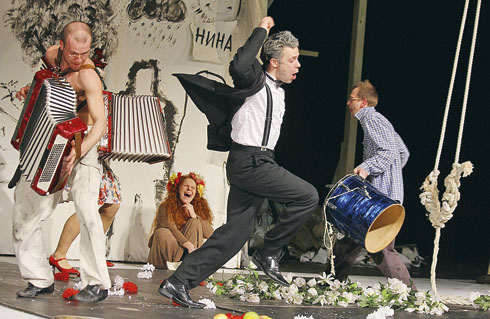
The director is trying to drive Chekhov into the comedy of absurdity
A seagull with cockroaches. Konstantin Gavrilovich shot himself at 23 hours 40 minutes, at the end of the fourth hour of the play “Chaika” in the production of Yuri Butusov on the stage of the Satyricon Theater
When the body of the artist of Tribuntsev was finally dragged into the backstage, the hall sighed in relief. Prior to this final shooting, Treplev was already dead several times, only in the performance of other artists (or characters), the final scene of Nina and Treplev was lost to us several times. It is due to such repetitions of some episodes that the performance and swollen to incredible sizes.
The taming of the obstinate
Yuri Butusov puts a lot, noisily, successfully and almost always - scandalous. With Shakespeare, he is practically on “you” - on the stage of Satyricon, “Richard III” and “King Lear” with Konstantin Raikin are in the main roles, here he put Macbett Ionesko (absurd paraphrase on the themes of the Shakespearean tragedy), his “Hamlet” goes to the Moscow Art Theater with an amazing Claudius - Khabensky, in Vakhtangovsky - "measure for measure." Shakespeare Yuri Butusov obeys with pleasure - they are related by a spontaneous uncontrollable beginning, enthusiasm for external effects and a tendency to madness.
Relations are built with Chekhov with difficulty. Yuri Butusov stubbornly tries to drive Chekhov into the comedy of the absurd, to instill a “alien” disease to him. The first attempt to tame the stubborn Russian playwright ended in a frank failure - “Ivanov”, played in the Moscow Art Theater backwards (from the end to the beginning), few managed to understand and love.
The Kurlyking rabid “seagull”, which has been expanded in the entire width and depths of the satirikon scene, is an unconditional product of today with its clip thinking and consumer entity. In his programmatic (exactly!) “Seagull”, Yuri Butusov completely abolishes any morality, makes her a scarecrow, smeared with tar and weaved in feathers, and throws her into the hall with a cry “Nate, eat!” The appearance of the director himself in the finale of each act, apparently, symbolizes the very “slap in the face of social taste”, which determines the genre of this aggressive, eclectic, causing and endless action.
People or partridges?
It all starts with the distribution of roles. Big red -haired Nina (Agrippina Steklova), fragile young Arkadina (Polina Raikina), fatal porcelain Polina Andreevna (Lika Nifontova), hysterical unhealthy shamraev (Anton Kuznetsov), dumb provincial Dorn (Artem Osipov), miserable shameful Treeplev (Timofey of Tribune), plaxyvyvyvy Trigorin (Denis Sukhanov) and the comic boulevard Sorin (Vladimir Bolsov) - characters collected from different times and genres, more similar to growth dolls than living people. However, this distribution is very conditional, since more than once during the performance the roles will be transmitted along the chain to each other - and then everyone will choose his Nina and his treplov.
Butusov obsessively repeats about the fictional world of “Seagulls”, insisting on the exceptional theatricality of this play, and therefore its artificiality, replacing real life and real people. Well, you can. I am ready to believe that the “Trevleva complex” eats the director, gnaws him like an apple worm. With this disease, something needs to be done, and then the desperate director bursts onto the stage and tries on himself a bloody bandage of the loser, like a jester-a crown.
The space of the scene, thrown and littered with ropes, fake fruits, colored rags, artificial colors, copper basins and buckets, flooded with water and red paint, forced by scrames, tables and beds-at some point turns into bloody mess, in which strange people who do not wake up and wriggle, not awakening either sympathy or laughter.
The only scene that the artists did not fill up with all kinds of rubbish is the first meeting of Nina and Trigorin, with which this frantic romance of two very similar people begins. Agrippina Steklov and Denis Sukhanov play her in one breath, not taking his eyes off each other, and this delight of discovery fills their dialogue with the very love electricity, from which the atmosphere of the scene is heating up to the limit, and the hall freezes in ringing silence. That's all. Everything else is drowning in this whirlpool of fake, musical and verbal husks, in the directorial “cockroaches”, which Yuri Butusov generously scattered throughout the scene and “awarded” the unfortunate artists with them. 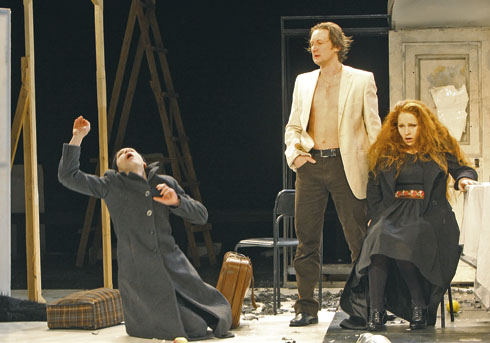
Simulacra and simulators
Everything else is drowning in countless "why." Why is the talented girl Polina Raikina - Arkadina? Why does she carefully depict an adult aunt, but even an inexperienced viewer shows that everything is here “from someone else’s shoulder”: heavy cosmetics, heels, and clumsy erotic body movements? Why does Dr. Dorn behave like an Odessa entertainer from the NEP? And why is the beauty and clever Polina Andreevna (Lika Nifontova) with an expression of unbearable suffering on a beautiful well -groomed face so sacrificingly in love with this fussy buba of Castorsky? Why is Trevelev’s head after a wound wrapped in a ship rope? Why does he read Brodsky from the advance for no reason? Why is Anton Kuznetsov, playing both Shamraev and Medveveveko, now and then turns into a dog and begins to embarrassed to seed on the stage on all fours, barking, sticking out his tongue, lifting the “back paw” under the sluggish laughter of the hall? Why does Trigorin cry all the time? Why is the play stuffed with musical hits that your “maids” Viktyuk is from Salvatore Adamo to Faustas Latenas? Why does the director periodically run out onto the stage and behave like a bad artist?
And finally, why does Yuri Butusov devote his fantastic product to the memory of the artist Valentina Karavaeva, who dreamed of playing Nina Zarechny and writing his monologues on an amateur camera (a well -known dramatic story on which the documentary film was shot)? The fate of Karavaeva is terrible and Opera is absurd. The former beauty and rising star, who played the main role in the film "Mashenka", after a car accident lost everything - both beauty and profession. And then she began to play at home the Chekhov "Seagull", and these frames discovered after her death make an impression of horror.
The case of Karavaeva is the real theatrical madness. Butusov’s case is just inflammation of cunning, the simulation of creative ecstasy.