
Translated material
The fourth wave
The fourth wave? Tunisia, Egypt, Yemen, Jordan, Algeria - tens of thousands of people in the most non -free region of the world, in the Muslim Middle East and North Africa, took to the streets
These countries do not remember such mass political protest since the collapse of colonial systems and acquisition of independence.
It all started at the start of 2011 in Tunisia, where there was a dictatorial regime for 23 years-the uprising continues to this day, more than 70 people have already died, only in one casserin-16 . Moreover, Tunisia is a completely prosperous country: less than 4% of the population lives behind the poverty line (in Egypt - 20%, and in Yemen, for example, 35% do not have work), and GDP per capita parity in terms of purchasing power is approximately the same as in Azerbaijan similar in number. While the situation is reminiscent of the one that was in Romania after the overthrow of Chausko: the dictator fled, its avoirs are frozen, most of the cabinet members were resigned, but in power - one of the close dictator.
Egypt followed Tunisia , in which the regime of sole power is also: President Mubarak has ruled the country for 30 years, 5 times he re -elected the head of state. Further, mass demonstrations spread to other countries of the region. The Internet was the source of information: it was this main medium of the 21st century that turned out to be both the organizer and the agitator of protest both within these countries and the way to find out that the resistance of the dictatorship in principle is possible. So the Egyptians learned about the "Jasmin Revolution" in Tunisia , and the Yemenets and Jordanians were indignant at the death of the co -religionists in northern Africa. The authorities of these countries are now faced with a choice: to arrange a bloody bathhouse or give the opposition power. Which, by the way, can be very different: both professing democratic values and quite fundamentalist-if, for example, in secular Egypt, supporters of the “Muslim Brothers” organization intercept the power.
Specialists in the theory of regimes, transformation, democratization are now arguing: will we witness a new, fourth wave of democratization in the classification of a famous political scientist, late professor of Harvard University Samuel Huntington.
The first occurred in Europe and North America as early as the 19th and early twentieth century: today in Western Europe 96% of countries belongs to the category of free.
The second wave of democratization was short and not too successful-it fell in the middle of the twentieth century and was largely inspired by the Second World War: somewhere, as in India, democracy took place, somewhere, like in Latin America, military coups and junta quickly carried it away.
The third bell rang, Huntington believes, in 1974, when he collapsed almost half a century of dictatorial regime in Portugal, about at about the same time the “black colonels” in Greece lost power, pledged to stop the military in Brazil, and the dictator Franco in Spain died. After 14 years, this wave finally covered and swept the inhuman regimes of Eastern Europe, and in 1991 there was no “Empire of Evil”-the USSR. It was then that the American philosopher Francis Fukuyama wrote about the “end of history”, referring to the triumph of the liberal idea in the world. Triumph, frankly, relative. On the one hand, if in 1990 there was 51 countries, in the classification of Freedom Forum classified as free, now there are already 87. On the other hand, the same monitoring agency in its reports writes about a “democratic recession”, about the strengthening of an authoritarian trend. Russia is one of the most striking examples.
The fourth wave of democratization cannot but begin. The question is when? People tend to want to be free and resist the rule of corrupt and cynical dictators, which is a compulsory consequence of the regimes that are deprived of any control from society, citizens. Sooner or later, this wave was supposed to reached the most non -free region of the world, 88% of the population of which live in the position of the half -workers . How will the current protests turn into? What is the effect of falling regimes in the Muslim Middle East and in Africa for the rest of the world? Will religious autocracies like the one in Iran appear at the site of the secular regimes of Tunisia and Egypt? All these are still no answers. But one thing is already known: here people also want freedom.
“People are often masters of their fate; The fact that we are slaves are not stars, but we ourselves, ”says the aging Julius Caesar in Shakespeare's play. Exactly.
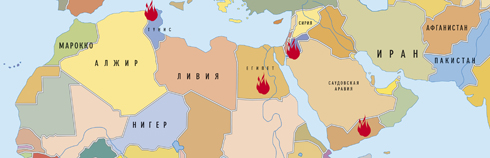
Morocco: King Mohammed VI and Prime Minister Abbas El Fasi are still fully monitors the situation in the country. However, the high level of corruption in the state apparatus, including at the very top, causes dissatisfaction of the population. At the same time, the activity of the radical Islamist group "As-Salafia al-Jihadi" increased in the country. Algeria: President Abdelaziz Buteflik for a long time enjoyed the support of the majority of the population-mainly because of the readiness to rigidly resist the radical-Islamic Islamic Front of Salvation, which terrorizes the population of the Algerian hinterland. However, the population is displeased with corruption, paternalism and low living standards. Tunisia: As a result of the January Jasmin Revolution, President Ben Ali fled from the country, the highest structures of power are paralyzed. Libya: The country is under the full control of its long -term leader Muamar Gaddafi, who, however, fears separatist manifestations in the south and the collapse of Libya according to the Sudanese scenario. Egypt: In the January anti -government speeches, up to half a million people took part, according to some estimates. Jordan: On January 28, anti -government protests broke out in Jordan. Sudan: As a result of the referendum on January 9, from the Muslim North, according to the vast majority of forecasts, the Christian-language south is bobbled. Syria: President Bashar al -Assad, the son of Hafuz Assad, as long as she manages to consolidate power in his hands and influence the situation in the neighboring Lebanon. Yemen: At the end of January, anti -government speeches began in the country in the Tunisian and Egyptian scenarios. Iran: After mass protests organized by the opposition in 2009 and brutally depressed, political lull has been observed in the country.