
Translated material
Four head horseman
What bad scenarios for the Russian economy look like

The Russian economy balances on the verge, and it is better to understand the script by which it will collapse
While the government was working on the anti-crisis plan, it became more and more obvious: the collapse of the Russian economy can occur according to the right-winged, militaristic or social-democratic scheme. But, most likely, the real script will be an explosive mixture of these three options.
Anti -crisis antiplan
For an outside observer, the process of creating an anti -crisis plan for 2016 by the government looks inexplicable. It began with an unofficial refusal of the White House from the proposal of the Minister of Finance Anton Siluanov at least try to write several scenarios for the budget for 2016. And the budget will have to rule, regardless of whether the government wants to save the economy or does not want. Especially if the average Urals price, as in January, will remain at $ 28 per barrel.
Then the Ministry of Finance announced that more than 500 billion rubles. The expenses of the federal budget (and the expenses were forced by as much by 15 trillion rubles) this year will not be possible to reduce. After which he completely mysteriously eliminated the compilation of the anti -crisis plan. Then they were entrusted with the Ministry of Economy.
Different departments were presented to the Ministry of Alexei Ulyukaev a certain volume of sound, in their opinion, proposals of the most diverse properties - from increasing taxes to an increase in expenses for agriculture. And the Ministry of Economy has drawn up (discarding the most radical proposals) a project of anti -crisis plan worth about 220 billion rubles. Well, then the Ministry of Finance left the prostration reduced the volume of the plan to 160 billion (about 1.1 % of the budget expenditures, or 0.2 % of GDP).
The non-meaningful document made in this way fell on February 2 at a meeting of Prime Minister Dmitry Medvedev. And then there was an even more strange thing. The offers already thrown out as obviously unacceptable proposals of the departments ordered to again send Alexei Ulyukaev. Under the pretext that they can be included in the second part of the anti-crisis plan-the one that is not money in 2016, but which can be realized later, until 2018. As a result, a plan was obtained in two parts, of which the first is unimportant, and the second is either impossible, or should be accompanied by revolutionary changes in the structure of the Russian authorities. And it is better to present in advance the possible nature of these changes.
A quirk trap
It would seem that the options in which the main impact on the Russian authorities will continue to have the financial and economic block of the government, headed by the First Deputy Prime Minister Igor Shuvalov, look as optimistic as possible. Whatever the tactical disagreements of the Ministry of Finance and the Ministry of Economy, economists in the government of Dmitry Medvedev are quite able to agree, and to agree on the basis of ideas voiced by the ex-minister of finance Alexei Kudrin. We are talking about a significant reduction in government departments - primarily on defense and social activist - by 25-30 % of the current. On the agenda and a fairly wide privatization of state -owneds, primarily state banks. As well as a reduction in civil servants, restriction of subsidies to regional budgets, stimulation of investments by reducing tax redistribution. Finally, we are talking about the reform of the social sphere and moderate political reforms that do not question the basis of the current political system - a weak autocracy.
The Central Bank embarrassedly states that even on the current modest scale of the Ministry of Finance, this is a prosklic policy: it strengthens the economic decline
This medium-term maximum program also therefore looks extremely attractive that Russia really has money for its implementation. Alexey Kudrin in January indicated a method that will help to win for reform for two or three years-spending 6 trillion rubles. National Welfare Fund in addition to 3.7 trillion rubles. Reserve fund.
Everything would be fine if it were not for one circumstance. It in an extremely soft form is already set out by the Bank of Russia in the ballot "What Trends are talking about" in early February. It states that according to the results of 2015, the budget policy of the Ministry of Finance, apparently, reduced the growth of Russia's GDP by 0.2-0.3 percentage points.
The Central Bank embarrassedly states that even on the current modest scale of the Ministry of Finance, this is a quotic policy: it strengthens the economic decline. It is already obvious: almost everything that the financial and economic unit can offer is an even larger quickening policy. In the event of its immediate implementation, the fall of GDP by 3-5 % in 2017 after the expected 1-2 % of the 2016 GDP recession is quite predictable. At the same time, 2015 has already shown: mainly the decline will be reflected in domestic demand and household income.
The use of such bitter drugs requires super -efficient power, which will not be able to fall apart in the fourth year of the recession - that is, in the year of the presidential election. Of course, the authorities in Russia consider itself strong. Of course, in fact, it is not one. In 2018, the implementation of “right -billed” reforms aimed at preserving the existing procedures will almost inevitably lead to a sharp drop in the loyalty of the population.
Anti -crisis plan of the Government of Russia (billion rubles)
On January 27, government chairman Dmitry Medvedev signed an anti -crisis plan for 2015 2.3 trillion rubles. "Business Gazeta" studied what this money will go for
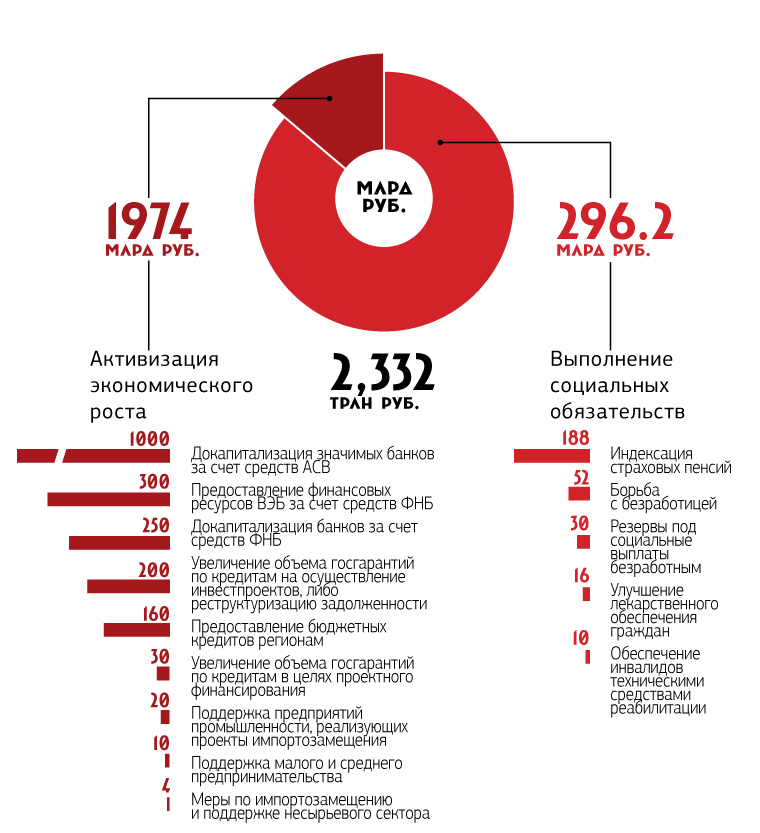

Source: Government of the Russian Federation (order of January 27, 2015 No. 98-r), © 2015, “Business Gazeta” (http: //bizgaz.rn) Military Field Romance
The second version of the victory of the forces of good over the forces of the mind is described repeatedly. This is the removal from the leaders of the management of the team Igor Shuvalov and the transfer of them to the Alliance of the Military-Industrial Complex, the lobbyists of the Rostec State Corporation and their allies from the post-state business. The program of this public is known: the rejection of the tough monetary policy of the Central Bank (and at the same time from the current Central Bank team) in favor of cheap refinancing of state banks; admission of inflation to levels of 15–20% per annum; The expansion of the “project financing” program imposed by the Central Bank of the economy and large -scale investment in infrastructure projects through the underestimation of the key rate of the Central Bank. At the same time, the budget policy itself can remain moderate. Moreover, the orientation of the White House on the non -impression of the number of civil servants and the non -exposure of the real disposable incomes of the population may also be preserved. In the end, the economic power of the state is measured not at all the welfare of citizens.
The problem here is not whether such a scenario will ensure the restoration of economic growth. Most likely, it will not provide - but that is not the point. And the case is in the standard ideas of the ideologists of this political wing about how long -term economic growth should be carried out in practice. Hence the threats. There are three of them. The first is an almost inevitable rejection of the convertibility of the ruble, the introduction of restrictions on capital export, the policy of the multiple exchange rate. The latter is needed for large -scale import of technologies and equipment in the name of the “new modernization”. Obviously, any actions in this direction will mean a new economic shock comparable in scale to January, and at the same time another step towards the breakdown of the financial system - this time, possibly, the latter.
The second threat is a foreign policy. The success of the military-industrial complex is inconceivable without the active expansion of Russia's participation in external conflicts and without military-political expansion. The existing sanctions against Russia are in fact moderate, anecdotal “counter -sanctions” make a decline in GDP almost the same contribution. But when changing the course towards the “emission-mobilization” sanctions will be almost inevitable.
Finally, the third factor is the orientation of the military-industrial lobby to the “restorative” (not to say “revenge”) logic in the economy. The issuing trillions of the Central Bank will not so much be aimed at creating some “giant human-like combat robots”, but to restore and complete late Soviet defense and infrastructure projects, regardless of whether someone needs them in Russia and abroad. BAM, the largest processors in the world, string transport, combat searclans, futuristic super -tanks and a new “buran” is that which will come to the surface until 2018.
Most likely, the response of the economic environment to these threats will ruin power before 2018.
Left turn
Work on the anti-crisis plan-2016 showed the presence of a third force in the government. An option from the current crisis by an increasing number of White House officials unofficially announces the construction of an effective social state in Russia based on recipes of moderate social democracy.
The construction of social democracy under the authoritarian political power is an extremely dubious idea
The logic of supporters of this ideology, concentrating around the social deputy prime minister Olga Golodets, sounds like this. The growth model in the Russian economy in 2010-2014 was built on constant increasing domestic consumer demand. The current collapse of budget revenues was transformed into a decline in GDP through a decrease in the incomes of the population. The task of the state is at all costs to restore consumer demand. Therefore, right now it is necessary to increase social expenses, and it does not even matter, due to which - the growth of public debt, expenditure of the National Welfare Fund or reducing expenses for the military. This will restart the growth model. Internal demand in itself is transformed into the flow of internal investments necessary for its satisfaction. The current foreign economic isolation of Russia is even a help in this strategy: sanctions can be considered as protecting national capital from competition. By the time of linging sanctions, the Russian economy should come in a new state - an effective state of universal prosperity, arranged following the example of Western Europe.
What can you say? To begin with the construction of such a state under an authoritarian political power is an extremely dubious idea. But the main drawback of this scenario is that 10 trillion funds of government reserves for the realization of a bright dream are clearly not enough. The only resource for the rapid (within 3-4 years) “unfolding” the state of universal prosperity in Russia is the simultaneous increase in taxes and public debt, for starting to 35–40% of GDP. Regardless of how the economy will respond to the “left turn”, such a strategy means instant increasing risks of an endogenous economic recession. And the almost inevitable result by 2018 is the collapse of economic activity and a new recession with the general satisfaction of the population of Russia from the onset of the next “Golden Age”.
Three in one
So which of the listed negative scenarios look the most likely? None of them. The peculiarity of the current political regime is in its maximum tendency to diversify risks. Most likely, already in the March-April of 2016, Vladimir Putin will make, as always, the choice in favor of three scenarios at once-the government program for this year will be composed of right-hand, mobilization and social democratic agenda in approximately equal proportions. This, on the one hand, will reduce the volume of threats of power emanating from the implementation of each of them. On the other hand, the few advantages that are contained for specific population groups will reduce to zero. The rejection of the conscious choice of the course is the basis of the current strategy of the authorities. And this strategy will work if oil prices are recorded closer to $ 40 per barrel, and not to $ 20.
It is likely that the unwillingness to make an energetic conscious choice - and there is a saving scenario for our power. After all, it has already been noticed: when the power in Russia does nothing, the result is not as bad as it should be expected.
Photo: Shutterstock.com