
Translated material
Carving fire
** 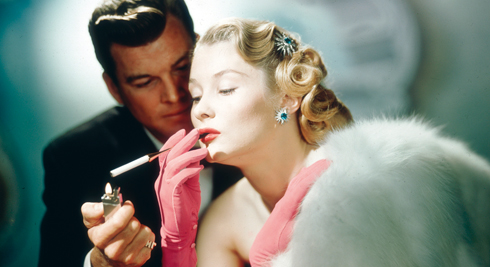 You need to lightly light it.
Do not give a light? Well, it would seem that a simple thing is a lighter. And by the way, the great Leonardo fought over her project, she acquired modern outlines only at the beginning of the last century, and today her exclusive options, along with fire, reproduce, say, a note “la”. The transformation of the fire traced the New Times **
Magazines "For real men" no, no, yes, they publish advertising articles about prestigious lighters. Cartier, Dunhill, ST Dupont ... One pronunciation of these names is the "holiday of the nasopharynx." Gold, diamonds, patented sound of an opened cap. The Dupon has only a note of “la”. Tested on tuning fork. 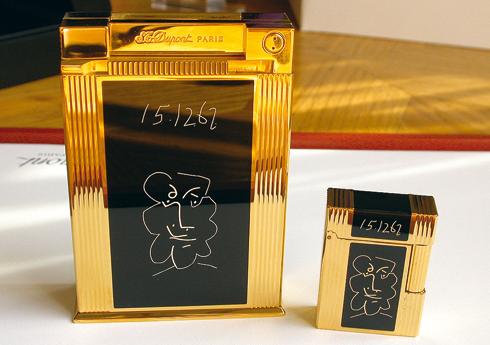
Only a narrow circle of faces can have such an exquisite thing. But snobs, using only super -expensive elite lighters, can also become an object of ridicule. For example, Oksana Robsky in the novel Casual, in general, makes a fair conclusion: there is nothing to show off, use a simple reliable Cricket.
And how the hero of the film “The Beast” performed by Belmondo suffered from expensive lighters! The cascader loser is forced to slide off the steep staircase over and over instead of a dummy-“stars”, and the last time an expensive lighter refuses the last time after time. And the director forces you to re -cross the scene ...
The struggle for fire
There is nothing easier than getting a flame: just remove the lighter from your pocket or struck a match. But this is when they are in a pocket or someone has to ask for a “light”. However, even in our time, life sometimes throws up situations when you only have to dream of these simplest devices. Then you understand what our ancestors had.
“On an impenetrable night, Ulamra fled, distraught from suffering and fatigue; All their efforts were in vain before the misfortune that befell them: the fire was dead! ” Thus begins the “struggle for fire”, the novel of the French writer, the laureate of the Goncurov Prize and the chairman of the Academy of the Goncurs Joseph Henri Roni Roni. The usual conflict of Paleolithic. But what about today's person in emergency conditions, if the lighter is lost, and the matches are wet?
Engineer Cyrus Smith in Jules’s novel “The mysterious Island” builds a lens with the help of two hourly glasses and, directing a bunch of sunlight at Truot, fomers the fire. True, those watches were pocket, with convex glasses, flat glass from modern hours will not help here. But the concentrator of sunlight can be built from a bottle -filled water, a pharmacy bubble, even from a plastic bag. A piece of aluminum foil or beer can is also suitable. The main thing is that the ray is directed to dry combustible material, and the focus was as short as possible.
| “Nothing special on the floor is noticeable,” said Dyukovsky. - ... I found only one burned Swedish match. Here she is! As far as I remember, Mark Ivanovich did not smoke; In the hostel, he used sulfur matches, by no means Swedish. This match can serve as evidence ... Anton Chekhov. "Swedish match" | 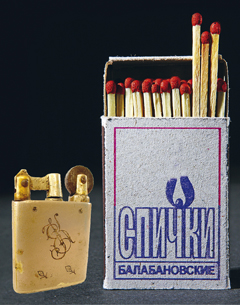 |
Experienced people know that fire can be obtained if about half the gunpowder can be poured out of the sleeve, and instead of a fraction or bullet, pour a small flap of fabric into it. If you charge the weapon with such a cartridge (an experienced person takes the gun, even if it goes behind mushrooms) and shoot in the ground, a smoldering flap will fly out of the barrel. Putting it in dry moss, you can light a fire. The gunpowder also set fire to a spark carved from stone or rub it between two stones. That is, they make a primitive fire.
Now we will study the method of some tribes in the Amazon Selva. Its essence is to rotate a rod made of solid wood in a recess made in a piece of relatively soft and dry wood. Of course, this can be done with their hands, but the Indians prefer small onions. They wrap the bowstring around the rod, then rotate and rotate the rod, moving the bow back and forth. Here, as in a joke: if you do not get fire, then at least warm up.
It is possible to get a living fire if necessary in four walls. (It is difficult for a modern person to imagine such a situation, but they happen.) Like it surprisingly, for this you will need only a small piece of cotton wool and slippers on rubber sole. Vata on a white (!) Wall must be rolled into a dense roller half a half thick. Then wind another layer of cotton wool on it and repeat this operation 4-5 times. Then the roller is placed on a wooden surface and vigorously rolled out by a slipper until it starts to smolder from the friction of the cotton. Smell to burn? Urgently inflate the fire.
Garnish knitting needles
The very word “matches”, as evidenced by dictionaries, is the “multiple uncounting form” of the word “spoke”, denoting a pointed wooden stick. Self -consumed means "incendiary." Matches are one of the most necessary for a person along with salt and soap objects. Amazingly, but two hundred years ago, the furnaces of the first steamboats and steam locomotives were kindled with a fire.
Who exactly came up with matches is still open. Strictly speaking, the first matches made in 1805 the French chemist Chancel. These were wooden sticks with a head from a mixture of sulfur, bertell salt and cinnabar, which was lit from touching a drop of concentrated sulfuric acid. It is clear that this was extremely impractical. 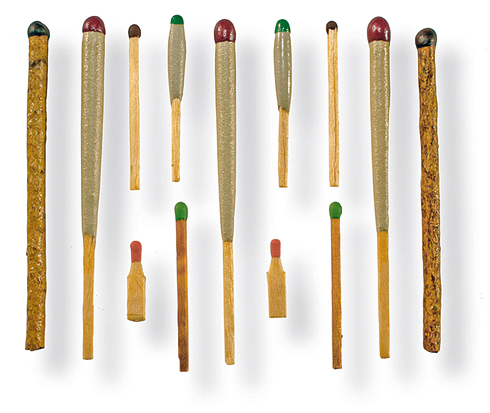
All attempts to improve Chancel's matches were unsuccessful while the German chemical student Jan Kammerer was in prison for participating in student unrest. The head of the prison, having learned that the prisoner was trying to make a promising scientific discovery, organized a kind of “sharashka” in the cell and began to supply the student with chemical reagents. Cummer guessed to add a certain amount of white phosphorus to sulfur. A match with such a head was easily lit after stirring along the wall of the prison chamber. According to one version, the inventor could not protect his invention and eventually died in a crazy house in complete poverty. According to another, Cammer in 1833 still managed to get a patent and sell it to the Viennese manufacturers, who came up with a match in the boxes and glue a rough piece of paper on it. So the need to struck the walls against the walls. That's just their production due to the poisonousness of white phosphorus was dangerous, and the suicides gained easy access to poison. It is not for nothing that Joseph Schweik is one simulator in a crazy house talks about his hard heredity and about her sister's sheltered matches.
True, by the beginning of the First World War, phosphorus matches were already banned in most countries. In 1847, a non -amorphic red phosphorus was opened. The German chemist Bether lubricated the paper with a composition containing a certain amount of this substance. During the friction of the match -headed head, bertell salt and glue, particles of red phosphorus were ignited about such paper. So safe matches appeared. They began to be called the "Swedish", after the Lundstrem brothers established production in 1851. Actually, these were already familiar matches.
What matches have not been invented since then, even burning under water! In 1898, the so -called non -chain matches appeared: they are lit almost any surface. Remember how the touching hero Charlie Chaplin did, conducting a match for the trousers of the tramps?
Return to the fire
The principle of action of the lighter was originally based on the sinking of a spark when the fire is hit on flint. Perhaps in Skolkovo new lighters based on nanotechnologies will come up with, but this will not change the essence: he pressed (turned the wheel, etc.), the light flashed, cooked ...
True, even before the appearance of tobacco in Europe, Leonardo da Vinci compiled the drawings of the first lighter in the form of a huge mechanism. At the beginning of the 19th century, the German chemist Johann Deniner proposed a table lighter in which hydrogen should have ignited. It is clear that using such a lighter is like playing a “Russian roulette”: a mixture of hydrogen and atmospheric oxygen is extremely explosive. 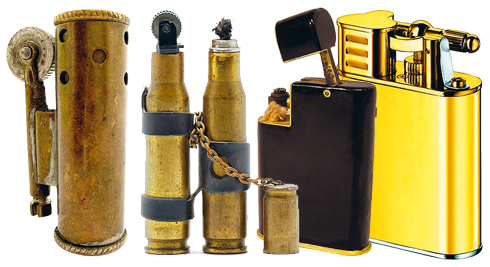
As the smoking was increasingly entering fashion, the lighters were improved. The principle of action appeared, based on the fact that the wick, moistened with a combustible composition, should be ignited by sparks from the blow of metal wheels through the silicon. And when in 1903, the Austrian chemist Karl von Velsbach determined the composition of the rafting of iron with the ceria, which is still being used, the lighters have sharply decreased in size, became safer and acquired an almost modern look. In any case, a lighter made from an inch shell of the time of the First World War, the author of these lines, being tucked up with good gasoline, works properly.
The hand stumbled in the darkness of Sintsov and took the lighter. “The engine works for others,” said the entered, “and they regretted our brother!” - And, struggling with a lighter, he lit a Katyusha standing on the table. A narrow blade of fire rose above the flattened shell sleeve. Konstantin Simonov. "Living and dead"
Initially, the gasoline lighter could be lit only with both hands. Such that could be handled with one hand, the English engineers Charles Wise and William Greenwood made the English engineers in the 20s of the last century. One of them lost his hand in the war, so the question of how to light one hand was fundamental. They prudently sold the patent to Dunhill, which brought them a welfare, and the company - prosperity.
Zippo founder George Blasedell brought Austrian lighters to the United States. He reduced them in size and connected the lid with the loop body. The windproof screen around the wick remained unchanged, with eight holes on each side. The name was given by the newly emerged reliable fastener-"Zipper". In addition to the low price, Zippo had an indefinite guarantee. Blasedell distributed his goods to truckers and drivers of intercity buses. Passengers and visitors to the roadside dumplings wanted to have the same simple lighters so that it could be lit even in a strong wind.
Undoubtedly, Zippo's popularity went uphill abruptly after the Second World War. The liberator soldier, smoking a Camel cigarette (of course, without a filter) with a lighter, is an image that has become popular thanks to a post-war cinema.
In general, while smokers remain on the ground, manufacturers of lighters without work will not remain ...
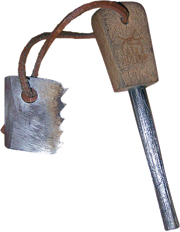 |
Fire, the principle of action of which is the basis of the lighter, is a gun (a file with a small notch), flint (mineral pier) and rubbish (all dry: scorched rag, moss, chilly mushrooms). Sparks from the blow of the flint against the Koille ignite Truit. From the verb “baptism” (in the meaning of “carving fire”), “resurrection” occurred, that is, “the flashing of a spark”.