
Translated material
The fate of the turkey
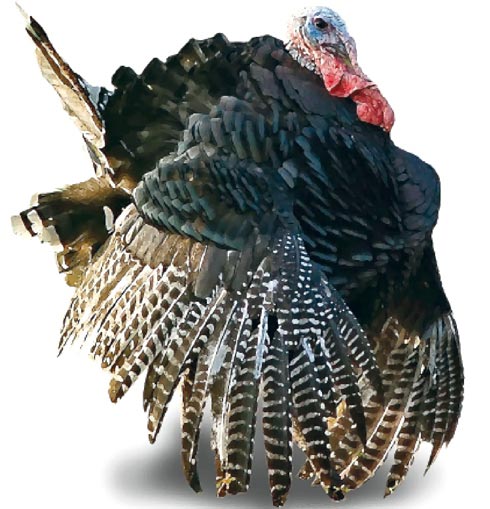
The fate of the turkey. On the fourth Thursday of November, Americans have a traditional celebration of thanksgiving, the US State Feast, which is also called Turkey Day, that is, Indian Day. How this bird was awarded such an honor and why the chicken is more common in our kitchen - the New Times recognized that a white -headed eagle was chosen by a symbol of the United States. For this, a respectable turkey would have approached more, which is also a true American.
Benjamin Franklin
The turkey sailed to Europe from behind the ocean along with potatoes, tomatoes, pineapples and sunflowers. The Spanish conquistadors brought from Central America to their homeland several domesticated birds. And the wild relatives were widespread in the territory of the current USA, in those places where the English puritans sailed on November 21, 1620 on the legendary ship.
The new lands met them unkind, but a year later the surviving colonists decided to thank the gentlemen. They ascended prayers, set the tables, invited friendly Indians led by the leader. Most likely, it was the Aborigines who first treated Puritan with a turkey. It was not so difficult for hunters to get it, because of the natural simplicity, which is considered stupidity ...
Türkiye and? It so happened that the day of thanksgiving, sometimes called not the thanksgiving day, but the Turkey Day, that is, the Indian Day, began to celebrate regularly. US President Franklin Roosevelt generally legalized the celebration, and now the Americans are gathering every year around the appetizingly fried bird on the fourth of November.
But - why Turkey? But does Türkiye have to do with it? Is Alexander Dumas right, who claimed in his “large culinary dictionary” that the turkey did not sail from America at all, but got into Europe from India in transit just through Turkey long before the opening of a new cos?
Dumas was mistaken. For the turkey, he took the Cesard, another representative of the Kurin detachment, really coming from India and who came to Europe from the regions of North Africa border between Tunisia and Algeria. The fact is that although in 1523 the turkey was fed to the table of the French kings called the “Indian chicken”, she, being in England, began to be called the “Turkish bird”. The British, almost three hundred years earlier than Dumas, fell into the same mistake. They mixed up a turkey with a guinea fowl, at about the same time imported by Albion to Turkish merchants. Both were called Turkey. And already from the British this name came to America.
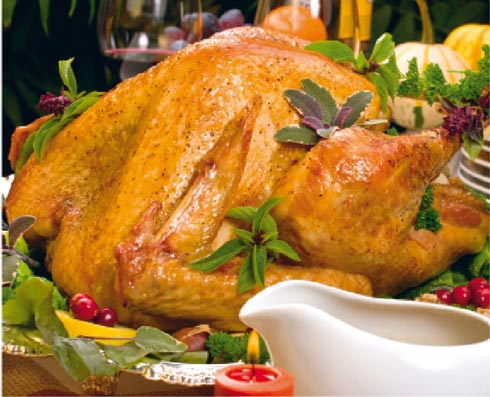 |
| Indiana for Thanksgiving according to the old recipe to wash and dry the turkey. Grate from the inside and from the outside with salt, pepper, put on onions sliced in large pieces inside, carrots, celery. Tie the legs with a strip of bacon, season the wings under the carcass, grease with softened butter, pour a glass of meat broth inside, put a turkey into a large bag made of thick and rough brown paper, previously smeared from the inside with butter, tightly close the bag, put the turkey down on the baking sheet, put in a two Half an hour. Remove vegetables from the finished turkey. A complex side dish of stewed (20 minutes) and baked in the oven (half an hour) of carrots, onions, celery, garlic, which are stewed with the addition of broth, bread crumbs, are salt and pour to taste. Green salad, mashed potatoes, cranberry sauce with sour apples and white half -dry wine are also supplied. For the preparation of turkey: turkey (up to 10 kg), salt, pepper, paprika, 1 bulb, celery stalk, 1 carrot, 7 tbsp. tablespoons of butter, 1 cup of broth. For the side dish: finely chopped celery stalks (4 pcs.), 2 cloves of garlic, 2 finely chopped bulbs, 2 finely chopped carrots, 5 tbsp. tablespoons of butter, 6 glasses of bread crumbs, a teaspoon of sage and oregano, 2 cups of broth, salt, pepper. |
But the proud Dumas persisted in error. So much so that he also rejected the traditional preparation of turkey, when it was stuffed with chestnuts so beloved in France, and claimed that Indiana would have a real gourmet only a “bishop’s nose”, that is, tender meat cut on both sides of the gouza, and give the rest to the servants. So the creator of the "three musketeers" was so uneconomous.
The hearty mince ultimately zoologists figured out that the “Conquistor” turkey and the North American - two different types. The first is characterized by brilliant black plumage, the second - brownish, as well as slightly smaller sizes. Now both in the United States are bred on farms, and both due to a specially balanced diet are much larger than their wild ancestors - up to 10 kilograms, or even more. They cook it simply - they bake in the oven and serve under traditional cranberry sauce, with fried potatoes.
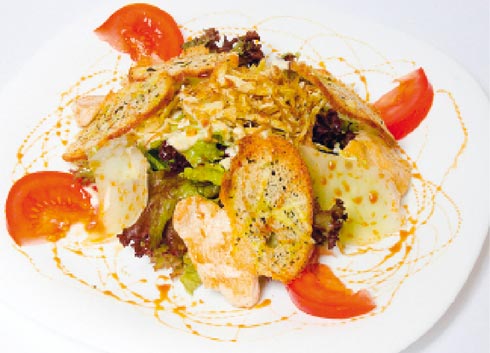 |
| A salad with chicken breasts in the marinade of 250 g of white chicken meat is marinated for 12 hours in yogurt with garlic, grated ginger, finely chopped mangoes, bake in an oven preheated to 250 degrees. Prepare a salad of salad leaves, 2-3 tomatoes, mozzarella (100 g), grated parmesan (50 g), olives, red onions. Add 1 tbsp. a spoonful of sauce (beat in a blender in a blender, 2 cloves of garlic, 4 tablespoons of cedar nuts and 150 ml of olive oil). Give the breasts to cool, cut into slices 1 cm thick, put slices on top of the salad, pour sauce from olive oil (2 tbsp. Tablespoons), vodka (2 tablespoons), honey (5 g), lemon juice and zest of one lemon, orange, lime. |
But this is “simple” is not easy. The turkey, with the light hand of the British cooks (and not at all French with their chestnuts), is stuffed. Moreover, minced meat is usually even more fed up than the meat itself. With the exception of “vegetable” minced meat (for example, rice with onions, from acidic cabbage) and “fruit” (from apples), minced meat is usually prepared using very nutritious ingredients. For example, bacon, ham. Moreover, to enhance the taste, ginger is added to such minced meat, which gives special acuity, nutmeg. But minced meat can be sweet, this will further emphasize the initially sweet taste of turkey. Such is the minced meat from white bread soaked in milk with raisins, almonds, walnuts, dried apricots and prunes. By adding 2-3 raw eggs, salt and a little sugar to such a mixture and filling the bird with this, you can be confident in the magnificent result.
Let the post, not a bird, is not a bird,
But you will have grief with chicken brains.
Joseph Brodsky. "Letters to the Roman friend"
For half a century, the turkey has bred and spread. In France, Spain, it has become an integral part of national cuisine. By the way, in France the popularity of the Indians was largely facilitated by the Jesuits, who saw a considerable benefit in the breeding of this bird. It is impossible to say that they monopolized the turkey market, but starting from the 17th century, their share in this business was high, therefore, now the turkey can be called the Jesuit, and no one will be surprised if he is offered a good piece of Jesuit. Moreover, in Israel, for example, turkey is used to simulate those products that the religious prohibition system applies. From white meat, turkey breasts are prepared with a magnificent “bujenin”, which only a real expert will distinguish from Buzhenina authentic, prohibited by a koshrut.
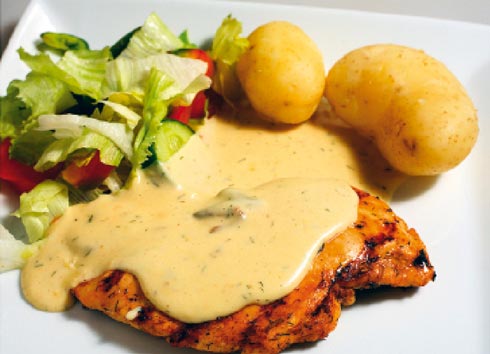 |
| Fry a chicken with herbs and mayonnaise, fried in olive oil with thyme, an ambassador and pepper chicken. Crown with Dijon mustard, roll in panic from finely chopped rosemary (5 g), garlic (10 g), thyme (5 g), crackers from white bread (50 g), olive oil (30 g). Bring to readiness in the oven. Serve with mayonnaise, fruit potatoes. |
The blue bird in Russia is the turkey is just entering the diet and still remains much more expensive in comparison with the chicken. And you can buy it not in all stores, especially in the province. But the chicken is almost always. The days passed when the chicken was only bluish, skinny, in the remnants of feathers, with a sad drooping scallop and forever closed eyes. Now chicken wealth has come: breasts, gutted, legs, hips, whole carcasses, chicken semi -finished products ... Eat - I don’t want to. And the chicken entered politics: we recall the notorious “legs of Bush”, which in the first post-Soviet years helped out the poor, and then became an object of lobbying efforts from both sides and a factor in Russian-American relations.
And the chicken story began quite prosaically. There is a believable version that the chicken was originally not considered at all as a food resource. In Southeast Asia, chickens began to be diluted back in the Stone Age, approximately at the same time, when they began to cultivate the land. What attracted the ancestors of the Vietnamese, Koreans and Thais in these absurd, by nature of skinny birds, who gave 4-6 eggs a year? Not their hard, fibrous meat!
He attracted the character of roosters, militancy and a desire to fight with an opponent to the death of the latter. It is believed that the cocks were one of the most ancient types of idle pastime. And besides, a way to earn. The passion for the rooster battles was contagious. At first she spread to India, then to the ancient Babylon. Barry -reliefs with the image of fighting roosters have also been preserved.
Only when the hens were in ancient Egypt, did they find their gastronomic qualities. Due to that, in particular, that far-sighted and skillful Egyptians were the first to invent and introduced an incubator. They learned to putting in the bird: they planted a special diet, fed with good grain, kept in special poultry houses, and fighting breeds were separated from meat. So modern chicken breeds were formed, and the weight of the chickens today ranges from one and a half to five kilograms. Compared to the Wild Bankavian rooster (the ancestor, according to Darwin, domestic chickens), weighing less than a kilogram, his descendants, for example, Brahma and Kokhinhin, can weigh almost five.
The chicken is fried ... Chickens have become the most common poultry in the world. The whole industry is engaged in their breeding, including large poultry farms and specialized poultry farms, and the largest exporters have long been the US and Brazil, supplying more than 6 billion tons of chicken annually to the world market. And the sixth part is eaten by Russia.
The most affordable bird was far from always. On the one hand, the breeding of chickens in Russia was a new, risky thing, depended on breeds imported from abroad. Accordingly, the price of chicken and eggs was high. On the other hand, the bulk of the chickens belonged to peasant farms, the bird was purebred and was kept in the most primitive conditions. With small weight, these hens had hard, dry meat. These are their descendants then lay in the strokes of customers weary by shortage. And those chickens that we are buying today are a product of relatively new intensive decay technology. At one time they were even called according to the method of growing: not chickens, but broilers.
Be that as it may, now almost a hundred chicken breeds are breeding in Russia. The chicken has become an integral part of the culinary culture. And what is surprising, because from this bird you can easily prepare anything you want with a minimum of trouble. Starting from the chicken broth, which is the best cure for all diseases (natural penicillin!), Continuing the Georgian legend-chicken-tabak and ending with a varnish (again from America) with sharp chicken wings fried on the lattice.
In general, as one hostess said, the chicken is so convenient!
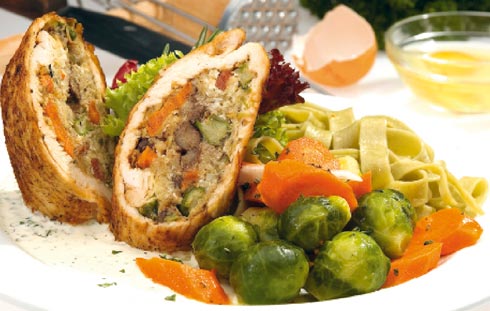 |
| Root from a turkey beat off turkey meat, put with layers. Cut white mushrooms and fry 2-3 minutes. Grate the entire surface of the meat with garlic, sprinkle with grated parmesan, spices (thyme, basil, oregano, salt, pepper), pour white wine. Cut carrots, celery, white onions into strips, chop the garlic finely, put on the edge of each layer along with the mushrooms, twist into a roll, tighten with a twine, let it brew 3-5 hours. Fry on each side for no more than 10 minutes, wrap in foil, put in an hour and a half heated to 250 degrees. |