
Translated material
The art of the flesh
Romeo Castelpucci arranged a provocation in Moscow
The art of the flesh. At the Chekhov festival in Moscow, the Italian Romeo Castelcucci made a real theater provocation, after which dumbfounded spectators could not recover for a long time
 |
The name Romeo Castelcucci is well familiar to those who are interested in the modern theater. The famous theater provocateur and scandalist Castelcucci was never shy in choosing expressive means in the name of the embodiment of his theatrical ideas. Living babies and fighting dogs are involved in his performances, roofs burn and crunch the bones of dead horsepower heads. Castelpelli came to the director from painting - he thinks with stage images and embodies them on the stage thoroughly, to the smallest details - just as they flare up in his, seemingly crazy head. No taboo - in art you can do everything!
But it is one thing to declare the freedom of creation, and another is to follow it. Castelpelucci always risks: he risks being misunderstood, accused of artistic extremism, of abuse of shrines, in humiliation of man, in short, God knows what. But when you look at this charming temperamental handsome man, when you hear how he says, how he formulates his thoughts, you understand that the art platform that he protects is not nonsense of inflamed consciousness and not fake shocking. This is a concept, a separate world where you are pulled with a drag, but which you can leave voluntarily.
Theater through the eyes of Jesus
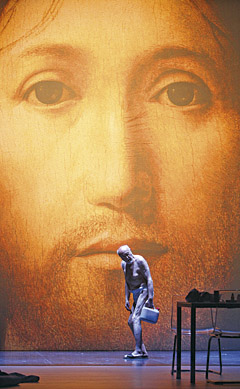
A few years ago, answering a journalist’s question about the attitude of religion and death, Castelpelli laughed: “I cannot reflect on death, because I do not know her. Probably, I will never see the world through the eyes of Jesus. ” He brought the first part of his “J” project (“Jesus”) to the current festival - “On the concept of the face of the Son of God”. The “face” looks at us from the walls - this is a huge, on the whole backdrop, the reproduction of the picture of Antonello and the Messina “Blessing Christ”. “The theater should be like that,” Castelpucci will say. Such as the gaze of Christ, penetrating your very essence.
It is strange that with his love for the tragedy, Castelcucci chose this particular image: a look from another world, the world of light and peace. All the more blasphemous seems to be the action that is unfolding against the background.
Sterile, similar to a sick leave. White chairs, a white table, a white bed, a mumbled TV and a snow -white sofa, on which an old man sits in a white robe and white homemade slippers, is barely audible. The young man in a white shirt with a tie carefully gives his father a medicine in a glass. Father obediently drinks. The son takes off his jacket from the hanger and, apparently, is going to leave. Father suddenly grabs the stomach, the son rushes to him with the words: "Are you not good?" - And he understands that the old father ... has gone. Father mutters echoingly: “Forgive me. Forgive me ” - and obediently gives himself to undress: the son takes off him a robe, a hospital shirt, diapers, brings a bucket of water and begins to carefully and patiently wash his pledged body. The old man cries and asks for forgiveness, barely standing on trembling bent legs. After a minute, everything is repeated again, only with greater strength. The son again undresses him, again carefully and patiently washes the body trembling with shame, brings pure linen, seats his father at the table. When a brown slurry will flow again from the old man later, the son will not stand and shout: “Damn it! Damn it! Father!" But, having heard the crying “sorry, sorry”, signs and go for a new portion of linen.
Father, shuffling his feet, will get to the snow-white bed, take a plastic canister from the nightstand with something brown and in desperation will begin to water it with it-a bed, himself, the floor, and then flop into this slurry, sobbing with impotence and shame ... There is a strange rumble from silence and crying, which grows and becomes unbearable. Under the hum and iron clang of Christ, the face of Christ is becoming brighter, unbearably bright, it seems to come to life from the inside, pulsing each skin cell. Its features are distorted, black tight shadows rush through the eyes, on the cheekbones, along a high open forehead, appearing through the image at first with small black drops, and then tearing it from the inside and filling it with muddy dark streams. And we understand that this is not blood. This is shit. Under a torn, hung, hung, hung in bright light, neon letters flare up with bright light: “You are (not) my shepherd” (“You are my shepherd are not my shepherd”) - and everything suddenly ends. The audience native to the seats feel like passengers of an airplane that fell into the turbulence zone. But that's all, the end.
Burning house
Castelpellchi loves to discuss his performances with the audience: he is always interested in what a person sitting in the hall reads. And the further the audience judgments go from the author’s concept, the more the director rejoices: “The viewer always sees not what I saw!” The director often repeats the phrase: "You will see how the house is built when it will burn." And fearlessly sets fire to the house he built. It is at Castelpucci that you understand how individual theater is. With the apparent unity of the hall, the highest directorial aerobatics - to establish with each separate mystical connection and transmit signals not to the public, but to the person.
From the memories of loved ones, from gloomy and humiliating details of life and dark skeletons in intra -family cabinets, thought runs like a light on a bicford cord, there, to this bewitching look, under which it is not scary and not ashamed. A look that can not change anything, but only obey the concept of being. From flesh and blood - to meat and shit.
Such a radical artistic solution delights some and scares others. Any spectator reaction, with the exception of complete indifference, is incredibly exciting Castelpelli. Some are crushed and in a state of shock, others run out of the hall, loudly clapping with chairs, thirdly covers nervous laughter - as a protection from an aggressive invasion of private life. And all this is the same fire of emotions and feelings that is carved from contact with the art of maximum frankness, and sometimes absolute shamelessness.
Is such a theater possible? Yes, a thousand times yes. Our conservative shy society, for the most part, denying contemporary art as such, is clearly not ready for such revelations. We are some kind of backward. Since the Khrushchev "fagots" have advanced a little. Mired in endless internal and external prohibitions, in the show -off system of values, we are doomed to hang out in the backyards of public consciousness and world culture - if we do not make an effort, we will not take this step to healing from fear both before our own history and before the vices of all mankind and man in it. The performance of Romeo Castelcucci - this is the burning house from which you need to have time to run out and look back.