
Translated material
The world after the USSR
After the USSR. Until December 1991, world policy was a heavy, but stable global structure: spheres of influence of superpower, clear and predictable rules of the game ... But then this bipolar world collapsed - along with the entire previous world order. What arose on his ruins, the design cannot be called in any way
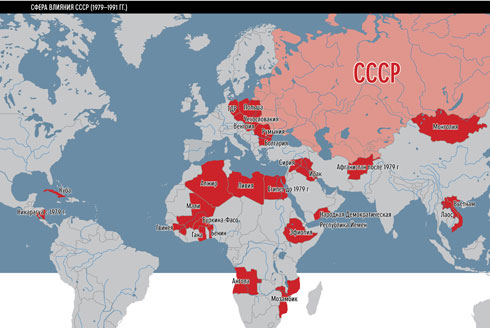
The abolition of the Soviet Union became the final point of the Cold War - an ideological confrontation, which in the second half of the 20th century spread throughout the world. Describing then the world situation, they spoke primarily about the horror of the global nuclear disaster. Now, more and more often recall another characteristic of that period: they say, the threat of guaranteed mutual destruction disciplined opponents, and contributed to the development of the rules of relations. Today, it is possible to only dream of the ordering and stability of the Cold War. The new world order, which was first proclaimed Mikhail Gorbachev, and then George Bush Sr., never came. From the old, only formal institutions remained, and they have long been unable to cope with the regulatory function. Ideas are replaced by imitation (as in China) or religion (as in the Muslim community). Humanitarian ideals turned into a crushing force, armed with NATO arsenals-the most powerful in the history of the military-political alliance.
To the question of fate, one of the most striking examples of erosion of international norms and rules is the Libyan operation. The press secretary and close adviser of the President of the USSR Andrei Grachev, speaking at a conference in the Gorbachev Foundation, spent a parallel that illustrates the nature of the change well: there is no Chalusku blood on Mikhail Gorbachev, but there is Gaddafi's blood on Barack Obama and Nicolas Sarczi. The thought is simple. Between the execution of the two most odious dictators of Eastern Europe and North Africa - a distance of a little over 20 years. Both of them were sure that they were adored by their people, but experienced a surge in unlimited hatred. The reprisal against both had the slightest attitude to justice, but few doubted that retaliation was deserved. Both became victims of explosive socio-political cataclysms that covered entire regions, and were completely not ready for them.
The difference, however, is that the perestroika Soviet leadership, abandoning the class approach to world affairs and the Brezhnev doctrine of “limited sovereignty”, created the conditions for the peoples to solve their fate - as they are able to do this. And modern Western countries, led by the United States, consider it legitimate and even necessary interference, up to the military-powerful, to help the peoples choose the “right road”.
"
One of the most striking examples of erosion of international norms and rules is the Libyan operation: there was no Chalusku blood on Mikhail Gorbachev, but there is a blood of Gaddaphi on Barack Obama and Nicolas Sarkoi.
"
The basic element is not a single state - large or small, democratic or authoritarian - is not able to fence off from the external environment today, to ensure the impermeability of the boundaries and the inviolability of its sovereignty. And in this sense, sovereignty today differs from how it was understood in the days of the USSR. At the same time, the world system did not turn into another quality, there were no structural units that would replace the state as its basic element. Neither transnational corporations, nor global non -governmental organizations, nor often mentioned, but from this no less mysterious network structures could create anything that would replace the previous model - international relations built on the interaction of sovereign states. But since these same states are weakened by the influence of numerous external factors, they are also not able to function as before. Hence the growing unpredictability of what is happening.
At the end of the twentieth century, the West took on world responsibility-not only by the right of the winner in the Cold War, but also as a carrier of the socio-political and economic model that proved his primacy. In the second decade of the XXI century, everyone reaping the fruits of this readiness. Several wars (Iraq, Afghanistan, Libya), the result of which is usually far from expected. The prospect of another armed intervention (Iran). Unresolved, but rather aggravated local crises (Hindustan and Korean peninsulas). A bold experiment with a single European currency, which, not being successively brought to the end, has turned into a severe headache for the entire world economy. Finally, the emergence of a country, which, not being a leading subject of changes in the late XX - early XXI centuries, managed to become their main beneficiary, and even to such an extent that recent triumphs look at it with great fear, China.
The Chinese mirror of this power, devoid of ideology, but trying to replace its absence with a cocktail from traditional postulates - from the ancient world to the recent past - to the best way personifies the spirit of the emerging world politics. China extracts considerable benefit from globalization, but violently defends its sovereignty and hand freedom. He believes in the balance of forces, and at the same time is doomed to confront attempts to build it - after all, while maintaining the current development trends of such a balance, it will be built against China. Add here a violently developing economy that realizes its huge internal weaknesses, and therefore panickically afraid of any instability. Of these and many other contradictions, the entire international environment is woven today.
As the West sags under the load of the burden of leadership, China is not only in a hurry to take responsibility, but also fundamentally avoids it. The main paradox: Beijing is really afraid to be pushed to the forefront and be in the position of the hegemon, against which everyone else will rally - something similar happened to America. And when Chinese strategists and politicians conjure that they are not interested in world dominance, they probably do not cunning. There is no universalist ideological base in the Chinese consciousness, without which large -scale expansion is impossible. However, the very position of the very rapidly growing recipient of benefits from globalization, as well as an increase in the weight of the PRC in the global economy and politics, will inevitably provoke the rest of the attitude towards China as a contender for world domination. With the ensuing consequences - restraint by all means and on all fronts.
"
In these 20 years, which took place after the collapse of the USSR, we observed a celebration of liberal values, based on the power of the United States and NATO, over traditional approaches in the field of international relations. From now on, it is worth expecting the victory of egoism - everyone will be more and more concerned about strengthening their own positions
"
The decisive stage of the next decade will be the decisive time during which the contours of the new alignment of forces in the world will begin to appear. The inertia set by the final of the Cold War ends. To appeal to that victory (West) or defeat (what Russia does with voluptuous masochism) is pointless - the situation is radically different today. In conditions of aggravating unpredictability, long -term strategies are hardly possible: the leitmotif is minimizing the damage and creating more favorable starting conditions in case the future begins to clear up. In these 20 years, which passed after the collapse of the USSR, we observed a triumph of values (liberal, based on the power of the United States and NATO) over principles (traditional approaches in the field of international relations). From now on, it is worth expecting the victory of selfishness - everyone will be more and more concerned about strengthening their own positions and ensuring stability in the face of external challenges.
There were no examples in history that the world order arose by itself, without major military conflicts that establish a new balance of forces. It seemed that the era after the Cold War was an exception, but today it is clear: the order did not appear. At the beginning of the 21st century, there are two factors that can reduce the risk of a large clash: a nuclear weapon that sharply increases the price of war, and universal economic interdependence. This inspires some optimism, although the same story teaches another - there is practically no limit of stupidity and greed that a person is able to show, whether it be personal mutuals or interstate.