
Translated material
Universal mathematician
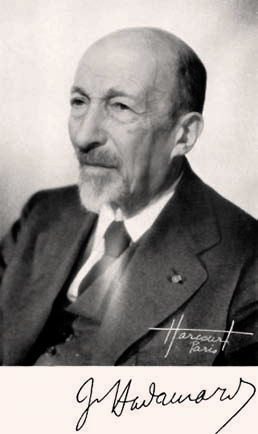 Jacques Adamar (French Jacques Salomon Hadamard, 1865-1963) was one of the best mathematicians of the late XIX - the first half of the 20th century. And deservedly considered the legend of science. Adamar gracefully combined work in pure mathematics with applied research and pedagogical activity and, as many outstanding scientists of his time, was actively interested in public life. Together with other representatives of the French intelligentsia, Adamar took part in the polemic around the famous anti -Semitic “Dreyfus case”, after which he fought for the observance of human rights until the end of his life.
At the end of the XIX century. Adamar writes a detailed textbook on elementary geometry. In the Soviet Union, this book was published as a textbook for pedagogical institutions, although its content can interest any student’s geometry. Many well -known “optional topics”, such as inversors and polar, are versed in separate chapters. Adamara “Elementary Geometry” uses more stringent evidence than a regular school textbook, but at the same time is not overloaded with mathematical formalism. The author from the very beginning discusses in detail the simplest geometric concepts, counting on the study of the subject “from scratch”.
An important component of the book is the tasks of evidence of mathematical statements. Well -chosen tasks of different levels of complexity help to expand the main material of the course and develop the skill of independent mathematical creativity, which is more important than the ability to solve problems for calculating the values from the school curriculum.
At the end of the first volume dedicated to planimetry, the addition “on methods used in geometry” is placed, in which Adamar addresses one of his favorite pedagogical topics, proper mathematical thinking. According to the author, everyone who will force themselves to think and follow in their reasoning a certain method can learn how to prove mathematical statements. " Adamar will later write about the methods of reasoning “The study of the psychology of the process of invention in the field of mathematics” is one of the best works about the psychology of creativity.
The second volume of “elementary geometry”, stereometry, was last published in an abbreviated version. Almost half of the material was excluded related to the elementary methods of the highest (projective and analytical) geometry. The remaining part refers to a significantly expanded school curriculum and is written as in detail and clearly as the first volume.
Nikita Khanbekov