
Translated material
Ray Bradbury left
- Wait, let me say. This is not for the sake of money, no. And not in order to stare at different differences. So many say, but these are all lies, inventions. They say that we fly to get rich in order to become famous. They say - for entertainment, it is boring, they say, sit in one place. But in fact, know something ticks inside, all the same, like a salmon or a whale and in the most negligible invisible microbe. Such tiny watches, they tick in every living creature, and you know what they say? Go further, they say, do not stay in place, do not stop, swim and swim. Fly to the new worlds, the construction of new cities, more and more, so that nothing in the world could kill a person. You see, Carrie? After all, this is not just you and I flew to Mars. The fate of all people, damn the fate of the whole genus of people, depends on the fact that we have time in our lifetime. It’s even funny, won where it waved, but it is so huge that fear takes.
Ray Bradbury. Strawberry window
The beginning of the space age is difficult to imagine without romantic-fantasy, who anticipated the difficulties and great achievements of the first steps of mankind into space. While in the 50-60s Soviet and American engineers and scientists prepared a breakthrough into space, people could already look into distant worlds thanks to writers.
Their names are still hearing: Arthur Clark, Isaac Azimov, Ray Bradbury, Ivan Efremov, Robert Heinline, Robert Shekeli, Philip Dick, Clifford Saymak, Stanislav Lem.
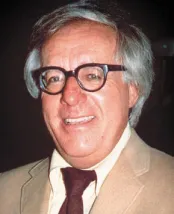
Unfortunately, only a few grades of those who created the first cosmic equipment, and those who inspired their works on labor and intellectual feats, overcame the ruble of the XXI century, overcame the faces of the 21st century. Ray Douglas Bradbury was the last of them.
The news of the death of the writer found many by surprise. More recently, we celebrated the 90th anniversary of the master with the whole world [1]. And it seemed that this was far from the last line, we were too used to knowing that Bradbury is with us.
But there are no miracles.
We can only remember.
Unlike many of his colleagues who developed cosmic science fiction, Ray Bradbury did not go deep into technical details and science, giving free rein to the artistic fiction. Even his cosmic stories are more like fairy tales or poems.
And at the same time, he did not disregard the danger that technical progress brought to our world. Bradbury foresaw a lot: the danger of using weapons of mass destruction (“there will be gentle rain”), a change in attitude to freedom and knowledge in society (“451 degrees Fahrenheit”). He also warned against a predatory attitude to our planet (“Tigers can be found here”).
But, despite the complex, sometimes terrible topics and anti -utopia, Ray Bradbury was a good -natured and attentive person. He called to believe in good and do his job with the soul ("wine from dandelions"). In full accordance with this, the master loved his work and was ready to support young people who chose the writer’s profession, as Nile Gaiman recalls this [2].
Ray Bradbury did not like many technical innovations so popular among people of the consumer society. Until the last day, he wrote his stories on a typewriter. And for a long time he did not allow her to sell his books in electronic form. Only in 2011, according to the insistence of the Simon End Shuster publishing house and Michael Congdo -on, the Bradbury literary agent, the story “451 degrees Fahrenheit” became available for sale in North America in electronic form $ 9.99.
Many experts then noted that Bradbury set the price of a barrier, since it significantly exceeded the cost of the paper book.
Possessing broad views and often published in the USSR and in Russia (though not receiving a penny of deductions in Soviet times), the writer gained the love of Russian -speaking readers. And thanks to the professional work of the galaxy of wonderful translators: Nora Gal, Lev Zhdanova, Deborah of Livshits and others. One of the few Western authors, he was almost not censored in the Soviet Union during the Cold War.
Speaking about the foresight of Ray Bradbury, with bitterness we can state that the main dream of his writer's youth has not yet been tough for humanity.

The story (or a collection of stories, published as one work in 1950) “Martian Chronicles”, which brought Ray wide fame, is still a dream, alas, alas, a few of the inhabitants of Planet Earth.
When the first interplanetary devices reached the moon, Mars, Venus and Mercury, it became clear that we were surrounded by “dead worlds”. Despite all the hopes and searches, not only a highly developed life, but also traces of the simplest organisms were discovered.
The forecasts of the romantics of the 50s were not justified. Perhaps this was the reason for the disappointment of society. Despite the fact that space studies continue and bring us huge amounts of information about the structure of the universe and our solar system, there are no mention of the former enthusiasm.
It seems when it became clear that there would be no quick result in space, cosmic expansion has moved to the periphery of human thought and activity. And Ray Bradbury himself in his work also moved away from cosmic science fiction, focusing on people's lives on Earth.
But still, despite the work in the last years of life on “earthly topics”, the dream of Mars did not leave the master.
In 2009, during a radio interview with a planetary society [3], he said: “I want me to be buried on Mars. I do not want to be the first living person to get there. It's already late. But I want to be the first dead to get to Mars. I want to get there in a bank from Campbell soup. Bury me on Mars, in Bradbury Abyss ... ”[4].
And who knows, perhaps, having fulfilled his will and thereby completing the “Martian Chronicles” of Ray Bradbury, we will be able to start a completely different history of Mars.
"They were dark and gold -eyed ...".
Alexander Khokhlov
1. Http://raybradbury.ru/person/interView/2010-aif-jubilee-interView/
2. Www.guardian.co.uk/books/2012/jun/06/ray-bradbury-neil-gaiman-Appregation
3. Http://365DaySofastronomy.org/2009/07/19/july-19th-visit-with-ray-bradbury/
4. The relief details on Mars are often called in honor of Mars; authors of science fiction about Mars. - approx. Ed.