
Translated material
Memory. Ivan Pushchin
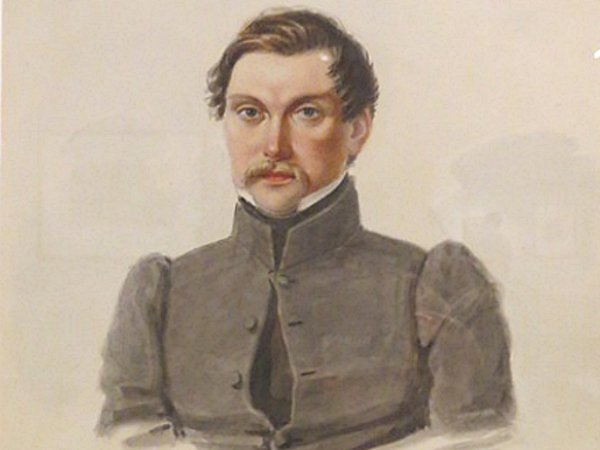
May 15, 1798, Ivan Pushchin, Decembrist, Lyceum friend Alexander Pushkin was born
Personal business
Ivan Ivanovich Pushchin (1798–1859) was born in the family of Senator Ivan Petrovich Pushchin and Alexandra Mikhailovna, nee Ryabinina. In August 1811, Santa Admiral brought him to the Tsarskoye Selo Lyceum, where Alexander Pushkin became the closest friend, who was a year younger than him. He studied Pushchin successfully, and the teachers were satisfied with him. He was especially fond of Russian and universal history, painted well, played in school performances.
A year before the issue, Alexander I asked the director of the lyceum Yegor Engelhardt whether there were no among his pupils who wanted to go to military service. There were more than 10 people - Pushchin was among them. Throughout the last year of training, future officers were engaged in military exercises in the hussar arena twice a week. After release from the lyceum in 1817 he entered the Life Guard of the horse artillery; In the same year, he received the rank of ensign, in April 1820 - the second lieutenant, in 1822 - lieutenant. In 1821–1822, as part of his part, he participated in a campaign in Poland.
With the military service, he had to say goodbye in 1822 after the conflict with the Grand Duke Mikhail Pavlovich, who complained about omissions in the form of a young officer. Having resigned as a headquarters captain, Pushchin was first going to go along the police line and take the position of a quarterly overseer, but the family sharply opposed this intention. The jurisprudence became a compromise - in the summer of 1823, Pushchin began the duties of a court judge in the St. Petersburg Criminal Chamber.
While still in military service, Pushchin entered a secret society under the name “Holy Artel”, founded by guards officers in 1814. His comrades in the organization were Alexei and Mikhail Muravyov, Wilhelm Kuchelbeker and other future Decembrists. Through the “artel” Pushchin was connected in 1817 with the “Union of Salvation”, and in the next - with the “Union of Blagodity”. When the latter was dissolved and a northern society was formed instead, Pushchin was instructed to organize his Moscow council. He considered it impossible the complete destruction of serfdom in the current conditions, Pushchin advocated the liberation of courtyard people; To fulfill this task in Moscow, he created a practical union. In the case of important events, Pushchin had to immediately arrive in St. Petersburg.
He really ended up in the capital shortly before the events of December 14 and took the living participation both in preparation for the uprising and in it. On Senate Square, he stood at the monument to Peter I. Having told the soldiers that he served in the army, accepted command over them and approved them in every way; Contemporaries noted that Pushchin courageously kept under the crankcase shelling and left the Square of one of the last.
He was arrested on December 16; At interrogations, he kept his dignity, basically was silent or denied the charges against him. The Supreme Criminal Court did not convince this: Pushchin was found guilty “in the participation of the tsareubia with the approval of the choice of the person intended, in the participation of the management of society, in the adoption of members and in the return of instructions and, finally, that he personally acted in rebellion and excited the lower ranks” and sentenced to death through the detachment of the head. By the decree given by the court on July 10, 1826, the punishment was softened: he was deprived of ranks and nobility and sentenced to exile in Siberia for eternal hard labor. August 22 of the same year, the term of hard labor was reduced to 20 years; At the end of his Pushchin, he was supposed to stay in Siberia.
After sitting for some time in the Shlisselburg fortress, Pushchin was sent to the Chita Ostrog, then to the Petrovsky Plant. In hard labor, he became the treasurer of the “small artel” - a kind of mutual assistance ticket office created by the Decembrists to support those who went from hard labor to the settlement. For the convict Putschin himself, it ended a few earlier appointed deadline: in 1839 he was transferred to a settlement in Turinsk in Western Siberia, where he spent four years. The climate greatly influenced the health of Pushchin: in 1840, he began strong chronic seizures. Appelling to his condition, he achieved a transfer to Yalutorovsk. If in Turinsk, as the Tobolsk governor showed, Pushchin “did not do anything besides reading books”, then in Yalutorovsk he added to agriculture, helped those in need, conducted extensive correspondence with his comrades, and collected other exiles on Thursdays. In a civil marriage with a woman-jacket in Siberia, Pushchin had two children-Anna and Ivan.
After the August manifesto of 1856, which became one of the first documents signed by the new Emperor Alexander II , Pushchin was allowed to return to the capital. In 1858, he married the widow of his comrade, Decembrist Mikhail Fonvizin Natalya Dmitrievna, nee Apukhtina. The marriage, alas, turned out to be short -lived: Ivan Pushchin did not become on April 15, 1859. The Decembrist is buried in the Fonvizins family tomb in Bronnitsy.
What is famous
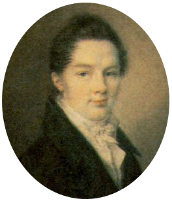 F. Verne. Portrait of I. I. Pushchin, 1810s. GM named after A. S. Pushkin
A prominent figure of the Decembrist movement, one of the authors of the manifesto, which the Senate had to publish after the victory of the uprising - it was Pushchin who was to force the senators to do this. A neighbor in the Lyceum and the closest friend of Alexander Pushkin. Protecting his talent, it was Pushchin who refused Pushkin to receive Northern Society and, perhaps, saved the poet. The author of the “Notes of the Decembrist” (published in London in 1863) and “Notes on Pushkin (the first edition - 1859),“ Letters from Yalutorovsk ”to the former director of the lyceum Yegor Engelhardt (1845).
What you need to know about
The transition of Pushchin to the judicial department was not a random decision, but a consequence of the desire to update the musty atmosphere of the then bureaucracy, corrupted by bribes and hooking. As a judge, he dreamed of honest performance of the duty to set an example of a true service for the benefit of society. At that time, the judicial service in the eyes of the nobles was considered humiliating. The act of Pushchin was so unusual that when he was seen by the dancing at the ball with the daughter of the Moscow Governor General Prince Golitsyn, one of the present was amazed: “How, the court judge is dancing with the daughter of a governor general? This is an unprecedented thing, there is something extraordinary here. ”
According to the Decembrist Yevgeny Obolensky, Pushchin “left military service and exchanged the uniform of the horse -guards artillery for modest service in the criminal chamber, hoping to relate and others to assume the duties from which the nobility was eliminated, preferring brilliant epipoty of the benefits that they could bring to lower judicial judicials The authorities are that noble way of thinking, those pure motives that adorn a person both in private life and in a public field. ” In turn, Pushkin, who understood the desire of a friend, in the early edition of the poem "October 19" 1825, responded to his act as: as follows:
You, consecrating you chosen dignity,
He is in the eyes of a public muni
Conquered the reverence of citizens.
Direct speech
About the beginning of friendship with Pushkin: “It had a mixture of excessive courage with shyness, and both of the out of place, which was so harmful to him. It happened, we will miss together, turn out yourself, but he will not be able to settle it. The main thing, he lacked what is called tact, this is the capital necessary in her friendly life. <...> All this together was the reason that he did not suddenly respond to his attachment to the lyceum mug, which since the first time was born in him, not manifesting, however, sometimes inherent in vulgarity. In order to love him in the real way, it was necessary to look at him with the complete well-being, which knows and sees all the irregularities of character and other shortcomings, puts up with them and ends that he would even fall in love with them in another comrade. Between us, somehow it soon and imperceptibly settled down. ”
About the urgent need for the uprising (from a letter from a friend in society): “We would be called scoundrels in fairness if we missed the current one, the only case. When you get it, everything will be over. There are 60 members here; We can hope for 1,500 ordinary people who are assured that Tsesarevich did not refuse the throne. ”
About the reasons for participating in the conspiracy (during interrogation): “Convinced in the woeful position of my fatherland, I joined society with the hope that in combination with others I can be useful to my weak abilities and have an influence on the change of government.”
About the circle of reading in the link (from the letter of Yegor Engelhardt): “I read everything that comes across the best; We send to each other wonderful books, we even have those that are prohibited. ”
Kondraty Ryleev - Decembrist Vladimir Shteingel: “Thank you for falling in love with Pushchin; I'm even closer to you. He who loves Pushchin is certainly a rare person himself. ”
Alexander Bestuzhev about Pushchin and his attitude to the uprising: “In society for a long time; Previously, he was very reasonable and said that it was impossible to start before 10 years and it was impossible to think; that there are no people or funds for that. When I was in Moscow (in May), he repeated the same. But, having heard about the death of the emperor, he immediately arrived in St. Petersburg and already spoke along with others that such an incident should not miss. ”
Alexander Pushkin - Ivan Pushchin, 1826 (on the anniversary of the uprising):
My first friend, my friend is invaluable!
And I blessed fate
When my yard is secluded
Small snow brought
Your bell announced.
I pray to the holy providence:
Yes, my voice is your soul
Gives the same comfort,
Yes, he will illuminate the sharpening
A ray of lyceum clear days!
Natalia Fonvizina - Ivan Pushchin: “I do not want your warm friendship, give me love hot, fiery, youth, and Tanya [d. From "Natalia" - "Polit.ru"] you will not remain in debt: she will sparkle, sparkle, light up with this rainbow light. "
10 facts about Ivan Pushchina
- The elder brother of Ivan Pushchina Peter died in 1812 from the wound received during the expulsion of the Napoleonic troops from Russia
- In 1820, Lyceum friends broke out at the post station: Pushchin returned from his sister from Bessarabia, and Pushkin went to the south for days earlier
- In the service in the Criminal Chamber, Pushchin met Kondraty Ryleyev and, "recognizing him well, he accepted him with a member in society"
- The last time Pushchin saw Pushkin in the Mikhailovskaya exile, where he brought the poet a list of “grief from the mind”; Later Pushkin responded to this meeting with poems (see "Direct Speech")
- The Duma of Northern Society was elected in the Pushchin house on Moika, 14
- During the uprising, the fur coat was shot in many places; He himself miraculously escaped wounds
- One of the accusations against Pushchin was based on the fact that he hugged and kissed Peter Kakhovsky, to whom Ryleev before that suggested killing the emperor
- Putshchina testimony is the most mean of all given by detained participants in the uprising
- In exile, Pushchin translated the first part of the “Franklin notes” (the second - Vladimir Steingel); The manuscript sent from Siberia was lost, and the draft was destroyed before the next search - the Decembrists were prohibited to use ink
- Pushchin's wife is considered one of the prototypes of Tatyana Larina and Sonya Marmeladova (she was familiar with both Pushkin and Dostoevsky)
Materials about Ivan Pushchina
Article about Ivan Pushchin on Wikipedia
Russian biographical dictionary. Ivan Pushchin
Ivan Pushchin in the Library of Moshkova