
Translated material
Mathematics in Mesopotamia
ša3 niĝ2-kas7 nu-zu ša3 igi-ĝal2 tuku
Does the wisdom have a soul that has not mastered the art of counting?
Sumerian proverb,
Alster B. Proverbs of Ancient Sumer, 1997, 54, 116

Usually, when we are talking about mathematics in ancient Mesopotamia, we mean the Old Babylonian period (1800–1595) or the second half of the 1st millennium BC. e. From these periods, many mathematical tablets have been preserved, which are published and well studied. But actually, mathematics in Mesopotamia was born before writing. Moreover, it served as the impetus for the development of the latter.
First, accounting chips were used to account for the products of temple farms depicting a particular type of product. To the 4th millennium BC. e. Instead of chips, clay signs with their images or rows of numbers began to be used. Already the first signs with the calculations of the amount of beer for beer or calculating the field area show us that the inhabitants of Mesopotamia were well versed in applied mathematics. A few mathematical signs that came to us from the 3rd millennium BC. e., show that the population of the interfluve (at first the Sumerians, who later replaced them) multiplied and divided them, operated with fractions, calculated the field area - including the fields of irregular shape - as well as the volume of walls and the number of bricks necessary for their construction.
There is an example of algorithmic calculation of livestock growth for ten years (TCL 2, 5499; CDLI: P131589): At the beginning of 4 cows and two heterosexual calves are given. Each second cow brings a calf every year. Every first calf is male, every second is female. In the fourth year, each calf becomes a bull or a cow. During the year, each cow brings a certain amount of serum and cheese. Serum and cheese prices are also set. At the end, the number of cows, bulls and calves in the herd is calculated in ten years; The total amount of serum and milk obtained for ten years, and their cost in silver.
Many first mathematical signs, such as described in the insert, clearly represent exercises, and not practical calculations - they operate with very large or very small numbers, describe the ideal situation, and there are no markers of economic documents in them. In the 3rd millennium BC. e. There were several different number systems and different systems of measures and weights. Thanks to a number of bureaucratic reforms by the end of the III thousand - the beginning of the II millennium BC. e. They were largely unified. The sixty -core number system began to be used wider than in total - the first tables with pairs of mutually reverse numbers appeared, the work of which is 60.
By the Starovillo period, all the genres of mathematical texts, as well as the circle of tasks solved (arithmetic, algebraic and geometric) have already existed. But from this time, unlike the previous one, thousands of mathematical tablets have reached us. Among them are tables for multiplication, reverse sizes, square and cubic roots, squares of consistent integers, sums of cubes and squares, and hundreds of verbal algebraic and geometric tasks. Therefore, when describing Mesopotamian mathematics, it is customary to rely on this period.
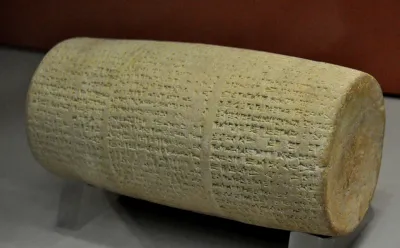
Based on the sources, we can conclude that the Babylonians knew how to solve linear and square equations, the systems of linear equations, used the rules for summarizing progressions, in tasks they used proportions and interest; They operated on the number π, calculated the area of the circle of the circle and the volume of the truncated cone, the area of the correct polygons and the wrong quadrangles; In practice, the Pythagoras theorem (without proof of the theorem itself) was applied. In ancient Babylon, some more complex equations were able to solve, which, with the help of a linear replacement of the variable, came down to an equation with a whole root that were searched for by overcoming.
They began to teach mathematics at the Starovilon school immediately after the students mastered the main repertoire of cuneiform signs. They started with the study of applied metrology and arithmetic, then they moved to verbal tasks in algebra and geometry.
Plimpton 322
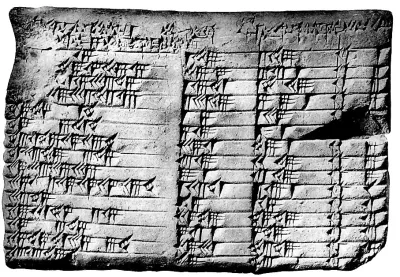
Found in the lower interfluve, presumably on the site of the ancient city of Lars.
Perhaps the most famous mathematical text written on a clay plate in the Starovilon era is the Plimpton 322 sign. George Arthur Plimpton, by whose name she is named, was the publisher of educational literature in New York-and a private collector. He purchased this tablet around 1922 for $ 10 from the American diplomat and antiquar Edward Banks, who was engaged in excavations in his free time, and also bought and resold clay signs (it is believed that he was the prototype of the Jones Indiana). In 1936, Plimpton transferred this sign as a gift to the University of Columbia, where it is also stored in the library of rare manuscripts and manuscripts.
Judging by the features of the letter, the plate was written at the end of the 19th or XVIII century BC. e. And therefore refers to the Starovilon period. E. Bank claimed that the sign was found in the ruins of the city of Lars, located in South Mesopotamia. Indeed, with its horizontal format, the plate resembles administrative documents from Lars, although this format is not characteristic of other mathematical tablets from this city.
It is believed that about a third of the initial size of the plate on the left is lost. The sizes of the preserved part of the plate are 13x9x2 cm. The front side of the plate is divided into four columns of fifteen lines each. The separation lines of the columns continue on the back of the plate, but the text on it is absent. Over each of the four columns on the front side, explanations in Akkadian are made using Sumerian logograms.
PLIMPTON 322 is a table that collects the Pythagor Troika - the dimensions of rectangular triangles, in which both legs and hypotenuse are expressed by integers. Two legs are written out in the plate, and instead of hypotenuse - a square of the hypotenuse to one of the legs. Its description is easiest to start with the fourth column entitled as "his/its line." This column contains the numbering of the line lines from 1 to 15.
In the second and third column, 15 pairs of numbers from Pythagorean triples in a six -this -core system are recorded. With an equation of the type A 2 + B 2 = C 2, the second column contains numbers A (correspond to the shortest side of the rectangular triangle). The third column contains numbers C (correspond to the hypotenuse of a rectangular triangle). The title of the second column contains the word “width”, and the third - “diagonal”. In both cases, these words are preceded by the IB2.Si8 logogram. The possible translation of this logogram is “square”, that is, the second column can be called “Square of the Width”, and the third - “The square of the diagonal”. However, mathematicians involved in this sign are still arguing about the interpretation of this logogram in this context.
The first column contains numbers obtained by separation from 2 into b 2 . It is entitled as "a square of the diagonal (hypotenuse) from which a unit is torn, so that the width (the short side) remains."
The first (in the 1940s), Professor of Brown University, a mathematician and science historian Otto Negebauer and Assyriologist Abraham Sachs became interested in a sign. They interpreted the plate as a record of Pythagorean numbers. For a long time, the plate was considered unique. Indeed, we are unknown to other similar tables with Pythagorer triples. But the tasks for the Pythagor, triangles are a common thing for the Starovillo school. So, Eleanor Robson [6], a specialist in Mesopotamian mathematics, studied the Plimpton 322 sign in the context of other Babylonian mathematical tablets and showed their similarity. In addition, she tried to reconstruct the missing part of the text. According to it ([6]: 116), in the lost part of the plate, pairs of mutually reverse numbers were recorded. They were used to find the short side and hypotenuse of a rectangular triangle with a long side equal to one using the method of supplementing the square. One of the intermediate results is recorded in the first preserved column. There are other attempts by both reconstruction and interpretation of the tablet [5]. Hayussi in his article not only offers his interpretation of various aspects associated with this text, but also briefly lists the theories of other researchers.
Literature for additional reading
Friberg, J. Methods and Traditions of Babylonian Mathematics: Plimpton 322. Pythagorean Triples and the Babylonian Triangle Parameter Equations. Historia Mathematica, 8 (1981), pp. 277–318.
Friberg, J. A Remarkable Collection of Babylonian Mathematical Texts: Manuscripts in the Schuffy Collection, Cuneear Texts I, Sources and Studies in the History of Mathematics and Physical Sciences, Berlin: Springer.
PROUST, C. On the Nature of the Table Plimpton 322. Mathematisches ForschungsinStitut
Oberwolfach, Oberwolfach Report 12/2011, PP. 664–666.
Robson, E. Neither Sherlock Holmes Nor Babylon: A Reassessment of Plimpton 322. Historia Math., 28 (2001), PP. 167–206.