
Translated material
Stars are born longer

In the early stages of the knowledge of interstellar molecular matter, molecular clouds were considered long -lived objects with a characteristic lifestyle of about tens of millions of years. Since the masses of clouds significantly exceed the mass of jeans (a critical mass for the onset of gravitational instability), they should quickly collapse, so to speak, under their own weight. Therefore, the assumption of the prolonged existence of molecular clouds required the assumption of the presence of some additional factor that prevents the collapse.
Within the framework of the so -called standard star formation model, molecular clouds are kept from the collapse with a magnetic field, and therefore starship in them occurs slowly, as the support of the magnetic field is lost. However, over time, evidence began to accumulate that molecular clouds live much less - only a few million years. One of these evidence was the so -called problem of Post T TAU (“after Ta Taurus”).
According to modern ideas, a star T TAU is a very young star of a sunny type, neither inside nor around which the processes have not yet stolen, and therefore it has a noticeable irregular variable. The ages of stars of type T TAU are several million years or less.
If the molecular cloud lives for several tens of millions of years and all this time is the starship, then we must see in it the recently born TAU stars who still behave both fifth -graders at a break, and more calm stars of Post T TAU for more than a dozen millions of years that look like teenagers.
But just with the presence, more precisely, with the absence of such “teenagers” - the stars of Post T TAU in star -forming molecular clouds - and the named problem is associated. Since the age of the “composite” object (in particular, the area of starship) is logical to consider the age of its oldest element, and we in the areas of active star formation (as it seems to us) do not see stars older than several million years, we have to conclude that there are no tens of millions of years of life of molecular clouds.
This conclusion has become one of the reasons for the peculiar decline of the standard model and the ascent of the new model - a gravity turbulent , according to which the molecular cloud is a transient clot in a turbulent interstellar environment, which is undergoing a full life cycle - from the formation of a clot and the birth of stars to dissipation - over several million years.
The basis of our ideas about the formation of stars similar to the Sun, a large extent is the study of a complex of molecular clouds in the vegetable body (for brevity, the “charioteer” in the name is often missed): this is the closest to us a complex of molecular clouds, and to study it as simple as possible. And recently, work has appeared on the study of the population of young stars in this complex [1].

It is funny that in such studies the proximity of the complex is not such an obvious advantage: it occupies an area of about 15 ° by 15 ° in the sky, and very large -scale observations are required to compose a full picture. At the same time, the stars of the type T TAU are highlighted quite simply: in addition to the already mentioned variability, they have an infrared excess of radiation (it shines the dust surrounding the young star and heated with optical radiation), ultraviolet excess (this shines the substance falling on the star) and other characteristic features.
With the stars Post T Tau is getting harder. They maintain high activity in chromospheres and crowns, therefore, to identify them, manifestations of such activity are used - the presence in the spectrum of emission lines or high X -ray luminosity. However, it is likely to confuse them with active stars of other species that are not related to the studied area of star formation, or, conversely, to lose sight of the “necessary” stars of Post T TAU, the observations of which were on the gap of their relative calm.
The complexity of identification leads to the fact that only about 150 stars were previously identified in Taurus, more old than classic stars like T TAU. The authors of the article call them non -disciplinary, since one of the age indicators is the presence or absence of a near -star disk. Most of the non -discount stars in space are distributed in the same way as stars with disks, that is, mainly in places of concentration of molecular gas.
These stars were born recently, probably, moreover, more than a generation, as formally younger stars with discs (classic stars like T TAU). However, there are a certain number of non -discount stars that occupy a larger square in the sky than stars with disks. Are they the remnants of the older population of the complex in Taurus or have nothing to do with it at all, accidentally projecting on the same part of the sky?
The answer to the question of the presence in the body of the older population is important for several reasons. Firstly, if it is, we may be necessary to reconsider the assessment of the age of the complex in the direction of its increase. And - Tadam! - There are no problems of stars Post T Tau. Secondly, if we, exploring the stars in the complex, will assume that they belong to one generation, and the generation there is actually not one, we will receive inaccurate statistical conclusions, for example, about the share of stars with discs.
This is important for us, because this value is now used as a measure of the life of the protoplanetary disk, and it, in turn, is one of the key criteria in building the theory of the formation of planetary systems. Well, so on, etc. From this we draw conclusions about the initial function of the masses, multiplicity, etc.


Adam Kraus and his colleagues made the following. They collected information about all the stars of the spectral class F0 and later, which in the sky fall into the area of the complex of molecular clouds of the Taurus-the charioteer and have ever been offered as members of this complex. In total, they examined 396 stars.
For them, the authors analyzed all the well -known parameters (properties of atmospheres, lithium content, radiation speeds, own movements) that would indicate: a) to their youth, b) for belonging to the complex of the Taurus - the charioteer. The list found 160 confirmed or probable “strangers”, that is, the stars of the background, and for 18 stars of information it was not enough to somehow identify them.
The remaining 218 stars are most likely part of the area of the starship under consideration, and 87 of them were not previously included in the “canonical” lists of members of the complex. And a significant part of the "beginners" is distributed in space not like stars with disks. More specifically, in areas of the highest star density, the proportion of stars with disks reaches 60%, while in areas between dense concentrations of stars it decreases to 25%. Where in the complex of Taurus - the charioteer, the star density is minimal, there are no stars with disks at all.
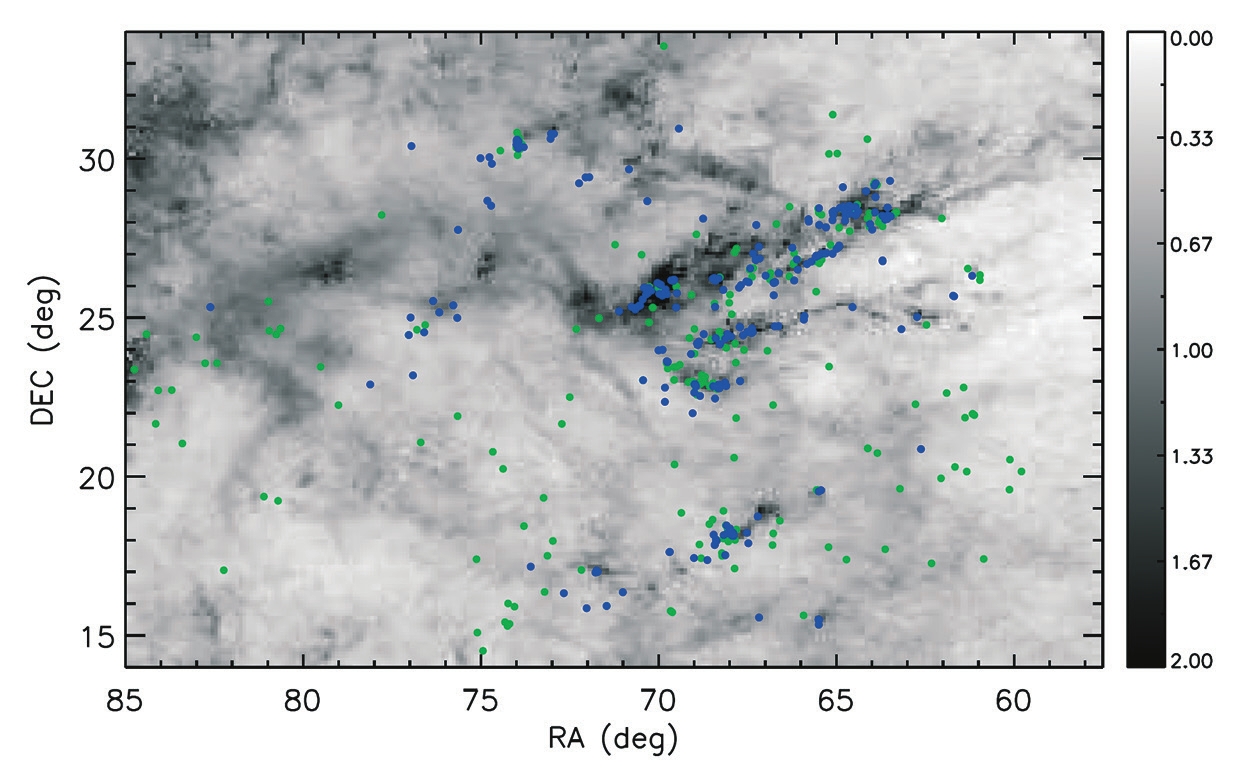
The second population consists of less young non -discovery stars. They are distributed in the area of the Taurus - the Binding more evenly and do not detect the correlation with the modern distribution of molecular gas. Either they managed to fly away from parental molecular clots, or these clots managed to disperse.
It should be noted that this division into two populations is somewhat conditional: the authors did not determine these ages, paying the main attention to the spatial distribution. Indirect data indicate that most of the stars of the "old" population have ages of about 10 million years, which is five times more than the age of the "canonical" population. At least a few stars have been exceeding 15 million years.

In general, the presence of the second population means that starship in the region, spatially and kinematically (in terms of speed) coincides with the complex of Taurus - the charioteer, has been going on for 10-20 million years. Most of the non -discovery stars studied in the article by Krouse, etc., is on the inner side of the molecular cloud. This may be the effect of selection: the more distant stars of the non -discount population could simply not fall into the existing sample and are still waiting for their detection.
It is possible that the first stage of star formation in this area covered a significantly larger volume of space than the current stage, and millions of 15 years ago, a starship complex of Taurus - a charioteer could compete in size with a starship complex in Orion. The authors do not exclude that in reality it can significantly go beyond the traditional limits of the search for its potential members.
Is it worth it to draw far from this discovery? It is possible that not. The proximity to us the complex in Taurus does not mean at all that it is a standard. Moreover, there are instructions that this is not so, for example, the atypical distribution of forming stars by masses and rather large (compared to other areas of star formation) the distance between them. So it may turn out that what is happening in Taurus remains in Taurus. In the end, as the famous astrophysicist Donald Osterbrock said, any well -studied object is a Beilar (i.e., unusual, special).
Dmitry Vibe,
Astrochemist, doct. physical. sciences, head. Department of Physics and
the evolution of the Stars of the Institute of Astronomy of the Russian Academy of Sciences
1. Kraus Al, Herczeg GJ, Rizzuto A. C. , Mann AW, Slesnick Cl, Carpenter JM, Hillenbrand La, Mamajek EE The Greaterus-Auriga Ecosystem I: There is a Distributed Older Population. Astrophysical Journal, 838, 150 (2017)