
Translated material
Negligent student Albert Einstein
Admission
Albert Einstein came to Zurich in October 1896 from Aarau, where he graduated from a cantonal school, receiving the right to enter the Federal Polytechnic Institute, which was called a polytechnic or even just Polis. That year, the Polytechnic was 41 years old. This was the only higher educational institution of Switzerland, which was not subordinate to any Canton, but directly to the federal government in Bern. At first they wanted to create a federal university, but the cantonal authorities were afraid that this would reduce the significance of local universities and opposed the initiative. The compromise was the creation of the Federal Institute for the training of engineers and teachers of gymnasiums. And although the Polytechnic, unlike universities, did not have the right to assign doctoral degrees 1 , the composition of its teaching staff was at the level of the best universities in Europe.
The first time Einstein tried to enter the Polytechnic a year earlier. Then it was a clear adventure: the former student of the Munich gymnasium, who had not finished the gymnasium course, was sixteen that year, and they took in the polytechnic from eighteen. Einstein knew the rules. In the summer of 1895, he wrote to his uncle Caesar Koch: “As you already know, I will go to Zurich in the Polytechnic. Certain difficulties are connected with this, since I should have been two years older ” [1, p. 12].
The family of the Einstein family Gustav Mayer, who lived in Zurich, addressed a letter to Professor Albin Duke with a letter to the Polytechnic rector, in which he praised the young man's abilities for mathematics and physics. The duke answered Mayer with a letter that was preserved in the archive of the Polytechnic Library 2 . In it, the Duke reports that he does not even consider the “child prospects” to free from the need to take all school exams before entering the institute, but, as an exception, he still allowed sixteen -year -old Einstein to check himself in the entrance examinations in the polytechnic.
Introductory exams lasted several days. Knowledge of arithmetic, algebra, geometry, physics, chemistry, drawing, foreign language, history, literature and natural science was tested. Having shown excellent knowledge of physics and mathematics, Einstein openly failed on exams in botany, zoology and French [3, p. 17].
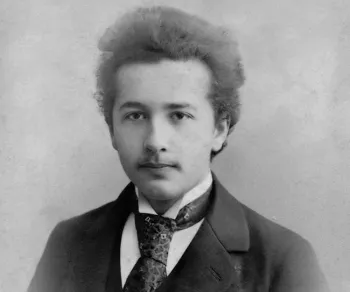
Einstein then signed up for the engineering department of the Polytechnic (the term "faculty" was not in Zurich in use). In “Autobiographical Chop” he recalled: “The exam showed me the regrettable failure of my preparation despite the fact that the examiners were condescending and full of sympathy. I understood that my failure was quite justified. It was only gratifying that the physicist G.F. Weber told me that I could listen to his colleagues if I stayed in Zurich. But the rector, Professor Albin Duke, recommended me to a cantonal school in Aarau, where, after a year's training, I passed an exam for a certificate of maturity ” [4, p. 350].
After school, Aarau Einstein chose for himself not an engineering, but a physical and mathematical department. In the autumn semester of 1896, together with Einstein, the VI department, preparing mathematics and natural science teachers for gymnasiums, entered his mathematical section a nine young men and one girl. Everyone knows the girl well now - it was Mileva Marich, who later became Albert's wife. Five of the youths to the intermediate undergraduate test conducted in the third year of study: in addition to Albert Einstein Jacob Erat, Marseille Grossman, Louis Collos and Louis-Gustav du Pasque. Albert was the youngest of this five: in the year of admission to the Polytechnic, he was seventeen years old. Grossman and Collos were almost a year older, Du Pasquie - two and a half, Erat and Milev - for three and a few years.
Teachers
Of Einstein’s teachers, three are usually distinguished by three: two outstanding mathematicians, professors of Herman Minkovsky and Adolf Gurvits, who could make glory to any first -class university, and physicist Henry Friedrich Weber, whose relationship with Einstein was initially excellent, and then spoiled. The future creator of the theory of relativity in his youth clearly underestimated his mathematics teachers. In “Autobiographical Notes” he admits: “There I had excellent teachers (for example, Gurvitz, Mingkovsky), so, in fact, I could get a solid mathematical education. I worked most of the time in the physical laboratory, carried away by direct contact with experience. The rest of the time I used mainly in order to study the works of Kirchof, Helmholtz, Hertz, etc. at home at home. ” [5, p. 264].
Only decades later, Einstein realized that “ access to deeper fundamental problems in physics requires the finest mathematical methods. This began to find out only gradually, after many years of independent scientific work ”[5, p. 264]. In “Autobiographical Chop” explains the reasons for its youthful neglect of mathematics: “But the highest mathematics was still of little interest to me in my student years. It seemed to me that it was such a branched area that it was easy to waste all your energy in a distant province. In addition, by my naivety, I believed that for physics it is enough to adequately learn elementary mathematical concepts and have them ready for use, and the rest is in the intricacies useless for physics - a misconception that only later I realized with regret. Obviously, I did not have enough mathematical abilities to distinguish the central and fundamental from the peripheral and not fundamentally important ” [4, p. 351].
It should be noted that Einstein felt the lack of his mathematical knowledge both in the process of creating the general theory of relativity and in attempts to develop a unified field theory. He constantly needed assistants to perform mathematical calculations and study mathematical models. He gave even consent to move to Princeton and work at the Institute of Promising Research only after he was promised to hire his assistant Walter Mayer, with whom he has been working since 1929. True, their cooperation fell apart shortly after arrival, and Einstein was forced to look for new assistants strong in mathematics.
For completeness, we will call other Einstein teachers in Zurich. Professor Wilhelm Fidler read a course on projective and drawing geometry, Professor Karl Friedrich Geyser - a course of analytical geometry and theory of invariants. Geiser's lectures on differential geometry made a great impression on Einstein with their artistry: “I was also seized by the lectures of Professor Geizer in differential geometry, which were real masterpieces of pedagogical art and helped me a lot later in the struggle that unfolded around the general theory of relativity” [4, p. 351].
The first three semesters of the Physics and Mathematics Department studied mathematics, divided by language: Einstein, Grossman, Erat and Marich listened to the lectures of the Gurvits and Fidler in German, the rest attended the lectures of Zheir Franca and Marius Lakomba, which were read at the engineering department in French. Frank and Geyser played an important role in the history of the Polytechnic. The head of the Department of Mathematics in French Jerome Franel was the rector of the Zurich Higher Technical School in 1905-1909 and did a lot for its restructuring and expanding the rights to the level of universities. In the first year of his rector, the fifty anniversary was widely celebrated since the creation of the Polytechnic. Franel achieved the right to award doctoral degrees of graduates of the Polytechnic, however, not immediately: the first of their own doctors of science appeared there in 1909.
From the mandatory courses that Einstein was supposed to attend, we also note the “introduction into astronomy” of Alfred Wolfer and the “Kant Philosophy” on August Stadler. The choice of optional academic disciplines was also quite wide. Karl Friedrich Geyser, in addition to the differential geometry, which Einstein admired so much, read a course of external ballistics, Ernst Fidler talked about central projections. There were courses that are not directly related to mathematics or physics. For example, the historian Wilhelm Exli 3 gave lectures on the policy of Switzerland and the history of its culture, Julius Platter - on banking and exchange business, Jacob Detstein - about the basics of statistics and insurance, Robert Bunny - about the work and worldview of Goethe [6, p. 23]. The most powerful impression was made on Einstein, a geology course that Albert Heim read (Albert Heim, sometimes write Albert Gam). Despite the fact that Haim’s lectures began at seven in the morning, his audience was always crowded. In a letter to the son of Albert Haim Arnold, sent on July 14, 1952, more than half a century after studying at the Polytechnic, Einstein sadly recalled the “melancholic magic” of his father's lectures early [1, p. 40].
Mathematical Congress
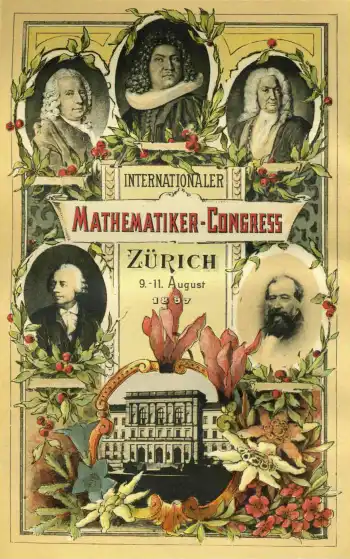
An important event not only in the history of the Polytechnic, but also in the history of world science was the first international mathematical congress, held in Zurich at the end of the first student year of Einstein - from August 9 to 11, 1897. All meetings of the Congress took place in the audiences of the Federal Higher Technical School. Professor Karl Friedrich Geyser was appointed president of Congress. He became a Privat-Docent at twenty years old, a professor at twenty-six, twice was elected rector: in 1881–1887 and in 1891-1895.
Congress was conceived and passed on a large scale. Invitations in German and French were sent to two thousand mathematicians and theoretical physicists from around the world, 208 people were present at Congress, of which twelve were from Russia. The organizing committee of the Congress included Felix Klein, Andrey Andreevich Markov, Henri Poincare, German Minkovsky. Georg Kantor, Jacques Adamar, Adolf Gurvitz and other outstanding mathematicians performed with reports on Congress. Due to the death of his mother, Henri Poincare could not come to Zurich, but his report “On the relationship of pure analysis and mathematical physics” was read by Journ Franel.
Surprisingly, judging by the reports, Albert Einstein did not attend Congress meetings, did not listen to Poincare's report, did not read it in the collection “Bibliotheque de Philosophie Scientifique” (“Library of Scientific Philosophy”), where it was printed under the header of “La Valeur De la Science ("value of science"). The report was the further development of the book “Science and Hypothesis”, which Einstein studied in Bern along with other participants in the Olympia Academy. And Poincare's thoughts expressed in this report were very close to those to which Einstein came in 1905, when he completed the construction of a special theory of relativity, and even to those that led to the construction of the general theory of relativity in 1915. In the report of 1897, Poincare argued that “ absolute space, absolute time, Euclidean geometry are not at all necessary attributes of mechanics; You can state the main facts so that they will relate to non -Euclidean spaces ”[3, p. 19]. In the same report, Poincare spoke about the relativity of the concept of the simultaneity of two events, and that the concept of “absolute broadcast” can be abandoned. All this gives reason to consider French mathematics one of the main predecessors of modern physics, who almost came close to the creation of a special theory of relativity. He had one step left, but Albert Einstein took this step in 1905. Who knows how the development of physics would go, do not miss Einstein Poincare's report at the first congress of mathematicians in Zurich?
Minkovsky and Weber
The already mentioned professor Albin Duke, who was during the time of studying Einstein by the rector of the Polytechnic, led the course of technical mechanics with exercises. As a continuation and development of this course, the Duke suggested that Professor Mingkovsky read the course of analytical mechanics. Herman Minkovsky has always shown interest in physics. The famous Heinrich Hertz invited him to a professor at the University of Bonn, and Minkovsky said that if it were not for the unexpected death of Hertz in 1894, he, Minkovsky, would probably be retrained into physics [3, p. 21]. The Minkovsky course in the Polytechnic was assumed for students of both the engineering department (the material seemed to them too complicated) and physical and mathematical (they showed great interest).
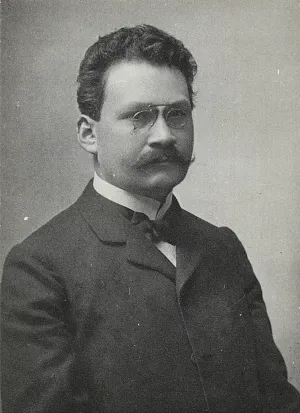
In the last student semester, Einstein, German Minkovsky, gave a lecture on the application of analytical mechanics to capillary phenomena. On this topic, on the instructions of Felix Klein, he wrote a large article in the “mathematical encyclopedia”, and the lecture in the polytechnic was based on this recently written article. Einstein was delighted: “ This is the first lecture on the mathematical physics that I listened to Paul ,” he admitted to his comrade Louis Collros [3, p. 21]. Here, discontent was clearly heard by other lectures on physics in the Zurich Polytechnic, since they were far from urgent physical problems of that time. Even the Ferdinand Rudio course on the use of analytical mechanics compared to Minkovsky's lectures looked outdated. It should be noted that the first Einstein's scientific work “Conclusions from the Capillary Phenomenon” [7], written in December 1900, is clearly connected with the Lecture of Mingkovsky.
The introduction to theoretical physics was read by the students by Patriarch Polytechnic Professor Henry Friedrich Weber, whose first lectures took place four years before Einstein's birth.
At first, the lectures of Weber brought Einstein in delight. In the second student year, he wrote to Milev Marich: “Weber with great skill reads about warmth (temperature, amount of heat, heat transfer, dynamic gas theory). I am glad to each of his lectures ” [1, p. 38].
However, over time, the curious student began to annoy the absence in the lectures of Weber at least some information about the latest discoveries in physics. This was noted in his memoirs Professor Adolf Fish: “The theoretical physics was read by a teacher of electrical engineering Henry Weber, read great. But being a typical representative of classical physics, he simply ignored everything that was done after the Helmholtz. Finishing the course, we knew the past of physics, but not its present and future ” [6, p. 27].
Einstein had to catch up with the gaps in the formation of an independent work of the house. He admitted: “I listened to some lectures with great interest. But usually I “skipped” a lot and with holy zeal studied the houses of the cororifier of theoretical physics. It was good in itself and also served that the unclean conscience calmed down so effectively that the mental balance was not disturbed by any notice. This wide independent training was a simple continuation of an earlier habit; The Serbian student Mileva Marich, who later became my wife, took part in it ” [5, p. 351].
It is unlikely that any lecturer will like a student who walks his lectures. Professor Minkovsky, admiring Einstein's theory of relativity, admitted to Max Born, who also studied for some time in the Zurich Polytechnic: “This was a great surprise for me. After all, Einstein used to be a real lazy person. He did not engage in mathematics at all ” [6, p. 26].
And with Weber, Einstein's relations in the end deteriorated. But the negligent student was seriously related to practical classes in physics: “However, I worked with zeal and passion in the physical laboratory of Professor G. F. Weber” [5, p. 351].
Kol in Einstein's test
But Einstein almost defiantly ignored the physical workshop for beginners, who was led by Jean Pernet. And when he still carried out the prescribed experiments, he did everything not according to the instructions, but in his mind. Once, angry Pane, asked his assistant what kind of opinion was about Einstein, because he does everything in his own way. The assistant replied: “ This is true, Mr. Professor! But his decisions are true, and the methods that he applies are always interesting ”[6, p. 28].
In the end, Pernet complained to the rector of the student’s absence of proper diligence, and Einstein’s student matrix was replaced 4 , and as an assessment for the workshop for beginners, a unit, or “Kol”, the lowest of the possible marks in the Swiss school (Einstein matrix, can also be seen among other documents about his studies in Zyurich [ 2 ]).
Профессор Перне вошел в историю не только тем, что поставил в матрикул Эйнштейна «кол» по своему предмету («Физический практикум для начинающих»). Он позволил себе усомниться в способностях будущего автора теории относительности заниматься физикой. По воспоминаниям самого Эйнштейна, Перне предупреждал его, что он даже не представляет себе, как трудно изучить физику.
— Почему бы вам не заняться медициной, юриспруденцией или филологией? — спрашивал профессор.
— Да прежде всего потому, что у меня нет к этому призвания, господин профессор, — ответил Эйнштейн. — Почему бы мне не попытать счастья в области физики?
— Как хотите, молодой человек, — резко оборвал разговор Перне. — Я только хотел вас предостеречь, это в ваших же интересах [6, c. 37].
И всё же первые три семестра Эйнштейн старался выполнять требования преподавателей и был в числе лучших студентов. Это показали промежуточные преддипломные испытания, состоявшие из пяти экзаменов. Милева Марич в них не участвовала, в том семестре она получила разрешение слушать лекции в университете Гейдельберга. Вопреки сложившемуся мнению об Эйнштейне как о «нерадивом студенте», Альберт сдал экзамены лучше всех на курсе. По двум предметам — аналитической геометрии и механике — он получил высший балл («шесть»). По остальным трем — дифференциальные и интегральные уравнения, наглядная геометрия и геометрия положений, физика — он получил оценку 5,5. Средняя оценка Эйнштейна — 5,7, у его верного друга Гроссмана — 5,6, столько же у Коллроса, у дю Паскье — 5,3 и у Эрата — 5,2. Это высокие оценки, позволявшие надеяться на получение диплома преподавателя.
Следует подчеркнуть, что у студентов Политехникума не было той академической свободы, которой гордились студенты европейских университетов. Вот как это описывает известный историк науки Йост Лиммерих: «Ни число семестров, ни посещение лекций не было заранее предопределено. Также и участие в упражнениях было делом самих студентов. Студент должен был сдать только выпускной экзамен, как правило, это был экзамен на получение докторской степени, плюс два экзамена по сопутствующим дисциплинам. Естествоиспытатели, как правило, защищали диссертации на соискание ученого звания доктор философии» [9, c. 4].
Посредственный студент
В отличие от университетских товарищей, студенты Политехникума должны были сдавать экзамены и зачеты каждый семестр. В «Автобиографических заметках», написанных спустя полвека после студенческих лет в Цюрихе, создатель теории относительности вспоминал: « Было всего два экзамена; в остальном можно было делать более или менее то, что хочешь » [4, c. 264].
Память немного подвела великого физика: количество экзаменов и зачетов менялось от семестра к семестру: в первом семестре три, во втором — четыре, в третьем — четыре, в четвертом — один, в пятом — два (в этом семестре он получил низший балл — единицу — по физическому практику для начинающих), в шестом — два, в седьмом — один, в восьмом — один. А затем последовала тяжелейшая серия из четырех экзаменов и защиты диплома, после которой, по словам Эйнштейна, « целый год после сдачи окончательного экзамена всякое размышление о научных проблемах было для меня отравлено » [4, c. 264].
После третьего семестра отношение к учебе у Эйнштейна изменилось: «Вскоре я заметил, что довольствуюсь ролью посредственного студента. Для того чтобы быть хорошим студентом, нужно обладать легкостью восприятия; готовностью сконцентрировать свои силы на всем том, что читается на лекции; любовью к порядку, чтобы записывать и затем добросовестно обрабатывать преподносимое на лекциях. Всех этих качеств мне основательно недоставало, как я с сожалением установил. Так постепенно я научился ладить с не совсем чистой совестью и организовывать свое ученье так, как это соответствовало моему интеллектуальному желудку и моим интересам» [5, c. 351].
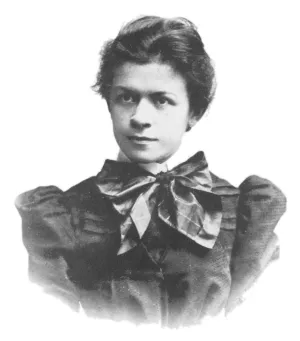
На выпускных экзаменах Эйнштейн показал результаты значительно слабее, чем на промежуточных преддипломных испытаниях. Тогда он был первым на курсе. А на завершающем этапе он оказался предпоследним: хуже него выступила только Милева Марич, получившая за четыре экзамена и дипломную работу среднюю оценку 4,0. Ниже всего ее оценка по теории функций — всего 2,5 балла. В результате она единственная на курсе диплом так и не получила. Вторая попытка через год тоже провалилась. У Эйнштейна заключительная серия экзаменов привела к средней оценке 4,91. Его дипломная работа была оценена скромными 4,5 баллами. Вместе с Марич он сдавал экзамены по теоретической и практической физике, астрономии и теории функций. Тяготеющие больше к математике остальные три студента отделения VI-A выбрали такие испытания: теорию функций, геометрию, алгебру и арифметику, теоретическую физику и астрономию. Лучше всех выступил Коллрос: по теории функций и астрономии он получил высший балл 6,0, за диплом — 5,5, в результате его средняя оценка составила 5,45 балла. Второй результат у Гроссмана: высшая оценка на экзамене по геометрии, те же 5,5 за диплом и средняя общая оценка 5,23. На третьем месте скромный Эрат — средний балл 5,14, всё равно лучше, чем у Альберта Эйнштейна. Луи-Густав дю Паскье в выпускных экзаменах участия не принимал, он решил продолжить обучение в университете. Таким образом, из одиннадцати студентов, зачисленных в 1896 году на отделение VI-A, диплом преподавателя математики в 1900 году получили только четверо.
Для любителей проверять опубликованные результаты отметим, что средний балл вычислялся по специальной формуле, в которой оценкам за разные экзамены присваивались различные веса. Так, оценка за диплом шла с весом 4, теория функций, физика, геометрия — с весом 2, остальные предметы — с весом 1.
Когда диплом получен, нужно найти место работы. Для физиков-теоретиков и преподавателей физики и математики в то время это была непростая задача. Вот что писал о физике Джеймс Франк: «Кто в начале ХХ века решился изучать физику, испытывал большую склонность к этому предмету. Удовлетворенность, которую обещала деятельность ученого, с лихвой перекрывалась неопределенностью перспективы трудоустройства» [9, c. 4].
Эту неопределенность в полной мере ощутил Эйнштейн, когда в течение двух лет безуспешно искал постоянное место работы. Он оказался единственным неудачником на курсе, Гроссман получил место ассистента профессора Фидлера, Эрат стал ассистентом профессора Рудио, а Коллрос — профессора Гурвица [6, c. 28]. У профессора Вебера было целых два вакантных места ассистента, но Эйнштейн так сильно раздражал его своим свободолюбием, что ассистентами стали выпускники инженерного отделения, но не строптивый Эйнштейн. И в дальнейшем Вебер сделал всё возможное, чтобы никто не взял Эйнштейна на работу.
Парадокс: именно Вебер на первом вступительном экзамене заметил способности Эйнштейна и разрешил посещать лекции в Политехникуме, несмотря на провал юного абитуриента 5 . То, что они к концу обучения Эйнштейна стали врагами, объясняется тем, что Вебер не оправдал ожидания любознательного студента узнать больше о современной физике. Консервативный профессор не обсуждал на своих лекциях ни работ Больцмана по статистической физике, ни уравнения Максвелла. Свою роль сыграла и принятая в то время ориентация Политехникума на подготовку инженеров, а не ученых. Для Эйнштейна больше подошел бы какой-нибудь продвинутый университет вроде Гёттингенского или Мюнхенского, но путь туда был для него закрыт: в университеты принимали с законченным гимназическим образованием, а после школы в Аарау можно было поступить только в технический институт.
Evgeny Berkovich
1. Schwarzenbach A. Das verschmähte Genie. Albert Einstein und die Schweiz. München: Deutsche Verlags-Anstalt, 2005.
2. ETH-Bibliothek. Studium am Polytechnikum in Zürich (1896–1900). ETH Zürich.
library.ethz.ch/standorte-und-medien/plattformen/einstein-online/studium-am-polytechnikum-in-zuerich-1896-1900.html.
3. Kollros L. Errinerungen eines Kommilitonen // Carl Seelig. Helle Zeit — dunkle Zeit. Zürich: Europa Verlag, 1956. S. 17–31.
4. Эйнштейн А. Автобиографические наброски // Собрание научных трудов в 4 т. Т. IV. М.: Наука, 1967. С. 350–356.
5. Эйнштейн А. Автобиографические заметки // Собрание научных трудов в 4 т. Т. IV. М.: Наука, 1967. С. 259–293.
6. Зелиг К. Альберт Эйнштейн. Сокр. перевод с немецкого. М.: Атомиздат, 1964.
7. Einstein A. Folgerungen aus den Capillaritätserscheinungen // Annalen der Physik. 1901, № 309 (3): 513–523.
8. Пайс А. Научная деятельность и жизнь Альберта Эйнштейна. M.: Science, 1989.
9. Lemmerich J. Max Born, James Frank, der Luxus des Gewissens: Physiker in ihrer Zeit. Wiesbaden: Reichert, 1982.
1 Это право Политехникум получил в 1908 году, а первые собственные доктора появились в 1909 году. Об этом см. ниже.
2 Экзаменационные ведомости, письма ректора и матрикулы студентов Политехникума хранятся в архиве библиотеки института, их копии выложены в Интернет [ 2 ].
3 В русском переводе книги Карла Зелига его ошибочно назвали Эшли [6, c. 23].
4 В книге Абрахама Пайса говорится, что «в журнале физико-математического факультета политехникума записано серьезное предупреждение Эйнштейну за пропуски лабораторных занятий» [8, c. 51]. Это явная неточность. Не говоря уже о том, что вместо факультетов в Политехникуме были отделения, предупреждение Эйнштейну было внесено в его личный матрикул, а не в какой-то выдуманный общий журнал.
5 В русском языке слово «абитуриент» обозначает человека, поступающего в вуз, в отличие от немецкого, где это слово обозначает сдающего в гимназии экзамены на аттестат зрелости. В основе слова «abitur» лежит латинское «abiturus» — тот, кто должен уйти. То есть «абитур» — это выход из школы, а вовсе не поступление в институт. Но язык развивается по своим законам, не всегда совпадающим с законами житейской логики.