
Translated material
Is the war around the corner?
The growing Russian-American confrontation will soon have another aspect, threatening the aggravation of the Ukrainian crisis. The Wall Street Journal reported that the State Department and the Ministry of Defense developed plans for the supply of so -called lethal weapons to Ukraine, primarily anti -tank missile systems. The presence of a weapon sending plan was confirmed by the head of the Pentagon James Mattis. The official representative of the military department, Michelle Baltans, noted that the United States “does not exclude the option” of the supply of “lethal weapons” to Ukraine. As follows from the article, now diplomats and the military are pushing their plan in the White House.
Although realistic observers believe that the procedure for making such a decision can take several months, the fact of developing such a plan is evidence of a serious turn in the approaches of the US executive power to military conflict in Ukraine. For several years, American lawmakers regularly adopted resolutions on the supply of weapons to Ukraine (Kyiv for obvious reasons lobbied in every possible way). However, the execution of these decisions was just as regularly blocked by the US Presidential Administration. Because the open supply of weapons to the conflict zone is a very risky business. First of all, because such a supply will require sending not dozens to Ukraine, but hundreds of military instructors. What will be fully used by the Kremlin propagandists (“The Board of the American Occupation Topping Ukrainian Land”) to legitimize their secret war against an independent state. Moreover, it is clear that the main task of the separatists will cause maximum damage to the advisers - to kill, and it is better to steal. The United States has a rich and sad experience of how the adviser's package became the first step on the way to a military disaster.
Another restraining consideration was the obvious instability of political power in Ukraine, the willingness to make hasty and risky decisions, the inability of Kyiv to control individual military formations. In 2008, the Saakashvili government incorrectly interpreted Washington signals, suggesting that the United States is ready to help in the event of a war with Russia. The same is possible now.
Well, of course, the United States really did not want to aggravate relations with the “unpredictable Kremlin”, which has many ways to make US muck. But literally in recent weeks, the situation began to change dramatically.
At first, General Paul Selva spoke at the hearing in Congress that the European command of the US Armed Forces advocates the transfer of anti -tank weapons to Ukraine, and the decision on this will be made soon. Then some analysts explained the statement by the fact that the general answered the questions of legislators when approved by the deputy chairman of the committee of the chiefs of staff and did not want to annoy the senators. However, a little later, the special representative of the president in Ukraine, Kurt Walker, said in an interview with the BBC: “The defensive weapon that will allow Ukraine to protect itself” and stop Russia that threatens Ukraine. “Again, I do not predict where we are doing this, this is a matter for further discussion and making a decision, but I think that the argument about the fact that this will be a provocation for Russia or spurring for Ukraine simply discards the decision back.”
I note that when it comes to a modern war, the conversations about the “defensive” or “offensive” weapons are malicious demagogy. If someone plans an offensive operation, then he naturally needs such “defensive” weapons systems as air defense systems (to protect his advancing troops) or anti -tank complexes (to prevent a possible counterattack of tank and mechanized enemy formations).
That is, it should be noted: Washington today has come close to concentrate on the possibilities of the “forceful” resolution of the Ukrainian crisis with all the risks with which this resolution is fraught. This happened as a result of an obvious failure of diplomacy. Minsk agreements were unfulfilled. Moscow and Kyiv have an endless dispute about which elements of these agreements should be carried out in the first place. Russia insists that first of all, laws on the special status of areas controlled by separatists should be adopted. Ukraine demands that it be given control over the border with Russia. Against this background, the day does not pass so that Kyiv does not declare an imminent Russian aggression (just Ukrainian General Staff as a news reported the deployment of three Russian divisions, although their formation has been taking place for about a year). And from the separatists controlled by Moscow there are provocative proposals for the transformation of Ukraine into a certain “Little Russia”. It is appropriate to recall that Putin has already happened to express his irritation by certain actions of the West by the renewal of hostilities in the Donbass. All this is pushing the United States to risky decisions on the supply of weapons ...
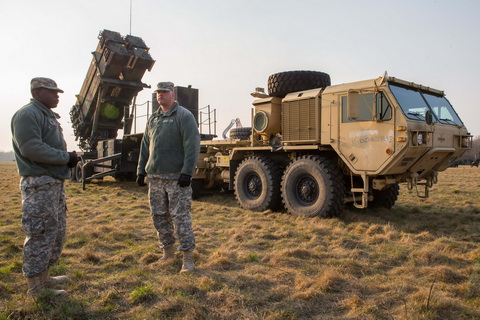
Photo: American air defense systems Patriot. Krystian Maj/Zuma/Tass